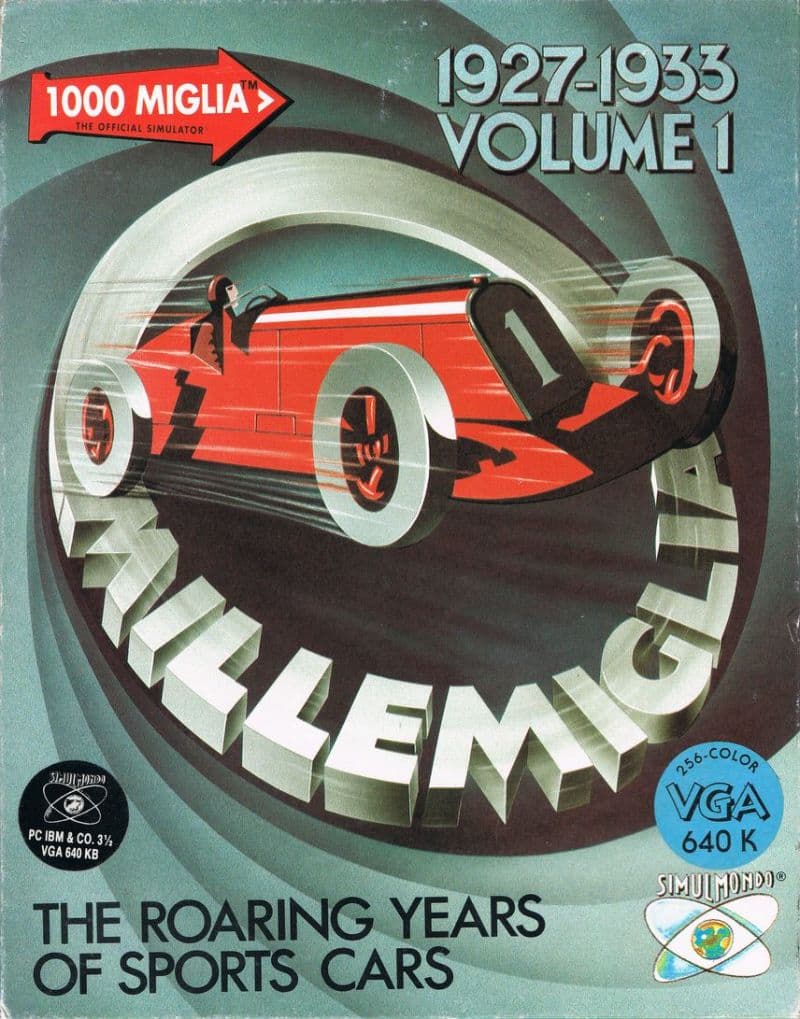
In 1000 Miglia, packing the wrong spare parts before leaving the starting line in 1927 Italy will force you to forfeit your entire run the moment a wheel snaps on a lonely mountain pass.
Tactics and micro-management in 1000 Miglia
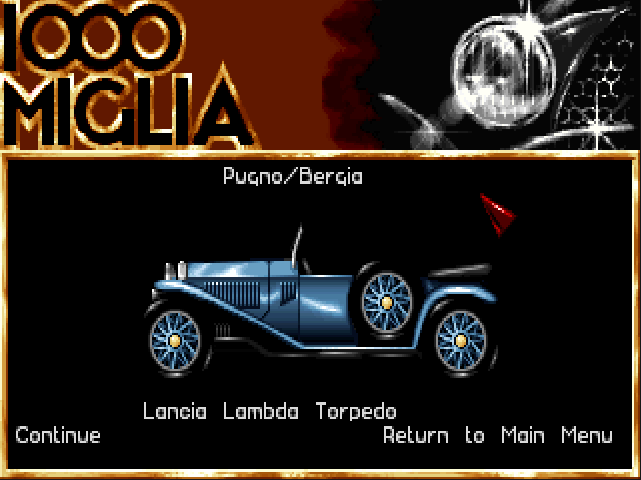
Most racing titles of the early nineties asked you to do little more than hold down an accelerate key and steer past generic checkered flags. Designed by Mario Savoia and Francesco Carlà, 1000 Miglia took a completely different approach by leaning hard into the grueling logistics of real-world open-road endurance racing between 1927 and 1933. Before you ever touch the ignition, you are confronted with menu choices that govern your mechanical survival across Italy. You select two drivers, distribute points across stats like Skill, Resistance, and Mechanics, and pair them with their favorite legs of the course.
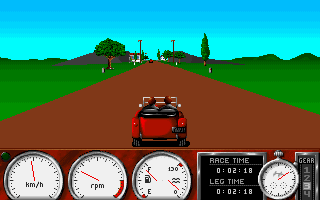
The strategic catch comes down to your boot space. Mechanical breakdowns are an absolute certainty during the journey, requiring you to pack specific spare components beforehand. If a tire blows or an axle fails and you forgot to bring the matching part, your race ends instantly right on the shoulder, wiping out your progress across the stage. While navigating the behind-the-car 3D view, you have to monitor your lower dashboard panel, manage a manual four-speed gearbox, and constantly evaluate whether your primary driver is too exhausted to handle the next sharp turn.
During any leg, you can pull up a map of the Italian countryside to track your progress against aggressive stage time limits. You can also manually switch control to your co-driver, letting your primary driver rest before fatigue leads to a high-speed crash into a roadside tree. Weather shifts continuously, forcing you to navigate through torrential rain, blinding fog, thick snow, and blacked-out night driving conditions. The simulation tracks all of this under the hood, and it punishes minor oversights without mercy.
Why the handling made classic gaming magazines furious
When Italian studio Simulmondo brought the title to home microcomputers, critics were divided over whether the realistic premise was actually any fun to play. In issue 37 of Amiga Format, reviewer Steve Jarratt handed out a meager 51% score, openly questioning why anyone would want to steer "the lumbering land wagons of the late 1920s" across sparsely detailed country roads. Later reviews were similarly cold, with Amiga Power awarding the original release a 53% before dropping their score to 46% when reviewing a budget re-release in 1994.
The complaints were not entirely unfair. The driving physics feel noticeably unresponsive, turning what should be crisp mountain curves into agonizing wrestling matches with slow steering response. Paired with twisty stage layouts, the handling frequently leads to frustrating collisions with opponent cars or scenery obstacles. Modern retrospectives on sites like Old-Games.com noted that while the strategic setup generates brief excitement, the driving reality often drives players straight back to arcade staples like OutRun.
Engine audio and hardware quirks on the PC
The transition from the original 1991 Amiga version to the 1992 MS-DOS version highlights the technical awkwardness of PC gaming at the time. Audio presentation in the DOS release relies on basic sound routines that players routinely complain sound less like a roaring vintage engine and more like a trapped hornet inside an empty tin can. Without a proper audio setup configured, hearing that harsh buzzing while fighting uncooperative steering through a snowstorm can test anyone's patience.
Because of the unforgiving difficulty and strict parts management system, the scene took notice. European cracking groups like CSL and Goonies created custom trainer cracked versions just to let players skip parts checks or bypass stage timers entirely. Programmatically, lead developer Mario Savoia gained critical engine experience on this project before moving on to program the well-known Arcade Pool for Team17.
Does this interwar racer hold up today?
If you judge 1000 Miglia purely as an action-packed racer, it stumbles hard. The combination of sluggish steering inputs, repetitive roadside visuals, and brutal game-over penalties for missing spare parts keeps it from competing with smooth arcade titles of the era. Yet, as a historical simulation experiment created by Simulmondo, its combination of driver fatigue management and pre-race preparation remains surprisingly unique.
Anyone looking at early European PC design will find plenty to dig into here. You get an uncompromising look at how developers tried combining strategy menus with third-person driving long before that became standard practice. Just prepare yourself for the steep learning curve and the sting of abandoning a long stage because you forgot to bring a spare wheel.
You can play 1000 Miglia online free in your browser right now, with no setup required. Load up the 1000 Miglia MS-DOS game for ten minutes just to experience the sheer tension of balancing driver stamina against a ticking clock while steering a fragile 1920s automobile through a dense fog bank.
Players' controls
Touch and gamepad controls
The on-screen keyboard and gamepad mapping the browser player uses on a phone, a tablet or a controller, as opposed to the real keys above. $PRO members make their own in the player and share them here; anyone can pick one to play with.
Make your own touch controlsPRO
- 1Open the editorSign in below, then pick what to make. The game starts with the editor open over it.
- 2Place your keysAdd keys and drag them where your thumbs rest, or map a controller's buttons. Test plays the game with them; Save keeps them, and you play with them from then on.
- 3Share themShare them right after saving in the game, or name and share them here. Players vote, and the best become this game's controls for everyone.
Go PROSee how it worksSign in+20 XP for sharing · +50 XP if yours become the game's own
- The game's own controlsNone yet: played with a real keyboard only.In use
3 screenshots
From the archive
No gameplay video yet
No gameplay video for 1000 Miglia yet. Sign in to add one.
No reviews yet
Tell the community what you think of 1000 Miglia. Reviews are public and tied to your username.
No archived manuals for 1000 Miglia yet
No manuals archived for this title yet. Sign in to upload the first scan.
Cheat codes, console commands and memory pokes for 1000 Miglia — each one verified and attributed.
Sign in to submitNo cheats yet for this title
Know a working cheat, poke or trainer? Add it with the button above. Moderators check every entry before it goes live.
No archived soundtrack for 1000 Miglia yet
No soundtrack archived for this title yet. Sign in to upload the first rip.
No save states for 1000 Miglia yet
No save states for this title yet. Sign in to share one.
Discussions
Sign in to post- Threads0
- Total posts0
- Online now6
Community · 1000 Miglia
Who's contributing, and what's new
- Reviews0
- Threads0
- Uploadsapproved0
- Contributors0
Recent activity
Nothing here yet
Reviews, discussion threads and approved uploads appear here as members add them.