
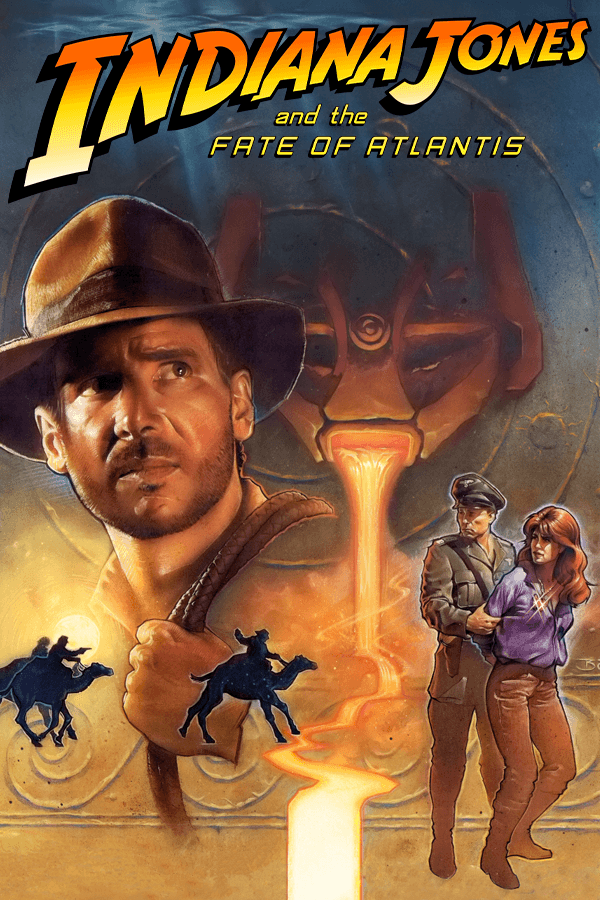

In Indiana Jones and the Fate of Atlantis, you travel from Barnett College to the sunken city itself to beat Nazi agents to a terrifying power source, changing how the entire story plays out based on whether you choose to rely on your brains, your partner, or your fists.
Most graphic adventures from this era gave you a strict list of puzzles and forced you down a single track, but designers Hal Barwood and Noah Falstein split this narrative right down the middle. Early in the story, after meeting up with former archaeologist turned psychic medium Sophia Hapgood in New York, the game asks you to choose your strategy. That single choice forks the campaign into three distinct routes, altering dialogue, item placement, and puzzle solutions across whole continents.
The system works because each branch actually plays differently rather than just swapping out text lines. You can tackle the search across Monte Carlo, Algiers, Tikal, the Azores, Crete, and Thera through three distinct styles:
Tracking your progress across all three approaches is handled by the Indy Quotient scoring system. Scoring the full 1000 points means finishing every path, which pushed players in 1992 to re-examine locations from completely new angles.
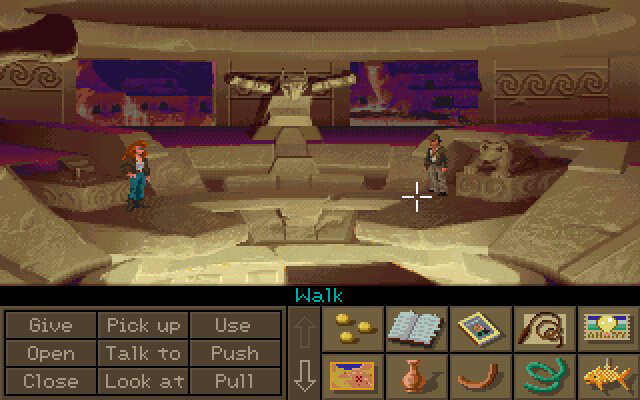
At the center of every route lies the Lost Dialogue of Plato, a translation book that contains the clues you need to unlock ancient Atlantean sites. Instead of guessing item combinations, you spend hours checking text passages against physical artifacts. You collect metal stone disks named Sun, Moon, and World, alignment devices that must be rotated until their carved symbols align according to Plato's exact instructions.
When the puzzle logic hits its mark, it produces some of the most satisfying moments in point and click history. Feeding small glowing beads of Orichalcum, the mysterious ancient metal, into old bronze statues or forgotten engines creates immediate, clear feedback. Armed with your whip, a few simple tools, and careful notes, you feel like an actual researcher piecing together lost secrets.
Not every stretch of the journey flows smoothly. Period reviewers at PC Review and PC Format praised the game's production and visual scope, but historical write-ups routinely called out the frustrating submarine sequence midway through the story. Navigating those cramped corridors while dodging crewmen quickly turned into a test of patience, complete with audio synchronization glitches on early talkie releases that original players remember all too well.
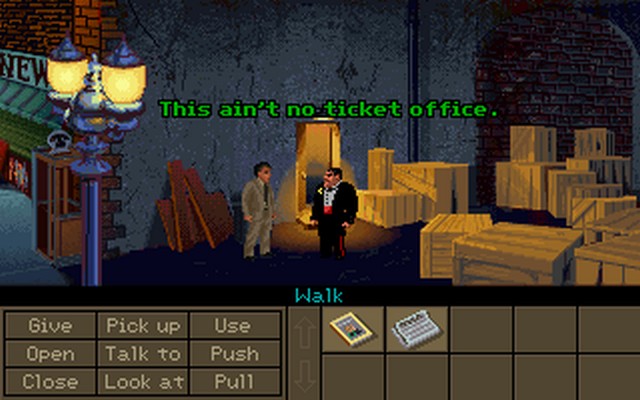
If you pick the action-heavy route, you have to deal with the real-time punching mechanics. Indy can aim punches high, middle, or low, while managing an opponent's health and sucker-punch meters. The controls are far from fluid, making combat feel clunky and unforgiving when high-ranking Nazi officers corner you in narrow halls.
The final act inside Atlantis introduces its own roadblocks. While the art direction led by William L. Eaken renders the ancient machinery with incredible detail, the actual level layout devolves into repetitive, maze-like stone passageways, lava doors, and locked gates. Nazi agent Klaus Kerner and scientist Dr. Hans Ubermann hunt you down while you spend endless minutes wandering back and forth across duplicate corridors to collect spare machinery parts.
The audio presentation helps carry you through those repetitive catacombs. Programmed on version 5 of the SCUMM engine, the game was among the early projects to use the iMUSE sound system written by Michael Land and Peter McConnell. With music composed by Land, McConnell, and Clint Bajakian, the soundtrack transitions instantly between calm exploration motifs and tense action fanfare based on what happens on screen, making fantastic use of AdLib, Sound Blaster, and Roland MT-32 synth boards.
When LucasArts released the game, it shattered expectations for movie-adjacent PC titles by telling an entirely original story set in World War II rather than rehashing a film script. Computer Gaming World highlighted the writing for keeping the right balance between genuine scholarship and mystical nonsense, an assessment that holds up today. Selling over one million copies on floppy disk and CD-ROM, it earned a top spot among the studio's releases.
Comparing this build to other 1992 projects shows how far SCUMM technology had come. While many competing titles still punished players with unwinnable states for forgetting an item ten hours earlier, this engine design keeps the experience fair. You can make wrong choices or lose brawls, but you are rarely soft-locked out of a solution.
The full-voice CD-ROM release brought extra life to the character interactions, but even the original text-only release held up on its strong script and background details. It marked a peak for LucasArts, proving that point-and-click mechanics could deliver action, historical mystery, and genuinely clever puzzles without relying on absurd cartoon logic.
You can jump into the MS-DOS game Indiana Jones and the Fate of Atlantis directly in your browser without downloading anything or messing with config settings. It is a absolute highlight of 1990s adventure design that every fan of the genre should experience firsthand.
Modern players trying it for the first time often assume that every object on screen will be highlighted automatically or that solutions are instantly obvious. Take time to read Plato's dialogue carefully, take notes on the disk alignment clues, and save your progress before stepping into combat with heavy guards.
In Indiana Jones and the Fate of Atlantis, you travel from Barnett College to the sunken city itself to beat Nazi agents to a terrifying power source, changing how the entire story plays out based on whether you choose to rely on your brains, your partner, or your fists.
Most graphic adventures from this era gave you a strict list of puzzles and forced you down a single track, but designers Hal Barwood and Noah Falstein split this narrative right down the middle. Early in the story, after meeting up with former archaeologist turned psychic medium Sophia Hapgood in New York, the game asks you to choose your strategy. That single choice forks the campaign into three distinct routes, altering dialogue, item placement, and puzzle solutions across whole continents.
The system works because each branch actually plays differently rather than just swapping out text lines. You can tackle the search across Monte Carlo, Algiers, Tikal, the Azores, Crete, and Thera through three distinct styles:
Tracking your progress across all three approaches is handled by the Indy Quotient scoring system. Scoring the full 1000 points means finishing every path, which pushed players in 1992 to re-examine locations from completely new angles.

At the center of every route lies the Lost Dialogue of Plato, a translation book that contains the clues you need to unlock ancient Atlantean sites. Instead of guessing item combinations, you spend hours checking text passages against physical artifacts. You collect metal stone disks named Sun, Moon, and World, alignment devices that must be rotated until their carved symbols align according to Plato's exact instructions.
When the puzzle logic hits its mark, it produces some of the most satisfying moments in point and click history. Feeding small glowing beads of Orichalcum, the mysterious ancient metal, into old bronze statues or forgotten engines creates immediate, clear feedback. Armed with your whip, a few simple tools, and careful notes, you feel like an actual researcher piecing together lost secrets.
Not every stretch of the journey flows smoothly. Period reviewers at PC Review and PC Format praised the game's production and visual scope, but historical write-ups routinely called out the frustrating submarine sequence midway through the story. Navigating those cramped corridors while dodging crewmen quickly turned into a test of patience, complete with audio synchronization glitches on early talkie releases that original players remember all too well.

If you pick the action-heavy route, you have to deal with the real-time punching mechanics. Indy can aim punches high, middle, or low, while managing an opponent's health and sucker-punch meters. The controls are far from fluid, making combat feel clunky and unforgiving when high-ranking Nazi officers corner you in narrow halls.
The final act inside Atlantis introduces its own roadblocks. While the art direction led by William L. Eaken renders the ancient machinery with incredible detail, the actual level layout devolves into repetitive, maze-like stone passageways, lava doors, and locked gates. Nazi agent Klaus Kerner and scientist Dr. Hans Ubermann hunt you down while you spend endless minutes wandering back and forth across duplicate corridors to collect spare machinery parts.
The audio presentation helps carry you through those repetitive catacombs. Programmed on version 5 of the SCUMM engine, the game was among the early projects to use the iMUSE sound system written by Michael Land and Peter McConnell. With music composed by Land, McConnell, and Clint Bajakian, the soundtrack transitions instantly between calm exploration motifs and tense action fanfare based on what happens on screen, making fantastic use of AdLib, Sound Blaster, and Roland MT-32 synth boards.

When LucasArts released the game, it shattered expectations for movie-adjacent PC titles by telling an entirely original story set in World War II rather than rehashing a film script. Computer Gaming World highlighted the writing for keeping the right balance between genuine scholarship and mystical nonsense, an assessment that holds up today. Selling over one million copies on floppy disk and CD-ROM, it earned a top spot among the studio's releases.
Comparing this build to other 1992 projects shows how far SCUMM technology had come. While many competing titles still punished players with unwinnable states for forgetting an item ten hours earlier, this engine design keeps the experience fair. You can make wrong choices or lose brawls, but you are rarely soft-locked out of a solution.
The full-voice CD-ROM release brought extra life to the character interactions, but even the original text-only release held up on its strong script and background details. It marked a peak for LucasArts, proving that point-and-click mechanics could deliver action, historical mystery, and genuinely clever puzzles without relying on absurd cartoon logic.
You can jump into the MS-DOS game Indiana Jones and the Fate of Atlantis directly in your browser without downloading anything or messing with config settings. It is a absolute highlight of 1990s adventure design that every fan of the genre should experience firsthand.
Modern players trying it for the first time often assume that every object on screen will be highlighted automatically or that solutions are instantly obvious. Take time to read Plato's dialogue carefully, take notes on the disk alignment clues, and save your progress before stepping into combat with heavy guards.
How Indiana Jones and the Fate of Atlantis is played — the keys the game listens to, grouped by what they do.
Highlighted keys are mapped — hover or tap one to see what it does.
Command-line parameters like 'atlantis k' force keyboard, 'atlantis m' mouse, or 'atlantis j' joystick mode. Specific movement and combat keys were not provided in the reference notes.
The on-screen keyboard and gamepad mapping the browser player uses on a phone, a tablet or a controller, as opposed to the real keys above. $PRO members make their own in the player and share them here; anyone can pick one to play with.
Cheat codes, console commands and memory pokes for Indiana Jones and the Fate of Atlantis — each one verified and attributed.
Sign in to submitHow Indiana Jones and the Fate of Atlantis is played — the keys the game listens to, grouped by what they do.
Highlighted keys are mapped — hover or tap one to see what it does.
Command-line parameters like 'atlantis k' force keyboard, 'atlantis m' mouse, or 'atlantis j' joystick mode. Specific movement and combat keys were not provided in the reference notes.
The on-screen keyboard and gamepad mapping the browser player uses on a phone, a tablet or a controller, as opposed to the real keys above. $PRO members make their own in the player and share them here; anyone can pick one to play with.
Cheat codes, console commands and memory pokes for Indiana Jones and the Fate of Atlantis — each one verified and attributed.
Sign in to submit