In 1988, Codemasters bundled four distinct takes on football into 4 Soccer Simulators, promising everything from full-pitch international matches to back-alley kickarounds on a single disk.
What happens when you actually load 4 Soccer Simulators
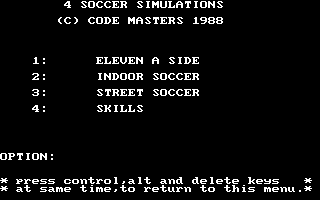
The gap between what budget computer games promised on their back covers in 1988 and what actually appeared on screen was usually wide enough to drive a bus through. When you boot 4 Soccer Simulators, you are presented with a simple menu offering four modes: 11-A-Side Soccer, Indoor Soccer, Street Soccer, and Soccer Skills. Each mode attempts to tackle football from a completely different angle, which was an ambitious pitch for a budget title developed by Codemasters.
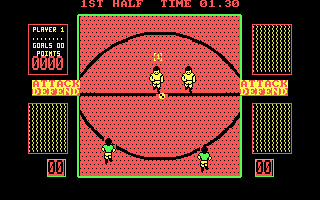
The reality hits as soon as you choose a mode and step onto the pitch. Played from a top-down view on vertically scrolling fields, matches are chaotic, fast, and frequently frustrating. The computer opponent moves at absolute breakneck speed, leaving human players scrambling across the turf just to get a boot on the ball. You can select from three difficulty levels and invite up to four players for two-on-two matches, but every game turns into a wild scramble anyway.
Four modes, four very different sets of headaches
Each of the four sub-games alters the rules and environment, but they all share the same underlying engine and control quirks. Rather than a single game with minor visual tweaks, the package breaks down into distinct play styles:
- 11-A-Side Soccer: The standard simulation following full football rules, including offside, fouls, penalties, throw-ins, corners, and goal kicks.
- Indoor Soccer: A five-a-side variant enclosed by solid walls where the ball bounces back into play without stopping for throw-ins or corners.
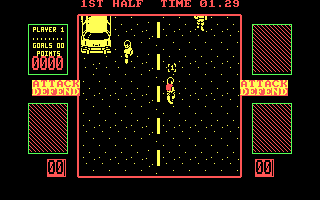
- Street Soccer: Set in an urban environment with minimal rules, allowing players to bounce passes off parked cars and houses, launch kicks over boundary walls, or slide-tackle opponents without referee intervention.
- Soccer Skills: A training ground package where you run through isolated drills, including penalty practice, goalkeeper training, 100-meter sprints, dribbling through cones, press-ups, sit-ups, bench jumps, and weightlifting.
The variety is genuine, but the structural limitations mean none of these modes offer any long-term progression. There are no league tables, cup tournaments, or campaign endings to work toward. Once a match ends, you are bumped back to the start. It is purely an arcade-style collection designed for single standalone matches or afternoon multiplayer sessions.
The MS-DOS version and its bizarre control scheme
If you played this on 1988 8-bit computers like the ZX Spectrum or Commodore 64, you dealt with twitchy joystick response. But if you play the MS-DOS game version on a standard PC keyboard, you encounter one of the most confusing control layouts of the era. Navigating the main menu requires pressing Space to cycle through options and Enter to confirm, which is simple enough. The pitch, however, is a completely different story.
On PC keyboards, movement was mapped in a way that split directional commands across non-intuitive clusters. Pressing Q and W controlled vertical movement, while W and E handled horizontal tracking. Trying to steer a running winger diagonally while an AI opponent charges at double speed feels like trying to pat your head and rub your stomach while riding a unicycle. Combine this with player controls that are massively over-sensitive and a player-switching system that frequently refuses to give you the nearest defender, and defending becomes a panic-driven ordeal.
Visually, the DOS release renders its action in a surprisingly small CGA play window surrounded by heavy borders. Goalkeepers move like they are trapped in wet cement, standing around sluggishly while outfield players zip across the screen like pinballs. David Whittaker composed the audio tracks across various versions, though on PC speaker hardware, sound effects were reduced to sparse clicks and chirps whenever a boot met the ball.
Why 4 Soccer Simulators still lures retro fans back
Despite the punishing keyboard scheme and total lack of tournament depth, matches run so fast it works in spite of itself. The street soccer mode is the real highlight here. Kicking the ball off the side of a brick house to bypass an aggressive defender feels satisfying in a way that rigid pitch simulators never quite managed. The skill drills also provide quick button-mashing side activities that make for decent local multiplayer rivalries.
Designed by a team including Peter Williamson, Gavin Raeburn, and David Darling, the game laid structural groundwork that Codemasters would refine for years. Portions of this package, specifically 11-A-Side Soccer and Soccer Skills, were later retooled to form part of 11-a-side releases like Italia 1990 on 16-bit machines. While full ST and Amiga standalone conversions of this four-game pack were advertised but never published, the original DOS version captures a specific moment when budget gaming was wildly experimental.
How to play 4 Soccer Simulators online today
You can play 4 Soccer Simulators free in your browser right now, with full keyboard access ready to go. The twitchy controls and rapid AI opponents take some getting used to, but running a quick match in Street Soccer or testing your rhythm on the bench jump mini-game requires zero setup. If you want to experience late-eighties budget sports games at their most frantic, launch a match and see how many rebounds you can score off the nearest wall.