
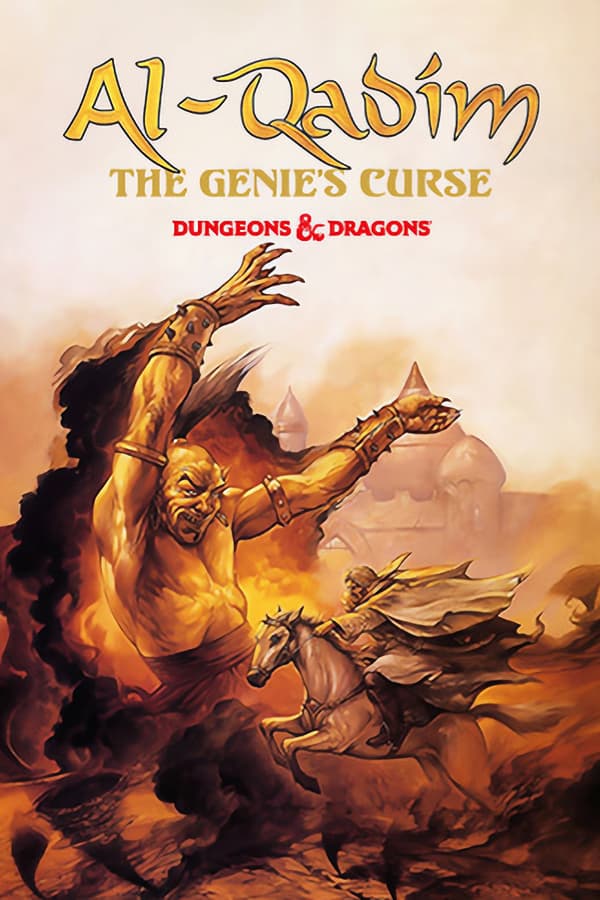

If you expected a traditional Gold Box experience when opening Al-Qadim: The Genie's Curse, the immediate leap into real-time scimitar combat and fixed character stats made it obvious that SSI was trying something entirely different.
By 1994, Strategic Simulations, Inc. had built a massive empire on turn-based, grid-focused D&D rulesets. Players expected to roll stats, spent hours balancing six-character parties, and spent combat rounds measuring movement tiles down to the foot. When developer Cyberlore Studios took on Jeff Grubb's 1992 Al-Qadim campaign setting, Zakhara, they stripped away almost all of those traditional mechanics. You do not roll stats, you do not build a party, and you do not pick a class. You start directly as the youngest son of Sultan Zubin Al-Hazrad, a second-level corsair who has just completed training under Master Corsair Sinbar.
Designer Herb Perez and programmer Ken Grey shifted the perspective to a diagonal-down view and drove all real-time interactions through a single primary action key or mouse click. That decision drastically altered how a player approached an official Dungeons & Dragons title. Instead of pausing to ponder spell slots, combat happens right away in real time, forcing you to swing your scimitar, fling magic shards, or launch projectiles from a sling while dodging incoming attacks. For purists raised on strict tabletop rules, this radical reduction felt jarring, but it moved the narrative forward at a clip unheard of in standard computer role-playing games of the era.
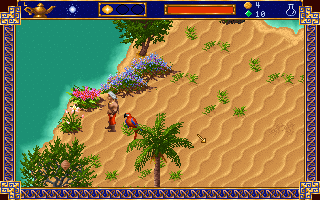
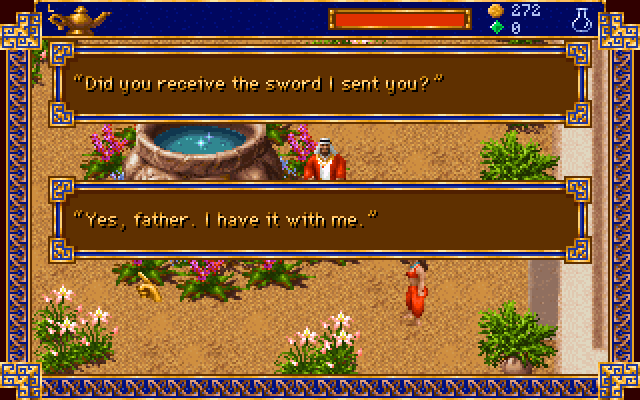
The campaign begins on a hidden island where your master tests your reflexes inside a trap-laden dungeon corridor. You find yourself navigating floor spikes, projectile traps, and aggressive sea serpents before you even return home to Zaratan. Once you arrive, you learn your family is accused of treachery, your betrothed Kara (the Caliph's daughter) is missing after a shipwreck, and mysterious "Nameless Masters" are corrupting genies across the land. To clear your father's name and stop the curse, you must move from island to island, relying on swift swordwork and conversation rather than character sheets.
Combat in this game depends entirely on timing, positioning, and resource management. Swinging your scimitar hits enemies directly in front of you, while sling rocks and magical energy shards let you pick off airborne or distant fiends. Healing does not happen through resting between encounters; you either chug health potions gathered along the way or seek out specific magical locations scattered across Zakhara. That design choice means every mistake in a trap sequence directly drains your limited survival supplies, making early dungeon runs far more punishing than they look on the surface.
The frustration for classic role-playing fans comes down to the complete lack of character customization. You cannot upgrade your armor, buy better swords, or alter your character's baseline attributes as the story unfolds. What you start with is effectively what you carry throughout the journey, save for new spell abilities and inventory items required for quest progression. Period magazine reviews reflected this rift instantly: High Score awarded the game a 100% score for its accessible story, while Computer Gaming World covered it under their role-playing section despite noting how far it strayed from core D&D mechanics.
Controlling your corsair presents its own set of mechanical hurdles. Moving with the mouse often feels floating and imprecise, particularly when you need to navigate narrow paths lined with crushing blocks or dart past flame jets. Most experienced players quickly abandoned mouse-driven movement altogether, relying on the keyboard arrow keys to get the crisp directional control needed for precise dodging. If you hesitate for half a second while navigating a floor trap, your health bar vanishes, sending you straight back to your last saved state.
What keeps you hooked despite the rigid equipment system is the setting itself. Cyberlore Studios brought the Al-Qadim setting to life with rich character portraits, detailed environment art, and a plot driven by honor, family duty, and genie mythology. It remains the only computer game ever built around this specific TSR campaign world. Instead of generic medieval taverns and damp European castles, your journey takes you through bustling desert bazaars, sultan palaces, and open ocean waters populated by elemental beings.
The design balance relies heavily on non-combat puzzles and multi-stage side quests to offset the linear character stats. You spend significant time resolving political rivalries, uncovering family secrets, and figuring out how to free bound genies without triggering fatal counter-curses. Home of the Underdogs noted that the interesting plot, colorful visual design, and spell variety made up for the difficult trap sequences. That balance gives the game a distinct personality, operating almost like an action-adventure game with a heavy narrative spine rather than a complex statistical simulator like Strategic Simulations, Inc. usually released.
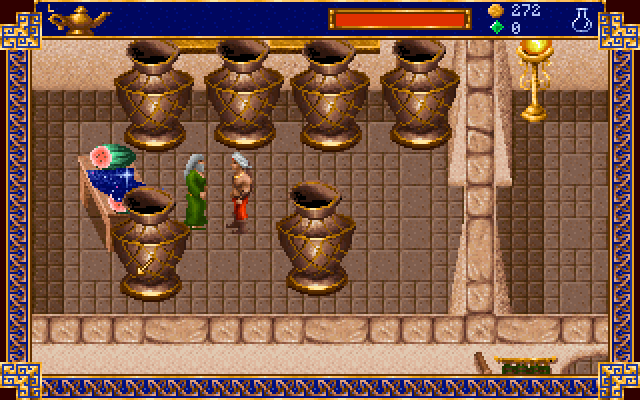
I remember spending hours trying to clean up regional side quests just to see the beautiful character portraits and hear the digitized sound effects kick in during key story beats. The game rewards curiosity; talking to townspeople or investigating side locations yields essential magical items and narrative context that make the main quest far more satisfying to resolve.
As an action-oriented departure for Cyberlore Studios, Inc., this title holds up surprisingly well if you approach it as a narrative action-adventure rather than a complex stat-heavy D&D simulation. The fixed equipment and unchangeable character stats will disappoint anyone looking to fine-tune a hero, and the precision-demanding trap hallways still generate plenty of modern player complaints. Yet the unique Zakhara setting, sharp pixel art, and memorable genie encounters give it a style that no other computer product from TSR's catalog ever attempted to match.
You can play 1994's Al-Qadim: The Genie's Curse free in your browser right here. Jump straight into Master Sinbar's hidden training maze, practice your scimitar swings on the local dungeon traps, and experience this unusual slice of Arabian Nights history with no setup required. You can play Al-Qadim: The Genie's Curse online right now and see how SSI's real-time experiment feels on modern screens. This original Al-Qadim: The Genie's Curse MS-DOS game is ready to run immediately, giving you instant access to Zakhara's genies and sea serpents.
If you expected a traditional Gold Box experience when opening Al-Qadim: The Genie's Curse, the immediate leap into real-time scimitar combat and fixed character stats made it obvious that SSI was trying something entirely different.
By 1994, Strategic Simulations, Inc. had built a massive empire on turn-based, grid-focused D&D rulesets. Players expected to roll stats, spent hours balancing six-character parties, and spent combat rounds measuring movement tiles down to the foot. When developer Cyberlore Studios took on Jeff Grubb's 1992 Al-Qadim campaign setting, Zakhara, they stripped away almost all of those traditional mechanics. You do not roll stats, you do not build a party, and you do not pick a class. You start directly as the youngest son of Sultan Zubin Al-Hazrad, a second-level corsair who has just completed training under Master Corsair Sinbar.
Designer Herb Perez and programmer Ken Grey shifted the perspective to a diagonal-down view and drove all real-time interactions through a single primary action key or mouse click. That decision drastically altered how a player approached an official Dungeons & Dragons title. Instead of pausing to ponder spell slots, combat happens right away in real time, forcing you to swing your scimitar, fling magic shards, or launch projectiles from a sling while dodging incoming attacks. For purists raised on strict tabletop rules, this radical reduction felt jarring, but it moved the narrative forward at a clip unheard of in standard computer role-playing games of the era.

The campaign begins on a hidden island where your master tests your reflexes inside a trap-laden dungeon corridor. You find yourself navigating floor spikes, projectile traps, and aggressive sea serpents before you even return home to Zaratan. Once you arrive, you learn your family is accused of treachery, your betrothed Kara (the Caliph's daughter) is missing after a shipwreck, and mysterious "Nameless Masters" are corrupting genies across the land. To clear your father's name and stop the curse, you must move from island to island, relying on swift swordwork and conversation rather than character sheets.
Combat in this game depends entirely on timing, positioning, and resource management. Swinging your scimitar hits enemies directly in front of you, while sling rocks and magical energy shards let you pick off airborne or distant fiends. Healing does not happen through resting between encounters; you either chug health potions gathered along the way or seek out specific magical locations scattered across Zakhara. That design choice means every mistake in a trap sequence directly drains your limited survival supplies, making early dungeon runs far more punishing than they look on the surface.
The frustration for classic role-playing fans comes down to the complete lack of character customization. You cannot upgrade your armor, buy better swords, or alter your character's baseline attributes as the story unfolds. What you start with is effectively what you carry throughout the journey, save for new spell abilities and inventory items required for quest progression. Period magazine reviews reflected this rift instantly: High Score awarded the game a 100% score for its accessible story, while Computer Gaming World covered it under their role-playing section despite noting how far it strayed from core D&D mechanics.

Controlling your corsair presents its own set of mechanical hurdles. Moving with the mouse often feels floating and imprecise, particularly when you need to navigate narrow paths lined with crushing blocks or dart past flame jets. Most experienced players quickly abandoned mouse-driven movement altogether, relying on the keyboard arrow keys to get the crisp directional control needed for precise dodging. If you hesitate for half a second while navigating a floor trap, your health bar vanishes, sending you straight back to your last saved state.
What keeps you hooked despite the rigid equipment system is the setting itself. Cyberlore Studios brought the Al-Qadim setting to life with rich character portraits, detailed environment art, and a plot driven by honor, family duty, and genie mythology. It remains the only computer game ever built around this specific TSR campaign world. Instead of generic medieval taverns and damp European castles, your journey takes you through bustling desert bazaars, sultan palaces, and open ocean waters populated by elemental beings.
The design balance relies heavily on non-combat puzzles and multi-stage side quests to offset the linear character stats. You spend significant time resolving political rivalries, uncovering family secrets, and figuring out how to free bound genies without triggering fatal counter-curses. Home of the Underdogs noted that the interesting plot, colorful visual design, and spell variety made up for the difficult trap sequences. That balance gives the game a distinct personality, operating almost like an action-adventure game with a heavy narrative spine rather than a complex statistical simulator like Strategic Simulations, Inc. usually released.

I remember spending hours trying to clean up regional side quests just to see the beautiful character portraits and hear the digitized sound effects kick in during key story beats. The game rewards curiosity; talking to townspeople or investigating side locations yields essential magical items and narrative context that make the main quest far more satisfying to resolve.
As an action-oriented departure for Cyberlore Studios, Inc., this title holds up surprisingly well if you approach it as a narrative action-adventure rather than a complex stat-heavy D&D simulation. The fixed equipment and unchangeable character stats will disappoint anyone looking to fine-tune a hero, and the precision-demanding trap hallways still generate plenty of modern player complaints. Yet the unique Zakhara setting, sharp pixel art, and memorable genie encounters give it a style that no other computer product from TSR's catalog ever attempted to match.
You can play 1994's Al-Qadim: The Genie's Curse free in your browser right here. Jump straight into Master Sinbar's hidden training maze, practice your scimitar swings on the local dungeon traps, and experience this unusual slice of Arabian Nights history with no setup required. You can play Al-Qadim: The Genie's Curse online right now and see how SSI's real-time experiment feels on modern screens. This original Al-Qadim: The Genie's Curse MS-DOS game is ready to run immediately, giving you instant access to Zakhara's genies and sea serpents.
How Al-Qadim: The Genie's Curse is played — the keys the game listens to, grouped by what they do.
Highlighted keys are mapped — hover or tap one to see what it does.
Input devices (mouse mode, joystick, or keyboard) can be configured in the SETUP option under the OPTIONS menu.
The on-screen keyboard and gamepad mapping the browser player uses on a phone, a tablet or a controller, as opposed to the real keys above. $PRO members make their own in the player and share them here; anyone can pick one to play with.
Cheat codes, console commands and memory pokes for Al-Qadim: The Genie's Curse — each one verified and attributed.
Sign in to submitaka Al-Qadim: Der Fluch des Dschinn
How Al-Qadim: The Genie's Curse is played — the keys the game listens to, grouped by what they do.
Highlighted keys are mapped — hover or tap one to see what it does.
Input devices (mouse mode, joystick, or keyboard) can be configured in the SETUP option under the OPTIONS menu.
The on-screen keyboard and gamepad mapping the browser player uses on a phone, a tablet or a controller, as opposed to the real keys above. $PRO members make their own in the player and share them here; anyone can pick one to play with.
Cheat codes, console commands and memory pokes for Al-Qadim: The Genie's Curse — each one verified and attributed.
Sign in to submit