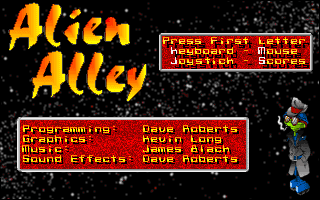
Alien Alley
In Alien Alley, you pilot a solitary starfighter against an endless wave of twin-firing intruder craft to see how high you can push your score before your shields collapse. Created as a practical demonstration for a 1994 coding guide, it strips top-down shooting down to its absolute bare mechanics.
An endless loop built on book disk source code
Every line of code in Alien Alley was written to teach readers how PC graphics worked. Programmer Dave Roberts designed the game as a practical example for his textbook, PC Game Programming Explorer, published by Coriolis Group Books in 1994. If you bought the book for $34.95, you received the complete Turbo C source code on a bundled 3.5-inch floppy disk.
Because the program was meant as an educational tech demo rather than a retail product, Roberts bypassed traditional campaign structures. There are no named star systems, briefing screens, or boss encounters. You spawn into space, fire at incoming craft, and survive until your ship explodes. It is an pure arcade survival test built entirely around scoring.
That design choice leaves the game feeling lean and immediate. You do not have to watch opening cinematics or navigate complex menus. You launch the executable, enter the void, and immediately start dogfighting against an unrelenting invasion line.
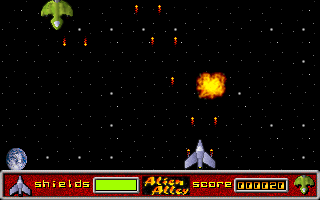
Shield math and button mashing in Alien Alley
The core survival loop relies on strict resource management. Your ship starts each flight with 80 shield units. Every energy bolt or missile that clips your hull subtracts 5 units from that pool. You can survive 16 individual plasma hits before your fighter disintegrates into space dust.
Physical contact with an enemy vessel changes the stakes entirely. ramming an alien ship triggers an instant crash, ending your run on the spot regardless of your remaining shield reserve. This mechanism forces you to weigh risky offensive line-ups against sudden collisions when enemy craft sweep across your path.
Up to four enemy ships appear on screen simultaneously. These attackers drift down from the top edge, weaving side-to-side while throwing plasma down the vertical lane. Because there are no alternate weapons or drop-down power-up items, your stock forward gun is your only defense.
The controls demand constant physical effort. Holding down the fire key does nothing, as the input routines lack an automatic rapid-fire feature. You must manually tap the spacebar for every single shot you discharge, turning intense firefights into a endurance test for your hand.
- Shield gauge begins at 80 units and drains 5 units per laser contact.
- Direct physical crashes destroy your fighter instantly.
- Four active enemy vessels occupy the airspace at any single moment.
- Manual key taps are required for every individual shot fired.
The technical wizardry under the hood
While the game structure remains basic, the underlying engine highlights impressive mid-nineties programming tricks. Artist Kevin Long crafted crisp vessel sprites, while composer James Black provided original MIDI background music. Roberts used the software to demonstrate smooth VGA palette manipulation, multi-plane background scrolling, and fast hardware page flipping techniques.
Sound card handling was surprisingly sophisticated for a instructional program. The game engine supports stereo-panned sound effects, directing blast noises to the left or right speaker based on where explosions occur on screen. On period hardware with a proper sound card, the audio presentation felt polished.
Running the software on modern setups reveals a few mechanical issues. When four enemy sprites flood the display along with multiple player projectiles, the frame rate can visibly dip under heavy emulation load. Audio drivers can also prove finicky depending on how your system handles hardware interrupt settings.
High scores, harsh truths, and arcade survival
The single biggest flaw in Dave Roberts' design is its complete lack of variety. Every enemy ship uses the exact same graphics, health pool, and flight trajectory. Once you learn how to dodge their horizontal sweeping pattern, the game never shifts tactics or introduces new hazards.
There are no stage transitions, level numbers, or saving functions. Your reward for clear flying is simply more of the same wave. You fight until you lose focus, make a fatal steering error, or decide to quit out of fatigue.
What keeps you hitting restart is the persistent top-10 high score table. The game saves your best runs locally to disk, prompting you to enter your name whenever you place on the board. Competing against your own top record provides the primary reason to master its tight steering windows.
As a commercial release, this action title would have struggled against polished retail shooters of the era. As a free companion project bundled alongside C programming tutorials, it delivered competent shooter mechanics that showed aspiring developers what their own custom code could accomplish.
Fire up this Alien Alley MS-DOS game in your browser
You can play Alien Alley online right now directly inside your browser window. You do not need to hunt down rare floppy disks, set up software emulators, or compile C code from an old textbook disk. Everything runs in your browser with zero installation required.
Modern players often approach this Alien Alley MS-DOS game expecting a hidden campaign mode, boss encounters, or pick-up weaponry. Remembering its origins as a raw code sample prevents disappointment. Treat it as a pure high-score survival run, keep your fingers ready to tap that spacebar, and see if you can carve your name into the top ten ranking table today.