
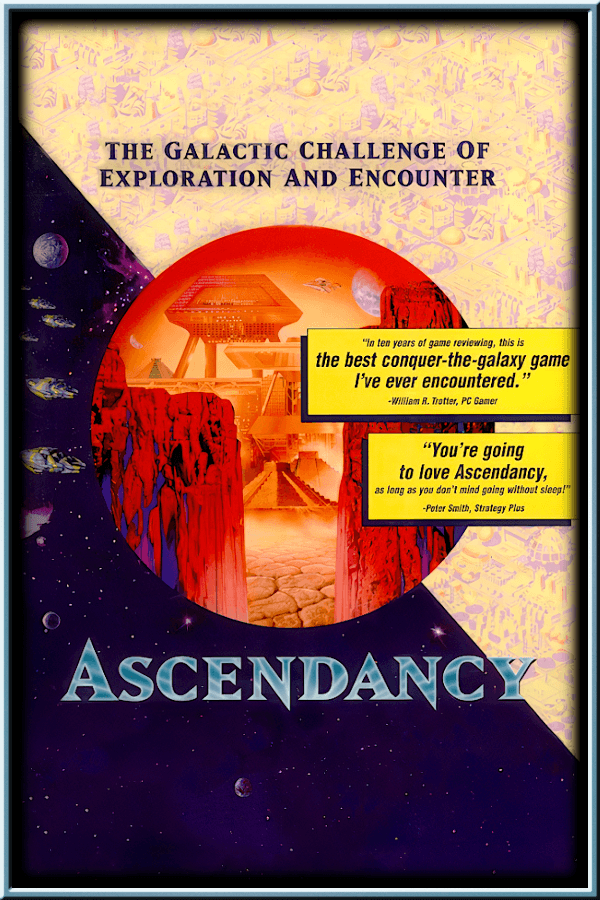

Building a galactic empire in Ascendancy starts with spinning a fully 3D star system in glorious SVGA graphics while listening to hypnotic alien synthesizers. Released in 1995, this space strategy game offered incredible visual polish and creative alien designs that made exploration feel genuinely strange.
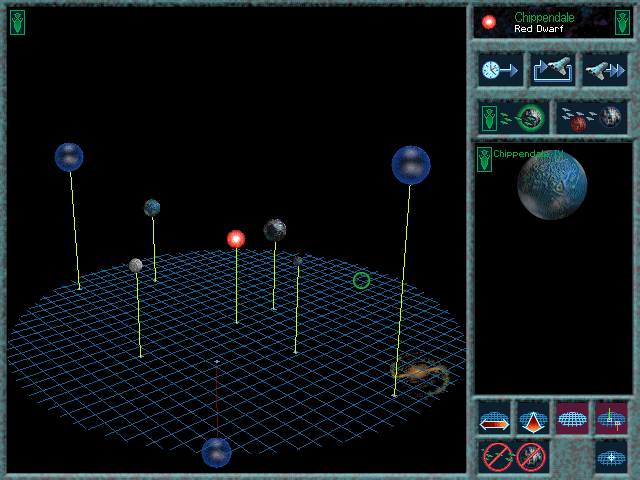
The Logic Factory gave the 4X space strategy genre a look almost nobody else was trying. Instead of flat menus and basic grids, you examine star systems and planetary orbits in full 3D space. Wormhole starlanes stretch across the cluster, linking up to seven competing alien civilizations together in a race across the galaxy.
Every planet you colonize displays a sphere covered in color-coded surface tiles. Red tiles boost industry, green tiles produce agriculture and population growth, and blue tiles speed up research. Deciding how to balance these surfaces forms the core economic engine of your empire. The system feels elegant and logical during the opening hours of a match.
Technological advancement uses a visual research tree that branches out in three dimensions. Rather than reading a plain list, you navigate connected nodes depicting parent and child breakthroughs. Unlocking higher tier technology gives you access to powerful modules for ship construction, including bizarre weapons like the Molecular Disassembler and the Orbital Whopper.
Custom starship design is where the 1995 title really opens up. You choose a ship hull, then manually fit power generators, engines, shields, and weapon systems into empty slots. Weapons consume energy on every shot, which forces you to calculate power management before sending fleets into combat.
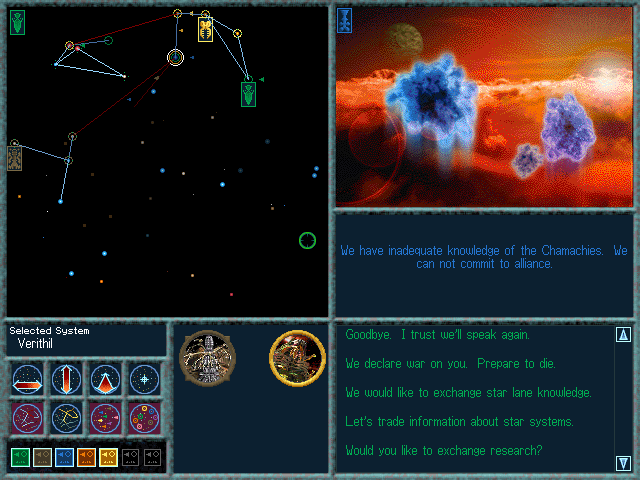
The developer offered 21 alien species, each with distinct visual designs and active traits. The robotic Minions instantly complete current planetary projects, the Dubtaks steal tech from opponents, and the Capelon can render their home colonies invulnerable for a short period. Choosing an alien species drastically alters your tactical options on the map.
Composer Nenad Vugrinec created an atmospheric soundtrack that perfectly fit the foreign mood of deep space. Combined with clean visual menus, the audio made every discovery feel fresh. Computer Game Review praised the presentation in October 1995, and the game won the Software Publishers Association Codie Award for Best Strategy Software in 1996.
Despite all its visual style, the original game suffered from a fatal flaw that ruined single-player games. The artificial intelligence was completely passive and incompetent. Computer opponents built illogical structures on planetary tiles, neglected research, and frequently left their home star systems completely undefended against invading fleets.
Reviewers at the time heavily criticized this lack of challenge, with Rock Paper Shotgun later referring to the opponent as a dunce of an AI. Without an aggressive enemy pushing back, conquering the star cluster quickly became an exercise in simple expansion without real military threat.
To fix the issue, the developers released a patch known as the Ascendancy Antagonizer. This patch dramatically overhauled computer logic, forcing rival alien species to build proper fleets and attack your colonies aggressively. Playing with the Antagonizer installed transforms a quiet sandbox into a genuine challenge for survival.
Late-game micromanagement presents another hurdle for modern players. Once you control dozens of star systems, clicking through individual planetary surfaces to select new construction projects turns into repetitive busywork. The lack of robust automation tools slows down the pacing during large endgame galactic wars.
If you enjoy strategy and tactics games, the trade-off here is clear. The diplomacy system lacks depth, and managing fifty worlds by hand late in a game will test your patience. Yet the alien designs, ship customization, and excellent ambient music still carry real charm.
This The Logic Factory creation stands apart from typical galactic Conquest games by leaning hard into weird alien art and creative technology trees. It provides a distinct flavor of 1990s science fiction that few competitors managed to match.
You can play Ascendancy online for free in your web browser right now with no setup needed. If you want to experience this classic Ascendancy MS-DOS game, launch it directly in your browser, pick a strange alien race like the Snivvlers or Capelon, and make sure to apply aggressive AI settings before launching your first colony ship into the unknown.
Building a galactic empire in Ascendancy starts with spinning a fully 3D star system in glorious SVGA graphics while listening to hypnotic alien synthesizers. Released in 1995, this space strategy game offered incredible visual polish and creative alien designs that made exploration feel genuinely strange.
The Logic Factory gave the 4X space strategy genre a look almost nobody else was trying. Instead of flat menus and basic grids, you examine star systems and planetary orbits in full 3D space. Wormhole starlanes stretch across the cluster, linking up to seven competing alien civilizations together in a race across the galaxy.
Every planet you colonize displays a sphere covered in color-coded surface tiles. Red tiles boost industry, green tiles produce agriculture and population growth, and blue tiles speed up research. Deciding how to balance these surfaces forms the core economic engine of your empire. The system feels elegant and logical during the opening hours of a match.
Technological advancement uses a visual research tree that branches out in three dimensions. Rather than reading a plain list, you navigate connected nodes depicting parent and child breakthroughs. Unlocking higher tier technology gives you access to powerful modules for ship construction, including bizarre weapons like the Molecular Disassembler and the Orbital Whopper.
Custom starship design is where the 1995 title really opens up. You choose a ship hull, then manually fit power generators, engines, shields, and weapon systems into empty slots. Weapons consume energy on every shot, which forces you to calculate power management before sending fleets into combat.
The developer offered 21 alien species, each with distinct visual designs and active traits. The robotic Minions instantly complete current planetary projects, the Dubtaks steal tech from opponents, and the Capelon can render their home colonies invulnerable for a short period. Choosing an alien species drastically alters your tactical options on the map.
Composer Nenad Vugrinec created an atmospheric soundtrack that perfectly fit the foreign mood of deep space. Combined with clean visual menus, the audio made every discovery feel fresh. Computer Game Review praised the presentation in October 1995, and the game won the Software Publishers Association Codie Award for Best Strategy Software in 1996.
Despite all its visual style, the original game suffered from a fatal flaw that ruined single-player games. The artificial intelligence was completely passive and incompetent. Computer opponents built illogical structures on planetary tiles, neglected research, and frequently left their home star systems completely undefended against invading fleets.
Reviewers at the time heavily criticized this lack of challenge, with Rock Paper Shotgun later referring to the opponent as a dunce of an AI. Without an aggressive enemy pushing back, conquering the star cluster quickly became an exercise in simple expansion without real military threat.
To fix the issue, the developers released a patch known as the Ascendancy Antagonizer. This patch dramatically overhauled computer logic, forcing rival alien species to build proper fleets and attack your colonies aggressively. Playing with the Antagonizer installed transforms a quiet sandbox into a genuine challenge for survival.
Late-game micromanagement presents another hurdle for modern players. Once you control dozens of star systems, clicking through individual planetary surfaces to select new construction projects turns into repetitive busywork. The lack of robust automation tools slows down the pacing during large endgame galactic wars.
If you enjoy strategy and tactics games, the trade-off here is clear. The diplomacy system lacks depth, and managing fifty worlds by hand late in a game will test your patience. Yet the alien designs, ship customization, and excellent ambient music still carry real charm.
This The Logic Factory creation stands apart from typical galactic Conquest games by leaning hard into weird alien art and creative technology trees. It provides a distinct flavor of 1990s science fiction that few competitors managed to match.
You can play Ascendancy online for free in your web browser right now with no setup needed. If you want to experience this classic Ascendancy MS-DOS game, launch it directly in your browser, pick a strange alien race like the Snivvlers or Capelon, and make sure to apply aggressive AI settings before launching your first colony ship into the unknown.
How Ascendancy is played — the keys the game listens to, grouped by what they do.
Highlighted keys are mapped — hover or tap one to see what it does.
Controls excerpted from available manual page snippets. Sound setup is configured separately via SETSOUND.EXE.
The on-screen keyboard and gamepad mapping the browser player uses on a phone, a tablet or a controller, as opposed to the real keys above. $PRO members make their own in the player and share them here; anyone can pick one to play with.
Cheat codes, console commands and memory pokes for Ascendancy — each one verified and attributed.
Sign in to submitaka Ascendancy: De Galactische Uitdaging · Ascendancy: Macht der Allmacht
How Ascendancy is played — the keys the game listens to, grouped by what they do.
Highlighted keys are mapped — hover or tap one to see what it does.
Controls excerpted from available manual page snippets. Sound setup is configured separately via SETSOUND.EXE.
The on-screen keyboard and gamepad mapping the browser player uses on a phone, a tablet or a controller, as opposed to the real keys above. $PRO members make their own in the player and share them here; anyone can pick one to play with.
Cheat codes, console commands and memory pokes for Ascendancy — each one verified and attributed.
Sign in to submit