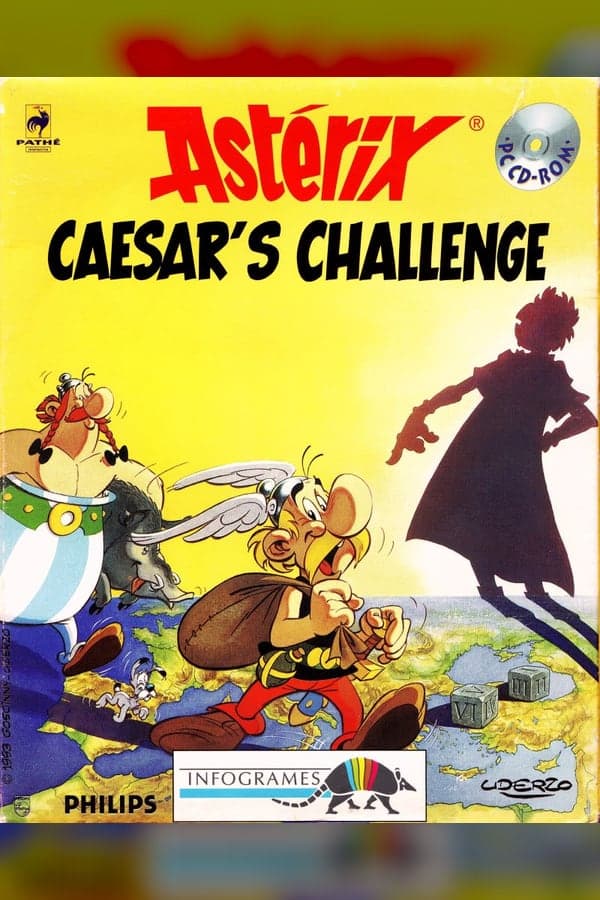
If you ever wanted to turn comic strip history into a digital race, Astérix: Caesar's Challenge breaks the Roman Empire into a board track of 54 squares. You roll dice, collect regional souvenirs, and scramble back to the Gaulish village before Julius Caesar claims victory.
Everything in this strategy tactics design rests on a simple premise: a digital board game needs quick turns and frequent interruptions. Up to four players choose between Asterix, Obelix, Impedimenta, Panacea, Justforkix, and Geriatrix. You roll, step across the top-down map, and handle whatever event lands under your boots.
Your goal is to gather specific souvenirs from distant lands to prove you made the journey. You can answer local trivia questions on country squares or pay the Phoenician merchant Ekonomikrisis with sestertii. Money comes from surviving minigame challenge spaces along the route.
The problem is that dice rolls dictate your pace far more than good planning. Landing on a prison or a trap space stalls your turn completely. Meanwhile, the villain Tortuous Convolvulus wanders around to disrupt your route whenever you gain momentum.
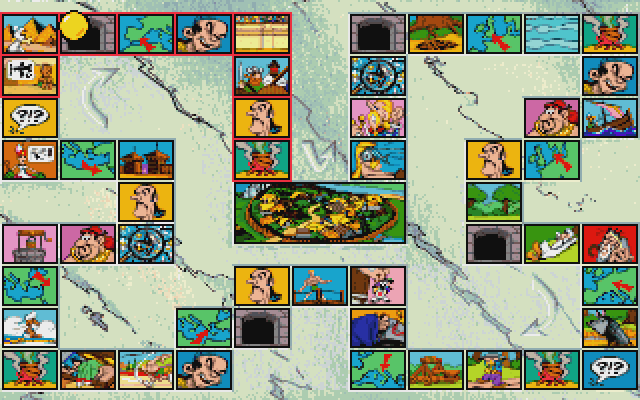
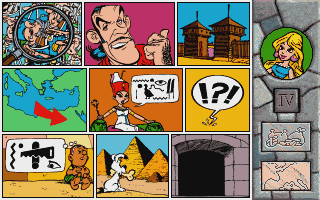
The action splits between moving across the board and surviving short reflex tests. Land on a challenge square, and the game throws you into a action scene. You might fight off a galley of pirates, hunt wild boars, or decipher Egyptian hieroglyphics under a strict timer.
One odd challenge asks you to identify animals purely by their sound inside a dense fog bank. Another forces you to escape confinement or play musical patterns correctly. These diversions give the turn-based pacing a sudden jolt, even if their difficulty feels wildly inconsistent.
To speed up your travels, board spaces offer direct help. Druid Getafix hands out magic potion flasks for temporary boosts, though he naturally skips Obelix. You can also acquire mechanical speed gadgets from the druid-spy Dubbelosix to cover extra ground.
French publisher Infogrames developed the title alongside partners like Philips Media France. Archives show Infogrames signed a 1.5 million franc contract in 1992 across six development milestones to bring the project to life. When it reached store shelves in 1995, French magazine Génération 4 handed it a modest 65% rating.
That score captured the frustration of the finished product. The game looks clean and uses sound well, but the underlying design lacks tension. If you fall behind on board placement, catching up requires endless luck with dice rolls and trivia placement.
The trivia questions repeat quickly during long matches. Once you learn the answers for specific country spaces, the educational edge disappears. What remains is a straightforward roll-and-move loop that reliance on party-style minigames cannot fully rescue.
As a single-player experience, this journey across Gaul wears thin fast. The computer opponents move without hesitation, but their presence highlights how little control you have over random space landings. It works best with three friends sitting around the same screen, arguing over boar hunting scores and trivia answers.
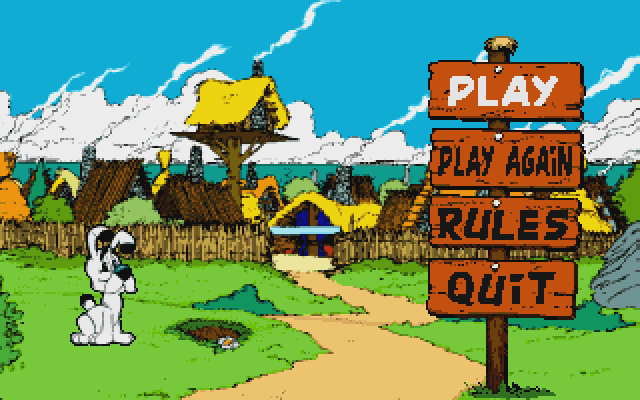
You can play Astérix: Caesar's Challenge online right now in your browser. It runs directly inside your window with no extra steps required. Pick Obelix, dodge Tortuous Convolvulus, and see if you can stock your inventory with souvenirs before Caesar shuts down the party.
If you ever wanted to turn comic strip history into a digital race, Astérix: Caesar's Challenge breaks the Roman Empire into a board track of 54 squares. You roll dice, collect regional souvenirs, and scramble back to the Gaulish village before Julius Caesar claims victory.
Everything in this strategy tactics design rests on a simple premise: a digital board game needs quick turns and frequent interruptions. Up to four players choose between Asterix, Obelix, Impedimenta, Panacea, Justforkix, and Geriatrix. You roll, step across the top-down map, and handle whatever event lands under your boots.
Your goal is to gather specific souvenirs from distant lands to prove you made the journey. You can answer local trivia questions on country squares or pay the Phoenician merchant Ekonomikrisis with sestertii. Money comes from surviving minigame challenge spaces along the route.
The problem is that dice rolls dictate your pace far more than good planning. Landing on a prison or a trap space stalls your turn completely. Meanwhile, the villain Tortuous Convolvulus wanders around to disrupt your route whenever you gain momentum.

The action splits between moving across the board and surviving short reflex tests. Land on a challenge square, and the game throws you into a action scene. You might fight off a galley of pirates, hunt wild boars, or decipher Egyptian hieroglyphics under a strict timer.
One odd challenge asks you to identify animals purely by their sound inside a dense fog bank. Another forces you to escape confinement or play musical patterns correctly. These diversions give the turn-based pacing a sudden jolt, even if their difficulty feels wildly inconsistent.
To speed up your travels, board spaces offer direct help. Druid Getafix hands out magic potion flasks for temporary boosts, though he naturally skips Obelix. You can also acquire mechanical speed gadgets from the druid-spy Dubbelosix to cover extra ground.

French publisher Infogrames developed the title alongside partners like Philips Media France. Archives show Infogrames signed a 1.5 million franc contract in 1992 across six development milestones to bring the project to life. When it reached store shelves in 1995, French magazine Génération 4 handed it a modest 65% rating.
That score captured the frustration of the finished product. The game looks clean and uses sound well, but the underlying design lacks tension. If you fall behind on board placement, catching up requires endless luck with dice rolls and trivia placement.
The trivia questions repeat quickly during long matches. Once you learn the answers for specific country spaces, the educational edge disappears. What remains is a straightforward roll-and-move loop that reliance on party-style minigames cannot fully rescue.

As a single-player experience, this journey across Gaul wears thin fast. The computer opponents move without hesitation, but their presence highlights how little control you have over random space landings. It works best with three friends sitting around the same screen, arguing over boar hunting scores and trivia answers.
You can play Astérix: Caesar's Challenge online right now in your browser. It runs directly inside your window with no extra steps required. Pick Obelix, dodge Tortuous Convolvulus, and see if you can stock your inventory with souvenirs before Caesar shuts down the party.
How Astérix: Caesar's Challenge is played — the keys the game listens to, grouped by what they do.
Highlighted keys are mapped — hover or tap one to see what it does.
Run ASTERIX.EXE to launch the DOS version. Manual control list is limited in available primary text.
The on-screen keyboard and gamepad mapping the browser player uses on a phone, a tablet or a controller, as opposed to the real keys above. $PRO members make their own in the player and share them here; anyone can pick one to play with.
Cheat codes, console commands and memory pokes for Astérix: Caesar's Challenge — each one verified and attributed.
Sign in to submitHow Astérix: Caesar's Challenge is played — the keys the game listens to, grouped by what they do.
Highlighted keys are mapped — hover or tap one to see what it does.
Run ASTERIX.EXE to launch the DOS version. Manual control list is limited in available primary text.
The on-screen keyboard and gamepad mapping the browser player uses on a phone, a tablet or a controller, as opposed to the real keys above. $PRO members make their own in the player and share them here; anyone can pick one to play with.
Cheat codes, console commands and memory pokes for Astérix: Caesar's Challenge — each one verified and attributed.
Sign in to submit