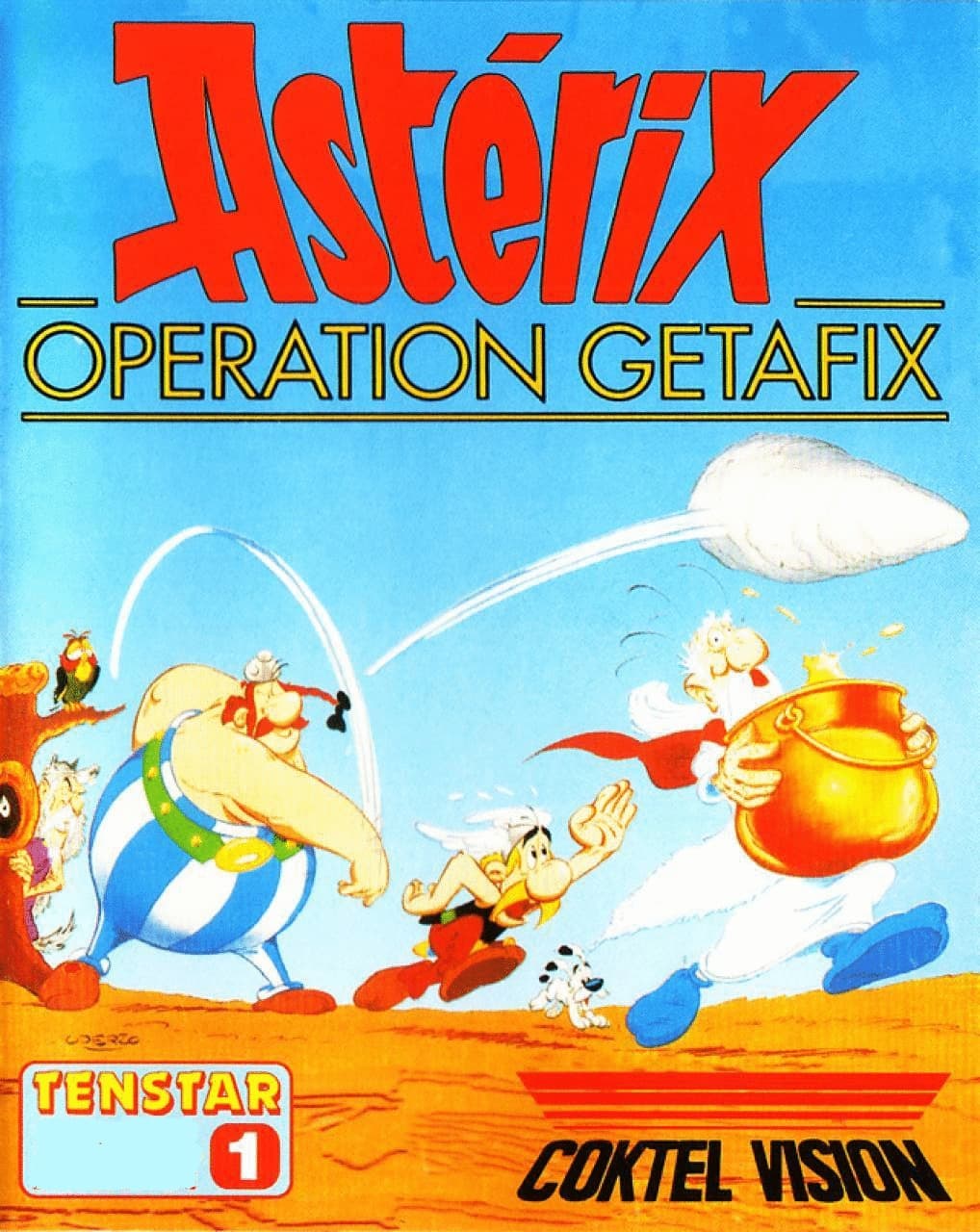
In Astérix: Operation Getafix, you are tasked with curing the Gaulish village druid after Obelix accidentally knocks out his memory with a flying menhir, sending you on a quest across side-scrolling forests to fetch potion ingredients one single item at a time.
The core setup places you in the winged helmet of Asterix immediately after a tragic comic accident. Obelix has hurled a massive standing stone straight into Getafix, leaving the village druid giggling helplessly and unable to brew the magic potion that keeps the local Roman garrisons at bay. To find a cure, you must explore a connected side-scrolling landscape that stretches from the Gaulish village through dense woods and straight into a heavily guarded Roman camp.
Your goal is to gather trial ingredients scattered across the landscape, bring them back to the village, and mix them into experimental cauldrons. The game allows you to test these concoctions on either the confused druid himself or on a captured Roman legionary tied up near the center of the village. If a recipe fails, you get a short slapstick sequence showing the victim turning green, shrinking, or sprouting feathers, after which you must head back out to hunt down the next potential remedy.
The single biggest issue you face isn't the Roman army, but a restrictive design choice that forces Asterix to carry exactly one item in his inventory at any given moment. Whether you pick up a handful of strawberries, a bundle of bay leaves, or a freshly hunted wild boar, you must carry that lone item all the way back across multiple screens to the village cauldron. If the resulting potion does not cure Getafix, you turn right around and retrace your steps across the exact same fields to fetch another ingredient. What starts as a lighthearted exploration quickly devolves into a grueling trek back and forth across identical scenery.
Walking through the forest means surviving continuous hazards that attempt to wear down your energy bar. Aside from patrolling Roman legionaries and angry wild boars charging along the ground, the woods frequently rain down flying and falling fish that you must jump over or duck under. Movement feels slightly floating, but the character sprites drawn by Pierre Gilhodes and the graphics team closely mirror the visual style of the original comics.
Combat avoids simple button-mashing by binding your primary attack moves directly to the keyboard's top row. Rather than using standard joystick fire buttons, brawling relies on four function keys to deal with oncoming enemies:
While landing a solid F4 punch and watching a legionary fly into the sky is satisfying the first dozen times, the sheer density of enemies turns combat into an annoying roadblock. Because you are constantly forced to backtrack across the same paths to deliver single ingredients, fighting through the exact same boar spawns and soldier patrols over and over becomes exhausting long before you solve the potion formula.
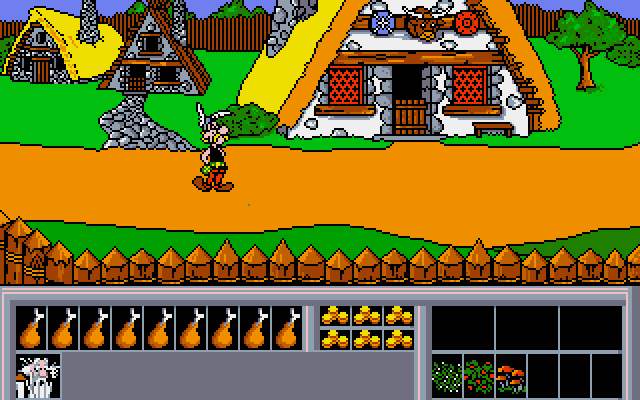
Not every ingredient on your shopping list can be found lying on the forest floor. Certain specialized items require money, forcing you to earn pocketfuls of coins through mini-games hidden around the map. You can sit down with gambling Romans or challenge Prolix, the fraudulent soothsayer who has set up camp near the village, to a game of rolling dice. Winning these bets gives you the cash needed to purchase rare supplies from local merchants.
Once you return to the village with an ingredient, gameplay shifts to a screen where you pour liquids into a cauldron. Mouse control in these mixing sequences can feel erratic if you move your pointer too quickly across the interface, a quirk stemming from how fast early MS-DOS execution timing ran on unthrottled processors. Precision drops significantly during these potion trials, making fine selection of ingredients fiddly.
Despite the control quirks, the payout for mixing a batch comes from watching the target's reaction. Feeding an untested brew to the tied-up Roman legionary results in absurd visual gags straight out of the French comic panels. Unfortunately, because there are dozens of wrong combinations and zero hint systems to narrow down the correct potion recipe, finding the winning mix is largely a process of brute-force trial and error.
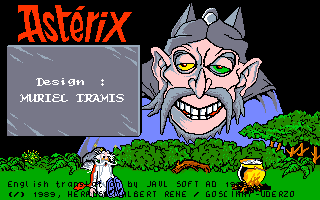
Conceived at French studio Coktel Vision under the direction of designer Muriel Tramis, this 1989 release served as a direct tie-in to the animated feature film Astérix et le coup du menhir. Built on Coktel's proprietary late-80s 2D engine, the game pushed 320x200 graphics that captured the expressive facial details of Uderzo's art style better than many contemporary 8-bit home console ports.
The audio presentation on MS-DOS machines was a mixed bag. The game included native support for multiple sound cards of the period, allowing players with a Sound Blaster card to hear punch audio cues and sound effects crisp, while PC speaker users had to settle for harsh internal beeps. However, composer Robin Aziosmanoff opted for a bizarre, frantic original melody for the main title, completely dropping Michel Colombier's orchestral soundtrack from the movie. Once you step into the actual gameplay screens, background music disappears almost entirely, leaving your long walks through the forest eerily quiet.
This project marked Coktel Vision's final time handling the Gaulish license before the publishing rights shifted over to companies like Infogrames and Sega. While period computer magazines like Génération 4 and Joystick handed out high review scores for the detailed sprite animation, domestic press like Power Play rated it as low as 38%, pointing out that behind the high-quality French art lay a shallow and repetitive structure.
Looking at the complete picture, the visual presentation of the Gaulish village remains wonderfully faithful to the source material, but the underlying game design fails to respect the player's time. The strict single-item inventory cap transforms what should have been a fun comic adventure into an exercise in endless walking. If you want a quick hit of late-80s European computer art, it is worth spending half an hour with it, but few players will have the patience to sit through the endless ingredient runs needed to reach the ending sequence.
You can play Astérix: Operation Getafix online free in your browser right now with no setup needed. When you jump into the DOS version, head straight into the woods to test out the F1 through F4 brawling keys on the first Roman patrol you meet, and sample the dice-rolling gambling game before the long walks back to the village start to wear on you.
In Astérix: Operation Getafix, you are tasked with curing the Gaulish village druid after Obelix accidentally knocks out his memory with a flying menhir, sending you on a quest across side-scrolling forests to fetch potion ingredients one single item at a time.
The core setup places you in the winged helmet of Asterix immediately after a tragic comic accident. Obelix has hurled a massive standing stone straight into Getafix, leaving the village druid giggling helplessly and unable to brew the magic potion that keeps the local Roman garrisons at bay. To find a cure, you must explore a connected side-scrolling landscape that stretches from the Gaulish village through dense woods and straight into a heavily guarded Roman camp.
Your goal is to gather trial ingredients scattered across the landscape, bring them back to the village, and mix them into experimental cauldrons. The game allows you to test these concoctions on either the confused druid himself or on a captured Roman legionary tied up near the center of the village. If a recipe fails, you get a short slapstick sequence showing the victim turning green, shrinking, or sprouting feathers, after which you must head back out to hunt down the next potential remedy.
The single biggest issue you face isn't the Roman army, but a restrictive design choice that forces Asterix to carry exactly one item in his inventory at any given moment. Whether you pick up a handful of strawberries, a bundle of bay leaves, or a freshly hunted wild boar, you must carry that lone item all the way back across multiple screens to the village cauldron. If the resulting potion does not cure Getafix, you turn right around and retrace your steps across the exact same fields to fetch another ingredient. What starts as a lighthearted exploration quickly devolves into a grueling trek back and forth across identical scenery.
Walking through the forest means surviving continuous hazards that attempt to wear down your energy bar. Aside from patrolling Roman legionaries and angry wild boars charging along the ground, the woods frequently rain down flying and falling fish that you must jump over or duck under. Movement feels slightly floating, but the character sprites drawn by Pierre Gilhodes and the graphics team closely mirror the visual style of the original comics.
Combat avoids simple button-mashing by binding your primary attack moves directly to the keyboard's top row. Rather than using standard joystick fire buttons, brawling relies on four function keys to deal with oncoming enemies:
While landing a solid F4 punch and watching a legionary fly into the sky is satisfying the first dozen times, the sheer density of enemies turns combat into an annoying roadblock. Because you are constantly forced to backtrack across the same paths to deliver single ingredients, fighting through the exact same boar spawns and soldier patrols over and over becomes exhausting long before you solve the potion formula.

Not every ingredient on your shopping list can be found lying on the forest floor. Certain specialized items require money, forcing you to earn pocketfuls of coins through mini-games hidden around the map. You can sit down with gambling Romans or challenge Prolix, the fraudulent soothsayer who has set up camp near the village, to a game of rolling dice. Winning these bets gives you the cash needed to purchase rare supplies from local merchants.
Once you return to the village with an ingredient, gameplay shifts to a screen where you pour liquids into a cauldron. Mouse control in these mixing sequences can feel erratic if you move your pointer too quickly across the interface, a quirk stemming from how fast early MS-DOS execution timing ran on unthrottled processors. Precision drops significantly during these potion trials, making fine selection of ingredients fiddly.
Despite the control quirks, the payout for mixing a batch comes from watching the target's reaction. Feeding an untested brew to the tied-up Roman legionary results in absurd visual gags straight out of the French comic panels. Unfortunately, because there are dozens of wrong combinations and zero hint systems to narrow down the correct potion recipe, finding the winning mix is largely a process of brute-force trial and error.

Conceived at French studio Coktel Vision under the direction of designer Muriel Tramis, this 1989 release served as a direct tie-in to the animated feature film Astérix et le coup du menhir. Built on Coktel's proprietary late-80s 2D engine, the game pushed 320x200 graphics that captured the expressive facial details of Uderzo's art style better than many contemporary 8-bit home console ports.
The audio presentation on MS-DOS machines was a mixed bag. The game included native support for multiple sound cards of the period, allowing players with a Sound Blaster card to hear punch audio cues and sound effects crisp, while PC speaker users had to settle for harsh internal beeps. However, composer Robin Aziosmanoff opted for a bizarre, frantic original melody for the main title, completely dropping Michel Colombier's orchestral soundtrack from the movie. Once you step into the actual gameplay screens, background music disappears almost entirely, leaving your long walks through the forest eerily quiet.
This project marked Coktel Vision's final time handling the Gaulish license before the publishing rights shifted over to companies like Infogrames and Sega. While period computer magazines like Génération 4 and Joystick handed out high review scores for the detailed sprite animation, domestic press like Power Play rated it as low as 38%, pointing out that behind the high-quality French art lay a shallow and repetitive structure.
Looking at the complete picture, the visual presentation of the Gaulish village remains wonderfully faithful to the source material, but the underlying game design fails to respect the player's time. The strict single-item inventory cap transforms what should have been a fun comic adventure into an exercise in endless walking. If you want a quick hit of late-80s European computer art, it is worth spending half an hour with it, but few players will have the patience to sit through the endless ingredient runs needed to reach the ending sequence.
You can play Astérix: Operation Getafix online free in your browser right now with no setup needed. When you jump into the DOS version, head straight into the woods to test out the F1 through F4 brawling keys on the first Roman patrol you meet, and sample the dice-rolling gambling game before the long walks back to the village start to wear on you.
How Astérix: Operation Getafix is played — the keys the game listens to, grouped by what they do.
Highlighted keys are mapped — hover or tap one to see what it does.
Key controls in combat default to function keys F1-F4. Mouse can optionally be used during menu prompts and ingredient mixing.
The on-screen keyboard and gamepad mapping the browser player uses on a phone, a tablet or a controller, as opposed to the real keys above. $PRO members make their own in the player and share them here; anyone can pick one to play with.
Cheat codes, console commands and memory pokes for Astérix: Operation Getafix — each one verified and attributed.
Sign in to submitHow Astérix: Operation Getafix is played — the keys the game listens to, grouped by what they do.
Highlighted keys are mapped — hover or tap one to see what it does.
Key controls in combat default to function keys F1-F4. Mouse can optionally be used during menu prompts and ingredient mixing.
The on-screen keyboard and gamepad mapping the browser player uses on a phone, a tablet or a controller, as opposed to the real keys above. $PRO members make their own in the player and share them here; anyone can pick one to play with.
Cheat codes, console commands and memory pokes for Astérix: Operation Getafix — each one verified and attributed.
Sign in to submit