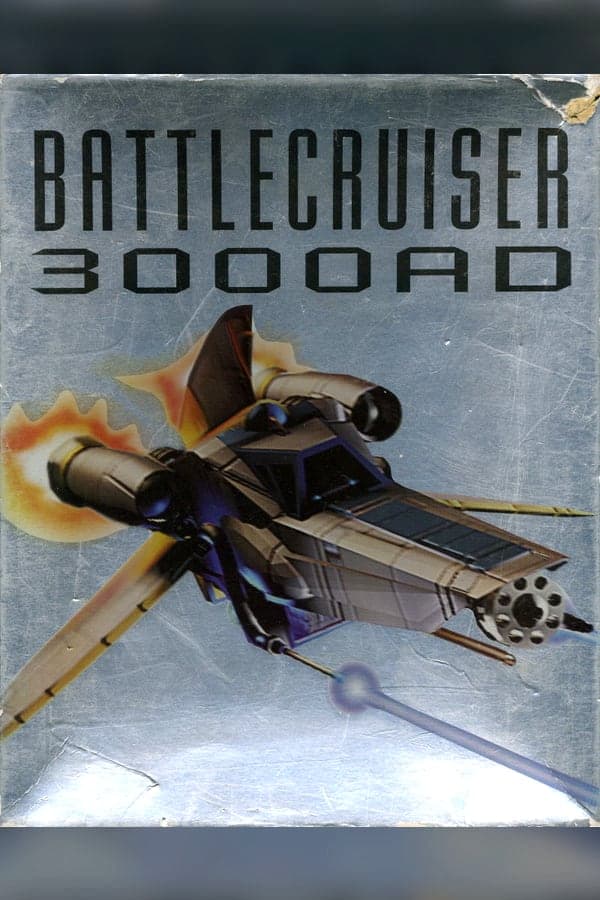
Battlecruiser 3000AD
Getting to grips with Battlecruiser 3000AD means staring down a wall of obscure acronyms on a bridge control view while attempting to steer a massive flagship across a galaxy without the executable dropping back to MS-DOS.
Commanding a flagship in Battlecruiser 3000AD
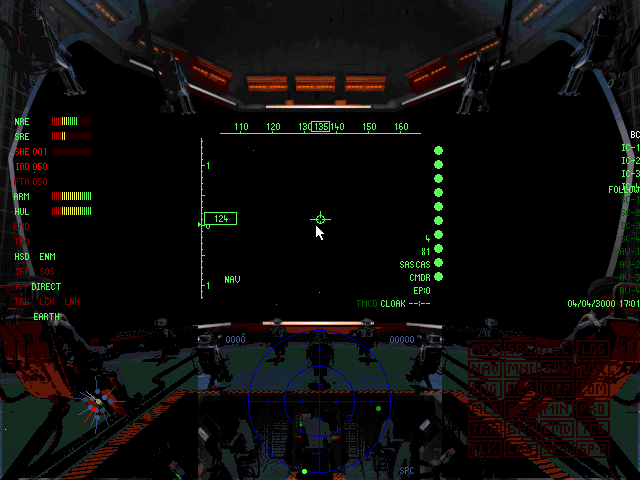
The first few minutes behind the command desk of a Galcom Battlecruiser feel less like pilot school and more like sitting in front of an active terminal inside an alien military compound. You sit in the primary commander seat, looking at dense readouts, star charts, and sub-system toggles while the threat of the hostile Gammulan Empire looms across the star sector. Instead of steering a nimble fighter with pitch and roll, your primary job is allocating power, managing crew assignments, deploying interceptor shuttles, and plotting long-range orbital coordinates.
Landing or conducting orbital ops requires precision tracking on the Tacops screen. Dropping crew or fighters onto planetary surfaces relies on precise geographic coordinates, like finding position 10888N, 8331E over Earth using a mouse overlay while keeping track of shields and generator loads. The game demands absolute attention to micro-management, asking you to order individual crew units around deck layouts and direct ground combat squads while tracking target vectors in real time.
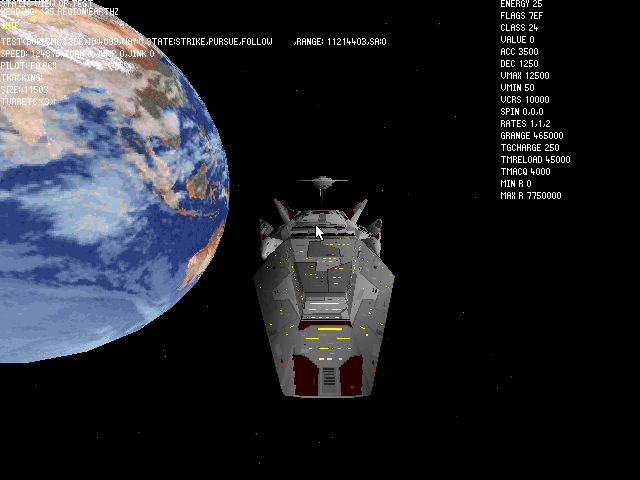
When starship engagements happen, you rarely dogfight directly in the main vessel. Instead, you launch smaller fighters and shuttles stored in your bays while coordinating defensive turrets from the bridge. The perspective locks you into a authentic commander viewport where long stretches of quiet flight turn into sudden panics over failing life support or sudden engine overloads.
Three ways to approach the galaxy
To help players digest the massive scale of its galaxy, developer 3000 AD organized the simulation into three separate play structures:
- Free Flight: An open sandbox mode where combat threats are removed, letting you learn ship systems, jump drives, and navigation without enemy starships shooting at your hull.
- Advanced Campaign Mode: The core narrative experience where dynamic alien civilizations react to your actions and alter mission parameters on the fly as the Gammulan conflict escalates.
- Xtreme Carnage Combat Simulator: A direct tactical training suite designed to jump straight into fire fights, dogfights, and gunnery practice.
The Advanced Campaign Mode remains the main attraction, attempting to simulate an unscripted, dynamic universe where non-player fleets carry out their own assignments regardless of where your ship is positioned. When it works, you witness full fleet battles unfolding across planetary orbits without any direct prompt from a linear mission trigger.
Ten years of promises, lawsuits, and exposed code
Designed by studio head Derek K. Smart, the initial production spanned nearly ten full years of development troubles and heated Usenet debates. Smart asserted that the game ran on a complex neural network designed to deliver unscripted artificial intelligence for crew members and enemy fleets. That ambitious scope created massive friction with publisher Take-Two Interactive, who forced the title onto store shelves in late 1996 to hit the holiday shopping rush before the code was stable.
The early boxed software reflected that rushed exit from the lab. Inside the main game file BC3000AD.DAT, players who opened the data tables found raw development code comments and unedited debugging strings left behind by the programmers. Despite the media chaos surrounding the launch, SEC filings later revealed that sales of the game generated 14.2% of Take-Two Interactive's overall revenue for that fiscal cycle.
Following a protracted legal fight over property rights that lasted over a year, Smart regained full ownership of the franchise in 1998. The developer patched the software, eventually releasing version 2.0 as a free download that quickly topped online file transfer charts for weeks.
The harsh reality of the 1996 release
When the software landed on store shelves in 1996, early reviews were brutally sharp. Computer Gaming World slapped the game with a score of 1 out of 5, while T. Liam McDonald at GameSpot refused to assign a numerical rating altogether. McDonald described the product as "one of the most bug-ridden, unstable, unplayable pieces of software ever released," summarizing its unfulfilled scope as "wishes sculpted in Jell-o."
The constant system lockups were bad enough, but the real headache was the total absence of clear documentation for a control setup that used almost every key on the keyboard. The manual in the box contradicted the actual key bindings, leaving you to guess how to power up weapons or clear room breaches. Traveling between star systems in standard flight modes took ages, which meant long stretches of staring at static space grids while praying the engine wouldn't crash back to the DOS prompt.
For those struggling through the unpatched initial code, built-in shortcuts became survival tools. Launching the executable with the command-line argument bc3000ad.exe /d1 enabled an internal debug mode, allowing players to instantly destroy targeted hostiles by pressing Alt + X. Another famous entry in the community cheat index was the string CowboyCurtis, used to bypass operational locks when ship systems froze completely.
Why you should test the bridge controls today
That initial release is a stark lesson in what happens when wild vision collides with firm shipping dates. Technical execution faltered, but few space games from the mid-nineties ever tried to simulate deck management, marine deployments, and galaxy-wide AI routines in a single package. If you bring some patience to it, learning how to manage crew assignments and balance reactor outputs yields a deep, uncompromising space simulation.
Modern players often assume the game is completely unplayable without heavy modern modding, but experiencing the raw DOS original reveals just how much design structure was already running under the hood. You can play Battlecruiser 3000AD online right here in your web browser, with zero setup and nothing to install. Load into the bridge, set your Tacops screen, and see if you can manage a capital starship against the Gammulan fleet.