Screenshot×61w ago
If you thought single-box Sokoban puzzles tested your patience, direct control of up to five cooperating ladybugs in Berusky will completely redefine how you look at grid-based logic.
AnakreoN expanded classic grid puzzles into a multi-bug nightmare
The screen opens on a clean top-down grid, looking simple until you notice that you are managing a full team of insects rather than a lone warehouse worker. In this 1999 release, your primary goal across every stage is to collect five distinct keys and clear an unobstructed path to the exit square. That sounds straightforward until you realize that one bug is trapped behind a wall of boulders, another is sitting on a one-way directional tile, and a third needs to haul explosives across the board without blocking its own return route.
Switching between bugs requires careful sequence planning because a single hasty step can seal off a corridor forever. Early training levels show you the basics of pushing blocks, but the design rapidly escalates into demanding spatial multi-tasking. If you leave Bug A standing in a narrow bottleneck, Bug B cannot carry the pickaxe needed to break through the stone barrier near the keys. You spend minutes staring at a static grid, mentally tracing six steps ahead for every character on the board before making your first actual move.
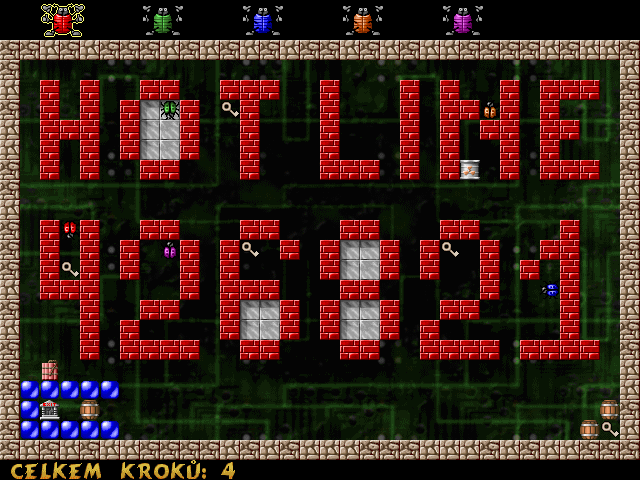
The fixed flip-screen layout forces absolute clarity. Because you see the entire puzzle from above at once, there are no hidden surprises lurking past the screen border, leaving every mistake squarely on your shoulders. It transforms this puzzle game into an exercise in strict mechanical discipline where success feels entirely earned.
The brutal shift from simple box pushing to tool management
Where basic block-pushing titles keep their rules light, this 1999 release introduces a whole catalog of logic items that alter how you interact with the board. Beyond standard pushable boxes and heavy stones, your insects encounter jackhammers to crush bedrock, pickaxes for brittle obstacles, and high-yield explosives capable of clearing tight chokepoints. Add colored keys tied to matching colored doors alongside directional one-way gates, and a level becomes a complex web of dependencies.
- Locate the colored keys to unlock matching security doors before moving heavy cargo.
- Clear directional obstacles with pickaxes or jackhammers without stranding the bug holding the tool.
- Position explosives carefully to breach hard barriers while preserving a path to the main exit.
- Coordinate all five bugs to gather the five main stage keys and reach the exit square together.
The main game offers around 120 levels spread across distinct difficulty sets, moving from introductory training up through easy, medium, and genuinely punishing hard sets. The difficulty curve does not gentle you into its late-game demands. By the time you reach the medium set, levels feel like tight engineering problems where using a tool out of order guarantees a hard reset.
For players who hit a total dead end, the developers included official level passwords and cheat codes. Typing a password lets you bypass a brick wall level, which was practically essential when trying to work through the later stages back in the late nineties.
Why Czech gaming magazines gave Berusky top billing on their cover CDs
Built by Czech developer AnakreoN for MS-DOS 5.x, the game was coded in raw C with modest visual demands. That lean codebase allowed it to run smoothly on modest home PCs that struggled with heavy 3D titles of the late nineties. Distribution took off when prominent Czech gaming publications like Level and Gamestar put the full game onto their cover CDs as a freeware feature, introducing it to thousands of players overnight.
The developers recorded over 20,000 downloads directly from their site, a serious figure for an independent European indie release at the end of the decade. The team eventually released the project under the open-source GNU GPL v2 license, opening the door for community updates. Developer BSzili later brought the title to Amiga hardware, and AnakreoN leveraged the foundation built here to release a full 3D sequel, Berušky 2, in 2004.
Level 17 and the quirks that came with early ports
No project from this era made the jump across modern platforms without a few rough patches. When early Windows conversions of the C codebase hit the web, players running through the middle difficulty set ran straight into a notorious crash bug on Level 17. The game would abruptly freeze or drop back to the desktop right as solutions were coming together, forcing players to wait for patch updates or skip the stage entirely with passwords.
Another persistent glitch cropped up on Easy Level 27, where specific tile interactions caused immediate application crashes. That flaw hung around through several distributions until the developers finally squashed it in version 1.7.2. These bugs left a mark on community memory, but the underlying puzzle architecture was strong enough that fans kept playing through the patch notes.
The real friction today isn't tech bugs, but the unrelenting strictness of the upper level sets. Miscalculating a single stone push thirty moves into an impossible-tier map leaves no room for recovery, demanding a full restart of the stage. It is an uncompromising design that expects complete precision from the player.
How to play Berusky free in your browser right now
You can run this full Berusky MS-DOS game straight from your web browser without hunting for floppy images or tweaking system config files. If you want to experience classic European puzzle design at its most rigorous, you can play Berusky online in seconds flat.
When you start your first session, jump into the training set to get comfortable with switching bug selection on the fly. You will immediately notice how heavy the movement feels and how crucial early space management is before moving a single crate. Clear the initial key rooms, save your pickaxes until you have mapped out the full board, and see how many stages you can solve before needing your first password skip.