Betrayal at Krondor
Streaming build
Checking storage…502 MB
Preload in background
Most role-playing games from 1993 locked you inside damp stone dungeons, but Betrayal at Krondor threw you onto an open, wind-swept road across Midkemia with a dark elf as a forced ally and barely enough gold for bread. Escorting Gorath to warn Prince Arutha creates an adventure where survival depends as much on whetstones and fire oil as it does on raw spellcraft.
Why Betrayal at Krondor abandons typical RPG dungeons for an open road
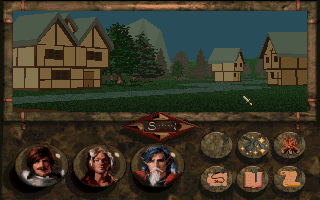
You begin Chapter I, titled Into A Dark Night, standing on a dirt path with three companions: Kingdom soldier Seigneur Locklear, a young mage named Owyn Beleforte, and Gorath, a renegade Moredhel dark elf who would just as soon cut your throat if he did not need your escort. Instead of staring at a wall inside a wireframe labyrinth, step-based movement pulls you forward across a sprawling 3D landscape rendered by developer Dynamix, Inc.. You can follow the road south toward Krondor or wander off into the grass to hunt down hidden supply caches and investigate roadside ambushes.
That freedom was unheard of in a 1993 role-playing (RPG) game. Instead of forcing you down linear corridors, the main quest to warn Prince Arutha about Delekhan's impending dark elf invasion sits alongside murder investigations, highway robberies, and distant villages that need help. Navigating three-dimensional underground caverns can admittedly turn clunky when you try to line up your steps, but the sheer expanse of the open world makes up for the awkward camera turns.
Tactical grid battles that reward patience and exact positioning
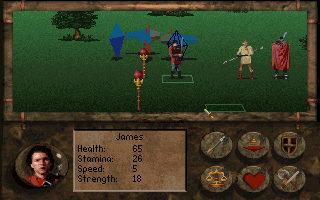
When an enemy militia or rogue assassin spots your party, the perspective shifts from first-person exploration to a turn-based tactical grid battle. Combat features digitized photos of live actors over 2D sprites, with rotoscoped animations for swings and spell casting. Victory requires careful management of distance, line of sight, and weapon status. If you attack an enemy with a chipped blade, your strikes slide off heavy armor, making item maintenance as critical as your turn strategy.
Early encounters hit hard, and a fresh party can bleed out within three turns if you charge in unprepared. I still remember turning a corner near Sethanon only to realize my party was out of rations, poisoned, and wielding rusted swords against a squad of Moredhel warriors. Keeping your party alive means stocking specific tools before leaving town:
- Whetstones and armor repair kits to keep blades sharp and chest plates intact after heavy combat.
- Poison and fire oil to coat weapon tips and increase damage against heavily armored bosses like Delekhan.
- Silverthorn anti-venom to purge deadly toxins inflicted by forest spiders and poisoned crossbow bolts.
- Spells like Eyes of Ishap to reveal enemy attributes and plan turn sequences around vulnerable targets.
Critics were divided on this design at launch. German magazine Power Play handed down a low 56% score, citing slow, sluggish turn-based grid movement and dated digitized visual capture. Yet publications like Electronic Games rated it at 97%, praising how tactical positioning and status management transformed standard fantasy combat into a thoughtful exercise.
The wordlock chests remain the finest riddles in MS-DOS history
You cannot talk about this title without mentioning the Moredhel wordlock chests scattered across Midkemia. Instead of relying on a thief's lockpick skill, these wooden boxes feature tumbler combinations where each dial displays letters. To open one, you must decipher a short poetic riddle hidden on the chest. Solving these puzzles rewards you with high-tier spells, silver coins, and crucial anti-venom, while entering a wrong combination triggers hidden traps that can wipe out an injured party.
The writing ties directly into the game's novel structure, written and designed by Neal Hallford alongside director John Cutter. Midkemia creator Raymond E. Feist granted the license and held editorial oversight, ensuring characters like Pug, James, and Patrus felt identical to their prose counterparts. The narrative unfolds across nine distinct chapters, spanning Chapter II: Shadow Of The Nighthawks to Chapter IX: Mad Gods Rage. The game even uses a chapter bookmark system for save states, emphasizing its structure as an interactive book.
How floppy disk stumbles led to a CD-ROM revival
Despite critical acclaim, initial floppy disk sales moved slowly. Publisher Sierra On-Line actually canceled a planned sequel titled Thief of Dreams when early retail numbers disappointed. The turnaround came in 1994 with the enhanced CD-ROM re-release, which replaced squeaky PC speaker audio with a rearranged General MIDI soundtrack composed by Jan Paul Moorhead. Glowing reviews followed, including a 94% score from Finnish magazine Pelit and the Role-Playing Game of the Year award from Computer Gaming World in June 1994.
By 1997, Sierra released the entire game as a free digital download to build hype for their spiritual successor, Betrayal in Antara. That move introduced a second wave of players to Midkemia, eventually leading to the official 1998 sequel Return to Krondor and a standalone novel adaptation by Feist himself. Cheat chest codes and debug commands embedded in the original code traded constantly on early internet message boards as fans mapped out every inch of the realm.
Play Betrayal at Krondor online without touching a floppy disk
The pacing drags during long cross-country treks, the 3D dungeon controls feel clumsy, and the early difficulty wall will crush anyone who skips reading item descriptions. Yet the deep tactical combat, brilliant wordlock riddles, and rich chapter storytelling hold up far better than most of its contemporaries. If you want to experience a classic Betrayal at Krondor MS-DOS game that treats your intelligence with respect, few adventures from the decade can pull you in so completely.
You can play Betrayal at Krondor online free in your browser right here, with no setup required. Running the game directly in your browser lets you jump straight into Chapter I, test your riddle skills on the first wordlock chest, and hear the full General MIDI music without hunting down vintage hardware.
How Betrayal at Krondor is played — the keys the game listens to, grouped by what they do.
- Action
- Interface
- Left click — Action button
- Right click — Examine button
Highlighted keys are mapped — hover or tap one to see what it does.
The complete listing of keyboard hotkeys from the Quick Reference Card was unavailable in source notes. Main interface is primarily driven via mouse point-and-click.
Players' controls
Touch and gamepad controls
The on-screen keyboard and gamepad mapping the browser player uses on a phone, a tablet or a controller, as opposed to the real keys above. $PRO members make their own in the player and share them here; anyone can pick one to play with.
Make your own touch controlsPRO
- 1Open the editorSign in below, then pick what to make. The game starts with the editor open over it.
- 2Place your keysAdd keys and drag them where your thumbs rest, or map a controller's buttons. Test plays the game with them; Save keeps them, and you play with them from then on.
- 3Share themShare them right after saving in the game, or name and share them here. Players vote, and the best become this game's controls for everyone.
Go PROSee how it worksSign in+20 XP for sharing · +50 XP if yours become the game's own
- The game's own controlsKeyboardGamepadWhat every player starts with.In use
3 screenshots
From the archive
No gameplay video yet
No gameplay video for Betrayal at Krondor yet. Sign in to add one.
No reviews yet
Tell the community what you think of Betrayal at Krondor. Reviews are public and tied to your username.
No archived manuals for Betrayal at Krondor yet
No manuals archived for this title yet. Sign in to upload the first scan.
Cheat codes, console commands and memory pokes for Betrayal at Krondor — each one verified and attributed.
Sign in to submitNo cheats yet for this title
Know a working cheat, poke or trainer? Add it with the button above. Moderators check every entry before it goes live.
No archived soundtrack for Betrayal at Krondor yet
No soundtrack archived for this title yet. Sign in to upload the first rip.
No save states for Betrayal at Krondor yet
No save states for this title yet. Sign in to share one.
Discussions
Sign in to post- Threads0
- Total posts0
- Online now6
Community · Betrayal at Krondor
Who's contributing, and what's new
- Reviews0
- Threads0
- Uploadsapproved0
- Contributors0
Recent activity
Nothing here yet
Reviews, discussion threads and approved uploads appear here as members add them.