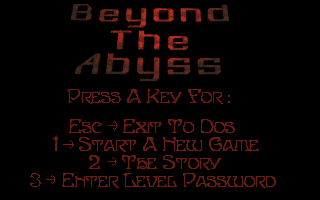
Beyond the Abyss
If you loaded up Beyond the Abyss expecting a smooth overhead dungeon crawler, your paladin was likely killed by stray monster fire before you even reached the first locked gate.
The 1994 arcade maze formula meets shareware fantasy
When flat maze shooters were competing with early 3D corridors, top-down action games had to lean on fast movement and dense wave combat to stay exciting. Developers tried to translate arcade staples into sprawling home computer levels that kept players typing passwords late into the night. Nowhere Software pitched their own answer to this formula with Beyond the Abyss, putting players in control of a single warrior fighting through linear underground passages.
You play as Roman, a paladin living near the village of Olin. The tyrant Medak has dispatched a legion of magical beasts to destroy Olin Castle. The only route connecting Medak's realm to the surface world is a subterranean death trap called the Abyss. Roman has to march into the darkness, clear out Medak's beasts, and storm the villain's fortress level by level.
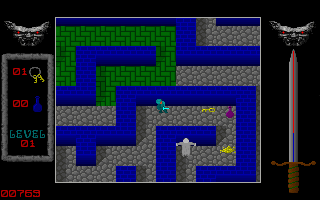
The campaign spans eighteen levels in the commercial version, though PC gamers in 1994 mostly knew the three-level shareware distribution. The opening map takes place in the wet drainage passages right under Olin Castle, forcing you to adjust to narrow stone paths. From there, Roman travels through arid outdoor deserts before rising up to Strato, a city floating in the sky. It is a classic medieval sequence, but the overhead view treats every biome as a claustrophobic puzzle grid.
Why fighting through Medak's maze feels like a trap
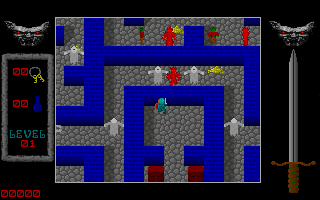
The moment-to-moment action follows classic top-down tropes, but the execution hits an immediate snag. Roman moves through mazes collecting color-coded keys, guzzling red health potions, and searching for exit portals marked by a distinct cross and half-circle emblem. Along the way, red statues left behind by fallen adventurers offer cryptic clues about what lies deeper in the dungeon.
The problems start as soon as you meet your first group of monsters. Combat relies on firing small projectiles down tight corridors, but your attack hitboxes are surprisingly small. Your tiny shots constantly pass right by enemy sprites or get caught on corner geometry, while enemy projectiles track your position without missing. Because the maze halls are barely wider than Roman's own sprite, dodging incoming fire is rarely an option.
This design creates a loop where taking damage is almost unavoidable. Instead of rewarding nimble circle-straffing or careful corner peeking, fights turn into brute-force trades. You end up hoarding health potions just to survive basic rooms, praying your shots register before your health bar drops to zero. That stiffness made the game a tough sell even among hardened action fans who were used to unforgiving shareware combat.
Key items, level passwords, and stubborn hitboxes
Progress relies heavily on systematic maze scrubbing. If you miss a single key tucked inside a dark alcove, you cannot advance through the locked doors standing between you and the exit portal. Here is what you need to track during a typical level run:
- Keys required to unlock matching gates blocking the main path.
- Health potions to offset the mandatory damage taken in narrow hallways.
- Red statues that drop environmental hints and lore tidbits.
- Exit seals combining a cross and half-circle to reveal the level password.
The password feature meant you did not have to start from scratch every session, which was a huge relief given how frequently Roman dies to fast-moving projectiles. Yet even with passwords, replaying a level feels tedious when the combat hitboxes work against you. Reviewers at the time noted that despite solid presentation ideas, the frustrating hit detection turned routine firefights into a chore.
When independent team Nowhere Software created and self-published the title, they clearly aimed for the frantic pace of coin-op arcade shooters. But without responsive collision routines, the high enemy density backfires. You spend more time wrangling clunky shooting angles than enjoying the progression through Medak's territories.
Is this DOS fantasy shooter worth your time today?
As an action game, Beyond the Abyss sits in a strange spot. It has decent environmental variety for a low-budget shareware project, and the fantasy framing gives Roman's quest a solid sense of place. Moving from gloomy sewer channels to open desert sands and sky palaces keeps the visual theme fresh across the full campaign.
Unfortunately, the underlying mechanics never quite come together. The combination of narrow corridors, microscopic shot hitboxes, and non-stop enemy attacks makes normal play feel unfair rather than challenging. It shows how small balance oversights and collision issues can derail an otherwise capable arcade blueprint.
If you enjoy obscure 1990s shareware, playing the Beyond the Abyss MS-DOS game offers an intriguing look at how small studios tackled top-down combat before standard twin-stick controls existed. Just do not expect the smooth shooting or tight collision box polish of its big-budget contemporaries.
How to experience Beyond the Abyss online right now
You do not need an old computer stack or complex software setups to test Roman's paladin skills today. You can play Beyond the Abyss online right here on this page, loading the shareware release directly in your web browser. If you want to sample Beyond the Abyss free in your browser, launch Level 1 and see if you can make it past the sewer beasts without draining your very first health potion.