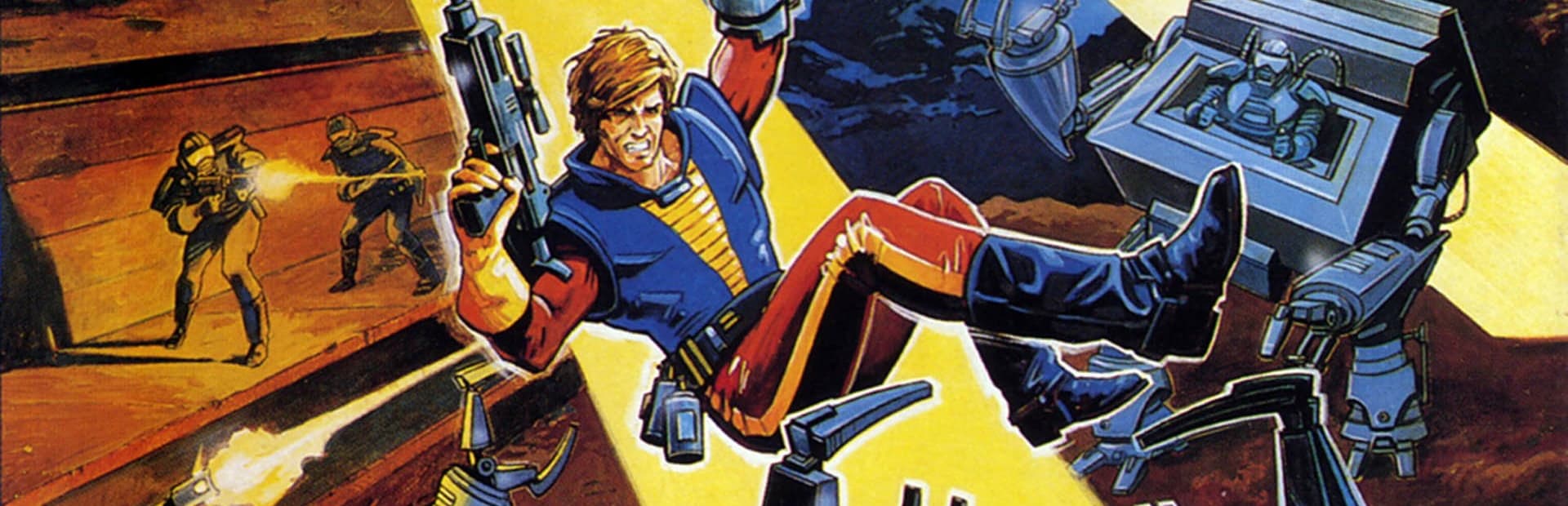
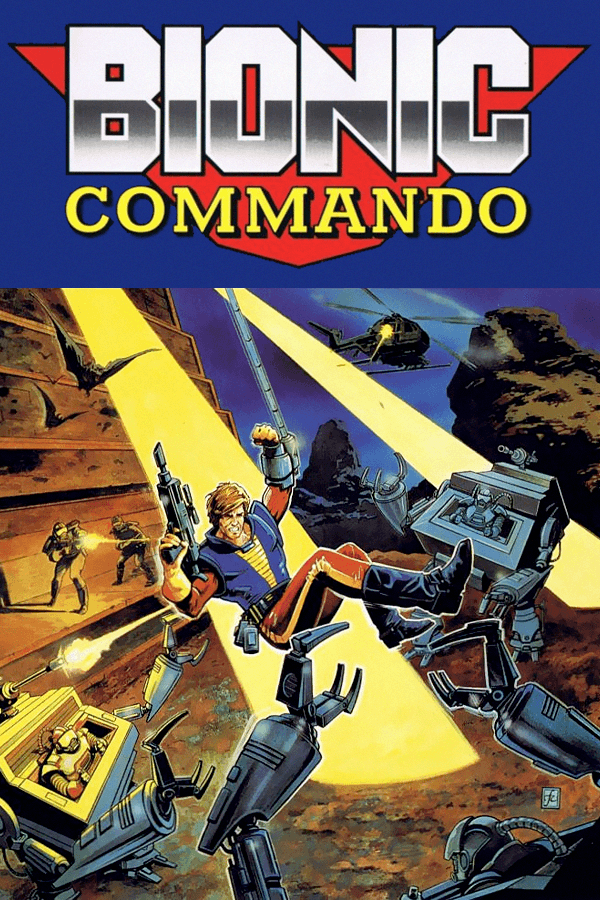

Capcom's 1987 arcade hit Bionic Commando stood out in arcades because it completely removed the jump button, replacing it with an extendable mechanical arm that let you swing across chasms and scale multi-tier fortresses. When Pacific Dataworks International brought the title to home computers a year later, that clever momentum-based traversal collided directly with the harsh realities of standard PC keyboards and internal speakers.
The MS-DOS port trades smooth arcade physics for keyboard acrobatics
Most side-scrolling action games from this era relied on simple muscle memory: hit spacebar to jump over a pit, hold a directional key to run, and press a button to shoot. Bionic Commando threw that template out the window by forcing you to latch onto overhead girders, swing through carefully timed arcs, and reel yourself up onto higher ledges. When you timing is right, scaling a tower without touching the ground feels fast and deliberate.
On a home computer in 1988, however, executing those momentum-based swings was anything but intuitive. Without an arcade joystick, trying to aim your mechanical claw diagonally while moving meant holding down three standard keyboard keys at once. If your keyboard suffered from hardware ghosting, the command simply failed to register, sending your soldier plunging straight into the hazard below.
The original arcade game was designed by Tokuro Fujiwara at Capcom Co., Ltd. under the name Top Secret, engineered around tight analog stick control and custom arcade hardware. Porting that experience to early PC hardware required compromise, but Pacific Dataworks International pushed the release out quickly under license for Capcom U.S.A., Inc.. The end result captured the core mechanical loop, but sacrificed much of the arcade original's fluid movement in translation.
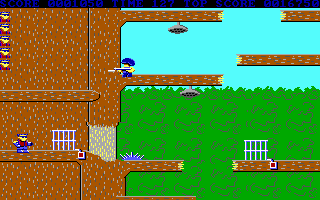
Grappling and shooting in the Bionic Commando MS-DOS game
Your objective across the campaign is straightforward: infiltrate a heavily fortified enemy base, rescue missing operative Super Joe, and destroy the enemy's launch computer to eliminate Generalissimo Kilt's forces. Doing so requires navigating complex, multi-story layouts filled with aggressive infantry, stationary gunners, and hazardous drop-offs. Because you cannot jump, positioning relative to the ceiling and nearby platforms dictates every single firefight.
The extendable arm is not merely a tool for climbing; it doubles as an offensive utility during combat engagements. You can extend the claw horizontally to reel in oncoming soldiers, pull yourself directly toward heavy enemies to close the gap, or push threats away when you get cornered. Mastering these mechanical interactions is essential for surviving the late-stage interior bases:
- Firing the hook straight up to winch yourself onto higher catwalks while dodging enemy crossfire.
- Latching onto ceiling beams at full speed to launch across wide floor gaps that lack solid footing.
- Hooking enemies directly to break their attack patterns and reposition them for a point-blank shot.
- Using overhead structures as temporary shields against low-angle turret fire from ground emplacements.
Unfortunately, the PC version adds severe input friction to these maneuvers. Standard movement feels sluggish, and adjusting your swing angle mid-air requires exact input sequences that are easy to misfire on a numeric keypad or arrow cluster. The core combat concept remains brilliant, but the keyboard layout turns routine platforming into an exercise in high-stakes precision.
Pacific Dataworks rushed the tech right into the PC speaker
Visually, the Bionic Commando MS-DOS game offers standard 16-color EGA graphics, but it fails to utilize the palette effectively. Background textures appear muddy and dark, making it hard to distinguish between solid, grapple-ready platforms and background decorations. Compared to other 1988 PC releases, the presentation lacks sharpness, giving the visual conversion the distinct feel of a rushed commercial translation.
The audio presentation suffers an even harsher fate. The port relies entirely on the system's internal PC Speaker, omitting any sound card support whatsoever. Instead of driving arcade synth lines or heavy bass hits, major gunshots and explosion sound effects resolve into tiny, single-channel beeps and clicks that barely punctuate the action on screen.
This lack of audio depth hurts the overall pacing. In an arcade cabinet, dramatic sound queues provided audio feedback whenever your claw latched successfully onto a platform edge. On the PC, you are left playing largely in near-silence, relying solely on visual cues to confirm whether your cable caught the girder or slipped past it.
Frustration wins out when precision platforming lacks a jump button
Looking back at the conversion today, the core design idea still deserves credit for daring to break side-scroller conventions. The grapple-swing mechanic offered a completely different way to read vertical space in a two-dimensional game. When you string together three clean swings across a room full of hazards, you get a quick glimpse of what made the arcade original famous.
However, as a PC port, the title struggles under its own technical limitations. The awkward multi-key aiming system, unforgiving level design, and total lack of mid-stage checkpoints mean that small control mistakes send you back to the start of a level repeatedly. It is a harsh design that rewards patience, but punishes anything less than strict input execution.
If you are a retro enthusiast curious about early grapple physics, it is worth exploring for its mechanical oddities alone. Just be prepared to fight the movement system as much as Generalissimo Kilt's army. It is an intriguing piece of late-eighties arcade port history, even if it is far more stubborn than its console counterparts.
You can play Bionic Commando online right in your web browser
If you want to test your timing against late-eighties arcade platforming, you can play Bionic Commando online for free right here in your web browser. There is nothing to install and no complex key mapper to configure before jumping straight into the mission.
Take five minutes to load up the first stage and attempt a three-point ceiling swing across the introductory enemy compound. Experiencing the total absence of a traditional jump button firsthand explains instantly why this experimental control scheme fascinated players and frustrated PC gamers back in 1988.