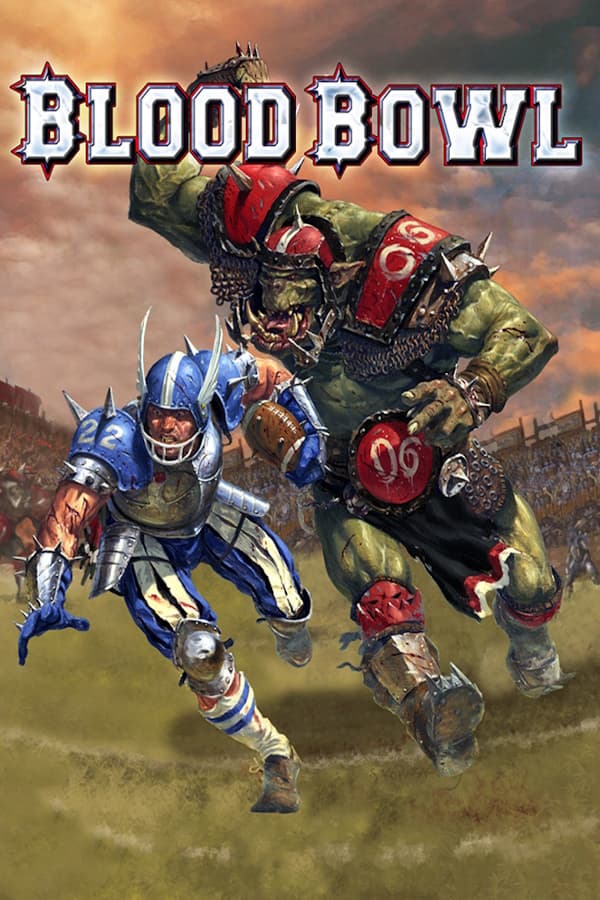

The 1995 MS-DOS release of Blood Bowl demands that you balance precise tactical positioning with constant violence, turning Games Workshop's famous board game into a brutal turn-based struggle on a digital grid.
Adapting a tabletop game to early personal computers always meant choosing between visual flair and mechanical precision. Destiny Software Productions took Jervis Johnson's board game design and ported the rules almost line for line, creating a strategy title where a single misstep or failed dice roll immediately ends your turn. You take charge of squads like The Elfheim Eagles, The Champions of Death, or The Underworld Creepers, managing rosters across single exhibition matches or a multi-game league mode.
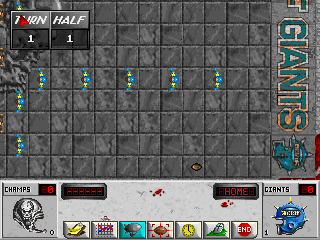
Every match takes place on a top-down pitch where you direct your players to move, throw passes, block opponents, or simply kick grounded rivals while the referee is looking the other way. Victory comes from scoring touchdowns by getting the ball into the end zone, but a viable strategy is simply beating the opposing squad into hospital beds until nobody is left to stop your ball carrier. Random events like pitch invasions keep matches unpredictable, while winning games grants your players random stat upgrades across a season.
The top-down view works well for planning complex running lanes and walling off key receivers, especially compared to the clumsy 3D cameras of later sports titles. However, the game strips out the special play cards from later physical editions, focusing instead on core positioning, blocking dice, and armor checks.
While the mechanics copy the tabletop rules faithfully, the implementation shows serious technical flaws. Computer Gaming World gave the title a modest 2.5 out of 5, while PC Gamer US settled on a 71 percent score, with reviewer Dan Bennett pointing out that the slow computer opponent severely hampered the single-player experience. The biggest flaw on the box was plain deception: MicroLeague advertised modem play prominently on the packaging, yet shipped a final game that completely lacked any online or network multiplayer support.
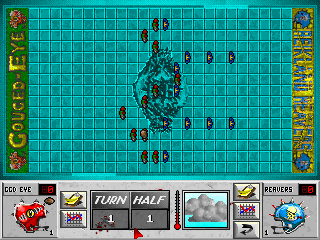
The artificial intelligence makes tactical blunders that frustrate purists. Even when controlling heavy, slow-moving running squads like Dwarves, the computer insists on attempting long passing plays rather than bashing through your front line. This bizarre behavior undermines the distinct playstyles of the various fantasy races, turning powerful front-line teams into predictable target practice.
The interface and presentation also leave much to be desired. Modern players attempting to run the game under emulation often hit a hard crash right at startup because the code expects the game files to exist in a rigid root directory structure, specifically requiring data folders like VOICE and ART inside a precise folder path, or it fails to find its primary graphics library, art.wad.
Success on the field relies on managing risk and executing your actions in the correct order every turn. Because any failed action instantly hands control over to your opponent, a safe turn follows a strict sequence:
If you play strictly by those rules, you can consistently beat the weak computer opponent despite its odd tactical choices. The satisfaction comes from watching a carefully orchestrated wall of Orcs punch a hole through an Elf defensive line, leaving your runner an open path to the end zone while digitized voice samples cheer from the speakers.
Compared to other 1995 strategy titles, this adaptation sits in a strange spot. It lacks the polish of contemporary strategy heavyweights, but it nails the cruel, statistical tension of the board game better than many believed a mid-nineties PC could manage. Sound support makes good use of digitized voice clips for ambient crowd noises and referee calls, adding welcome atmosphere to the pitch actions.
What holds up today is the uncompromising turn-based puzzle at the heart of every drive. What fails to hold up is the murky visual palette, the brain-dead passing AI for heavy teams, and the total lack of the promised head-to-head modem connection. If you want a quick hit of tactical fantasy football without wrestling with installation paths, it is still a solid slice of sports strategy history.
You can play Blood Bowl free in your browser right now, running the full DOS version complete with digitized audio and full league modes directly in your tab without touching a setup script. Line up your green-skinned linemen, protect your ball carrier, and see if you can pull off a touchdown drive without rolling an early turnover.
The 1995 MS-DOS release of Blood Bowl demands that you balance precise tactical positioning with constant violence, turning Games Workshop's famous board game into a brutal turn-based struggle on a digital grid.
Adapting a tabletop game to early personal computers always meant choosing between visual flair and mechanical precision. Destiny Software Productions took Jervis Johnson's board game design and ported the rules almost line for line, creating a strategy title where a single misstep or failed dice roll immediately ends your turn. You take charge of squads like The Elfheim Eagles, The Champions of Death, or The Underworld Creepers, managing rosters across single exhibition matches or a multi-game league mode.
Every match takes place on a top-down pitch where you direct your players to move, throw passes, block opponents, or simply kick grounded rivals while the referee is looking the other way. Victory comes from scoring touchdowns by getting the ball into the end zone, but a viable strategy is simply beating the opposing squad into hospital beds until nobody is left to stop your ball carrier. Random events like pitch invasions keep matches unpredictable, while winning games grants your players random stat upgrades across a season.
The top-down view works well for planning complex running lanes and walling off key receivers, especially compared to the clumsy 3D cameras of later sports titles. However, the game strips out the special play cards from later physical editions, focusing instead on core positioning, blocking dice, and armor checks.
While the mechanics copy the tabletop rules faithfully, the implementation shows serious technical flaws. Computer Gaming World gave the title a modest 2.5 out of 5, while PC Gamer US settled on a 71 percent score, with reviewer Dan Bennett pointing out that the slow computer opponent severely hampered the single-player experience. The biggest flaw on the box was plain deception: MicroLeague advertised modem play prominently on the packaging, yet shipped a final game that completely lacked any online or network multiplayer support.
The artificial intelligence makes tactical blunders that frustrate purists. Even when controlling heavy, slow-moving running squads like Dwarves, the computer insists on attempting long passing plays rather than bashing through your front line. This bizarre behavior undermines the distinct playstyles of the various fantasy races, turning powerful front-line teams into predictable target practice.
The interface and presentation also leave much to be desired. Modern players attempting to run the game under emulation often hit a hard crash right at startup because the code expects the game files to exist in a rigid root directory structure, specifically requiring data folders like VOICE and ART inside a precise folder path, or it fails to find its primary graphics library, art.wad.
Success on the field relies on managing risk and executing your actions in the correct order every turn. Because any failed action instantly hands control over to your opponent, a safe turn follows a strict sequence:
If you play strictly by those rules, you can consistently beat the weak computer opponent despite its odd tactical choices. The satisfaction comes from watching a carefully orchestrated wall of Orcs punch a hole through an Elf defensive line, leaving your runner an open path to the end zone while digitized voice samples cheer from the speakers.
Compared to other 1995 strategy titles, this adaptation sits in a strange spot. It lacks the polish of contemporary strategy heavyweights, but it nails the cruel, statistical tension of the board game better than many believed a mid-nineties PC could manage. Sound support makes good use of digitized voice clips for ambient crowd noises and referee calls, adding welcome atmosphere to the pitch actions.
What holds up today is the uncompromising turn-based puzzle at the heart of every drive. What fails to hold up is the murky visual palette, the brain-dead passing AI for heavy teams, and the total lack of the promised head-to-head modem connection. If you want a quick hit of tactical fantasy football without wrestling with installation paths, it is still a solid slice of sports strategy history.
You can play Blood Bowl free in your browser right now, running the full DOS version complete with digitized audio and full league modes directly in your tab without touching a setup script. Line up your green-skinned linemen, protect your ball carrier, and see if you can pull off a touchdown drive without rolling an early turnover.
How Blood Bowl is played — the keys the game listens to, grouped by what they do.
Highlighted keys are mapped — hover or tap one to see what it does.
Run INSTALL.EXE to configure game and audio settings. Full command mapping documentation is incomplete in available records.
The on-screen keyboard and gamepad mapping the browser player uses on a phone, a tablet or a controller, as opposed to the real keys above. $PRO members make their own in the player and share them here; anyone can pick one to play with.
Cheat codes, console commands and memory pokes for Blood Bowl — each one verified and attributed.
Sign in to submitaka Blood Bowl: The Game of Fantasy Football
How Blood Bowl is played — the keys the game listens to, grouped by what they do.
Highlighted keys are mapped — hover or tap one to see what it does.
Run INSTALL.EXE to configure game and audio settings. Full command mapping documentation is incomplete in available records.
The on-screen keyboard and gamepad mapping the browser player uses on a phone, a tablet or a controller, as opposed to the real keys above. $PRO members make their own in the player and share them here; anyone can pick one to play with.
Cheat codes, console commands and memory pokes for Blood Bowl — each one verified and attributed.
Sign in to submit