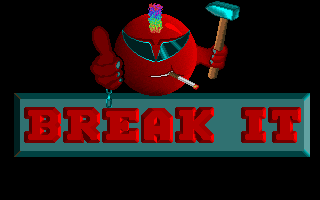
If you spent any part of 1995 hunting through shareware floppies, you likely ran into Break It, a brick-busting action title that pushed the traditional paddle format into faster, messier territory.
What Break It actually brings to the table
By the mid-1990s, the classic block-breaking formula had already been refined by arcade mainstays, yet PC shareware authors kept finding ways to tweak the template. WSP-Software released Break It as a shareware title designed for basic DOS PCs, pitching a fast-moving arcade challenge directly to desktop players. Rather than completely reinventing the wheel, the game focuses on delivering immediate, responsive ball control across screen after screen of densely packed layouts.
When you start a round, the setup looks straightforward enough: a paddle sitting at the bottom of the screen, a lone ball ready to launch, and a wall of geometric blocks waiting above. The difference shows up the second the ball hits your paddle at an awkward angle. Movement is crisp, and managing the bounce vector demands quick reflexes if you want to keep the ball from slipping past your bottom boundary.
As an action game built around simple inputs, the main draw comes from clearing dense brick arrangements while balancing risks. Some blocks require multiple hits to shatter, while others disappear instantly, altering the bouncing rhythm on the fly. You constantly calculate whether to aim for a clear narrow channel to send the ball into the top reservoir or play it safe near the lower guard line.
Power-ups change how you handle the ball
The core momentum shifts whenever shattered blocks drop power-up capsules down toward your paddle. Catching a drop might widen your board, give you extra lives, or grant laser capabilities that let you blast through stubborn bricks without waiting for ball bounces. Other items alter the speed of the ball, forcing you to quickly readjust your timing from a casual pace to a frantic sprint.
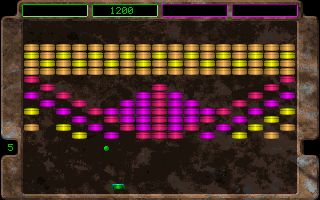
Not every item drop works in your favour, though. Snatching the wrong icon can shrink your paddle down to a sliver or send the ball zooming past your defenses before you can react. Learning which falling shapes to catch and which ones to dodge becomes just as important as keeping your eye on the main ball.
This risk system keeps you moving across the lower screen continuously. If you get greedy for a laser upgrade, you might drop the active ball and lose a life anyway. That constant decision-making prevents late-stage levels from feeling like standard mechanical repetition.
Where the DOS version of Break It gets stubborn
Every classic PC title has its frustrating quirks, and this 1995 release is no exception. The difficulty curve can spike without warning, dropping you into layouts where initial angles leave almost zero room for error. A single bad rebound right off the launch can send the ball straight into a side pocket and down past your paddle before you even register the motion.
The audio presentation also reflects its shareware roots. On standard PC speakers, the rhythmic bleeps and boops of bouncing off hard surfaces can get grating during extended sessions. Running the game through a proper Sound Blaster setup cleans up the audio feedback, giving each hit a punchier sound that fits the rapid pace on screen.
Control input can also feel unforgiving depending on your setup. While keyboard controls respond instantly, tracking high-speed rebounds across the entire screen width requires precise tap-steering. If you misjudge a paddle stop by a fraction of a second, the ball slips past, ending a promising high-score run on the spot.
Why fans of paddle games still talk about Break It
Despite the steep spikes in difficulty, the game captures what made shareware releases from WSP-Software so easy to pick up during the MS-DOS era. The levels do not waste your time with lengthy intros or bloated menus; you load the executable, hit start, and immediately begin managing trajectories.
The variety in level construction keeps runs interesting. Certain stages line up indestructible barriers that force you to work around awkward angles, while others stack multi-hit blocks into thick walls that require concentrated hits to break through. Successfully threading the ball into the empty space behind a block wall, watching it ricochet around rapidly to clear a dozen bricks in seconds, remains immensely satisfying.
For anyone who spent hours trying to top local scoreboards on early office PCs, the formula holds a very specific charm. It is pure reflex testing, unburdened by narrative filler, where a good run depends entirely on hand-eye coordination and spatial awareness.
Give Break It a spin directly in your browser
If you want to experience this solid slice of PC arcade history, you can play Break It online free in your browser right here. There is no software to install and no setup routine to fiddle with, letting you jump straight into the paddle action within seconds.
Playing the Break It MS-DOS game today reveals just how tight the ball physics and paddle movement really were. The tactile responsiveness of aiming a tricky bank shot into a narrow gap is something static screenshots simply cannot convey. Launch the game directly above, keep your eyes on the falling item drops, and see how many stages you can clear before running out of lives.
How Break It is played — the keys the game listens to, grouped by what they do.
- Interface
Highlighted keys are mapped — hover or tap one to see what it does.
The control map in the source notes is incomplete.
Players' controls
Touch and gamepad controls
The on-screen keyboard and gamepad mapping the browser player uses on a phone, a tablet or a controller, as opposed to the real keys above. $PRO members make their own in the player and share them here; anyone can pick one to play with.
Make your own touch controlsPRO
- 1Open the editorSign in below, then pick what to make. The game starts with the editor open over it.
- 2Place your keysAdd keys and drag them where your thumbs rest, or map a controller's buttons. Test plays the game with them; Save keeps them, and you play with them from then on.
- 3Share themShare them right after saving in the game, or name and share them here. Players vote, and the best become this game's controls for everyone.
Go PROSee how it worksSign in+20 XP for sharing · +50 XP if yours become the game's own
- The game's own controlsNone yet: played with a real keyboard only.In use
2 screenshots
From the archive
No reviews yet
Tell the community what you think of Break It. Reviews are public and tied to your username.
No archived manuals for Break It yet
No manuals archived for this title yet. Sign in to upload the first scan.
Cheat codes, console commands and memory pokes for Break It — each one verified and attributed.
Sign in to submitNo cheats yet for this title
Know a working cheat, poke or trainer? Add it with the button above. Moderators check every entry before it goes live.
No archived soundtrack for Break It yet
No soundtrack archived for this title yet. Sign in to upload the first rip.
No save states for Break It yet
No save states for this title yet. Sign in to share one.
Discussions
Sign in to post- Threads0
- Total posts0
- Online now6
Community · Break It
Who's contributing, and what's new
- Reviews0
- Threads0
- Uploadsapproved0
- Contributors0
Recent activity
Nothing here yet
Reviews, discussion threads and approved uploads appear here as members add them.