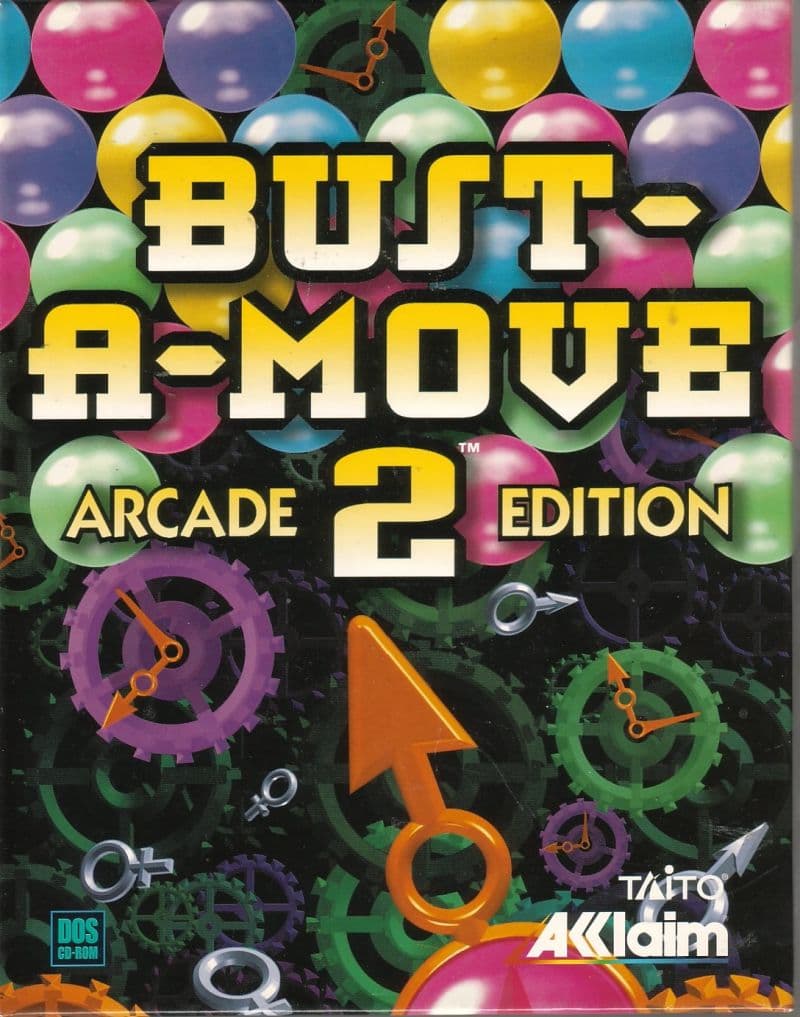
Bust-A-Move Again
Streaming build
Checking storage…298 MB
Preload in background
Line up the pointer, bounce a bright orb off the glass sidewall, and watch a massive cluster of bubbles drop down the screen in Bust-A-Move Again, Taito's 1996 arcade puzzle port.
Bank shots, chain reactions, and the pressure of the falling ceiling
The core trick of Taito's matching classic looks simple on paper: you swivel a gear-driven pointer at the bottom of a narrow well, aiming a colored bubble into a field of descending spheres. Match three or more of the same color and they snap out of existence. But clearing direct matches alone will get you killed by level three. The real game lies in identifying the root bubbles holding up massive multi-colored clusters and severing them at the joint, sending a dozen unpopped spheres tumbling down for massive drop-down bonus points.
Every few shots, a audible metallic clunk echoes as the upper ceiling drops down a notch, crushing your operating space. If any bubble breaks past the deadline marked at the bottom of the pit, your run ends immediately. To survive the later arrangements, you have to master wall bank shots. Bouncing a shot at an acute angle off the left edge to wedge it into a microscopic gap on the right side of the board is the difference between clearing a stage and suffocating under a low ceiling.
The pacing never lets you relax. Designed originally by Seiichi Nakakuki, the layout forces split-second geometric calculations. You spend half your time praying for a blue bubble to clear your bottleneck, and the other half agonizing over whether to take a safe direct pop or risk a bank shot that could accidentally seal off your only open channel.
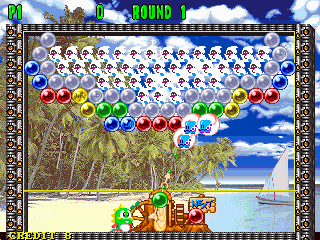
Branching world maps and the brutal reality of CPU matches in Bust-A-Move Again
Unlike standard linear arcade puzzle games, the single-player campaign structures its levels across a branching map reminiscent of Darius. After completing a zone of five levels, you choose between two lettered paths, such as branching from Zone A toward Zone B or C. This branching map gives you 30 total zones across a full tree, meaning a single complete run only exposes a fraction of the total puzzle setups designed for the game.
If you prefer head-to-head competition, the title includes both a local two-player mode and a single-player CPU tournament. In competitive mode, making drop-down combos or popping four or more bubbles simultaneously dumps gray nuisance bubbles directly onto your opponent's playfield. The CPU opponents do not play like humans: higher-tier computer characters possess perfect aiming trajectories, calculating pixel-precise wall bounces instantaneously without missing a beat.
The difficulty scaling in the CPU tournament hits an absolute wall around the fourth match. While the early opponents linger and make human-like mistakes, late-stage opponents will routinely execute four-tier garbage transfers before your third shot even leaves the launcher. It is a harsh, unforgiving arcade loop designed to consume quarters, translated directly onto home monitors.
How Taito brought Puzzle Bobble 2 to the MS-DOS platform
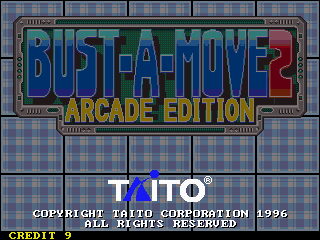
Originally running in arcades on Taito's F3 System hardware under the title Puzzle Bobble 2, the home conversion was published by Acclaim Entertainment, Inc. to bring the coin-op directly to PC owners. Programmers Hiroshi Maruyama and Junichiro Noguchi carried over the frame-exact physics and sprite work of the arcade original, ensuring that bubble collisions match the cabinet down to the individual pixel.
Character designer Kazuhiro Kinoshita populated the roster with cute dragon protagonists Bub and Bob alongside a cast of strange fantasy opponents. Western releases underwent localization edits, replacing some animated character models on the side panels with minimalist floating hands. However, the arcade heritage remains intact under the hood: entering specific button holds at the map screen triggers a known arcade cheat code that unlocks the hidden playable CPU cast and brings back those regional variant characters.
Audio was handled by members of Taito's sound team Zuntata, including Norihiro Furukawa, Kazuko Umino, Yasuko Yamada, and Shuichiro Nakazawa. Played through a standard Sound Blaster card on a 1996 PC, the synthesized music tracks keep up a frantic tempo that matches the ticking down of your shot clock. The springy popping sounds and punchy drop-down cues give real weight to large clears.
Where the MS-DOS version stumbles and why it still holds up
For all its snappy physics, the PC port carries a few persistent mechanical flaws that will test your patience:
- The pointer sensitivity on keyboard controls lacks micro-stepping precision, making extreme bank shots harder to line up than they were on an arcade joystick.
- The sudden difficulty spike in the CPU tournament mode feels blatantly unfair, as the AI skips the natural human delay needed to calculate shots.
- The lack of an onscreen aiming sightline means you must memorize geometry angles purely through trial and error.
- Later puzzle maps in the upper branching zones place unreachable key bubbles behind massive solid blocks that leave virtually zero room for error.
Compared to rival releases of 1996, Taito Corporation kept the focus firmly on immediate spatial action. There are no overly complex secondary mechanics or bloated storylines here. It is an exercise in pure angle calculation, reaction speed, and managing spatial panic under a strict timer.
Play Bust-A-Move Again free in your browser today
If you want to experience this arcade classic without hunting down vintage hardware, you can play Bust-A-Move Again online right now. The full 1996 release runs directly in your web browser with zero installation or extra setup required. It offers the exact same fast-paced bubble popping action that kept players hooked in arcades and on home PCs decades ago.
To get the most out of your first few runs, avoid the temptation to clear obvious single matches right in front of you. Instead, look for narrow corridors along the sidewalls and bounce your shots high into the board to snap the top anchors. Dropping a root structure early clears half the screen in a single move and gives you the breathing room you need when the ceiling starts its descent. You can launch this classic puzzle game directly in your browser and test your aim today.
How Bust-A-Move Again is played — the keys the game listens to, grouped by what they do.
Highlighted keys are mapped — hover or tap one to see what it does.
No web source or digital manual documents the specific MS-DOS keyboard controls for this title. Configuration settings are handled via SETUP.
Players' controls
Touch and gamepad controls
The on-screen keyboard and gamepad mapping the browser player uses on a phone, a tablet or a controller, as opposed to the real keys above. $PRO members make their own in the player and share them here; anyone can pick one to play with.
Make your own touch controlsPRO
- 1Open the editorSign in below, then pick what to make. The game starts with the editor open over it.
- 2Place your keysAdd keys and drag them where your thumbs rest, or map a controller's buttons. Test plays the game with them; Save keeps them, and you play with them from then on.
- 3Share themShare them right after saving in the game, or name and share them here. Players vote, and the best become this game's controls for everyone.
Go PROSee how it worksSign in+20 XP for sharing · +50 XP if yours become the game's own
- The game's own controlsNone yet: played with a real keyboard only.In use
2 screenshots
From the archive
No gameplay video yet
No gameplay video for Bust-A-Move Again yet. Sign in to add one.
No reviews yet
Tell the community what you think of Bust-A-Move Again. Reviews are public and tied to your username.
No archived manuals for Bust-A-Move Again yet
No manuals archived for this title yet. Sign in to upload the first scan.
Cheat codes, console commands and memory pokes for Bust-A-Move Again — each one verified and attributed.
Sign in to submitNo cheats yet for this title
Know a working cheat, poke or trainer? Add it with the button above. Moderators check every entry before it goes live.
No archived soundtrack for Bust-A-Move Again yet
No soundtrack archived for this title yet. Sign in to upload the first rip.
No save states for Bust-A-Move Again yet
No save states for this title yet. Sign in to share one.
Discussions
Sign in to post- Threads0
- Total posts0
- Online now6
Community · Bust-A-Move Again
Who's contributing, and what's new
- Reviews0
- Threads0
- Uploadsapproved0
- Contributors0
Recent activity
Nothing here yet
Reviews, discussion threads and approved uploads appear here as members add them.