
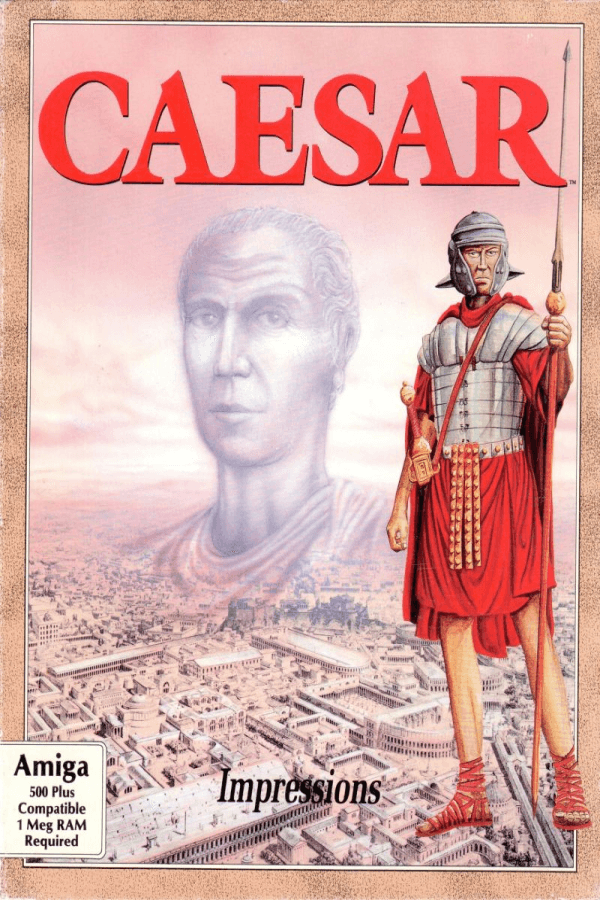

Building an empire in Caesar comes down to a constant, punishing balancing act between pleasing the bloodthirsty crowds in the coliseum and keeping your treasury solvent enough to placate the Emperor.
Taxing your way from governor to Emperor in Caesar
Every city builder forces you to balance money and growth, but Caesar ties your entire survival to four specific numbers: favor, prosperity, culture, and peace. Designed by David Lester and published by Impressions Games, the game puts you in the sandals of a low-ranking provincial governor trying to build functional Roman cities and climb the imperial ladder. If you fail to supply water to housing or leave roads unconnected, citizens complain at the local forum, rioting breaks out, and your standing with Rome plunges.
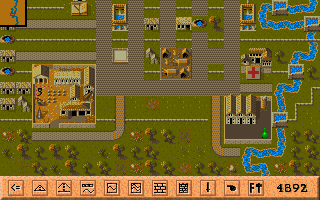
Unlike contemporary city builders that gave players total freedom to sandbox a modern grid, this 1993 title traps you inside strict imperial quotas. You spend your early minutes laying down basic housing estates, paving stone roads, and laying out aqueducts to feed public baths. Every building requires a path to the wider network and a supply of labor, meaning a single misplaced tile can starve an entire district of water or leave your newly constructed temple empty.
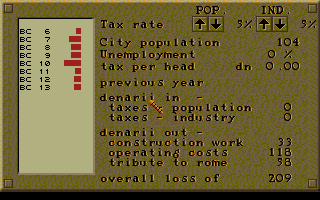
The economy relies heavily on raw production and trade. You cultivate vineyards for wine, organize slave labor, and manage trade routes to maintain income. The real tension comes from the Emperor, who demands regular tributes that scale aggressively as your province grows. Spend too much on bathhouses and libraries to boost your culture rating, and you won't have enough gold left to pay imperial taxes, triggering a rapid downfall.
The brutal micromanagement behind Roman city planning
Managing a province sounds grand on paper, but the actual work happens in the mud of low-level logistics. You are responsible for every school, library, theater, and coliseum placed on the top-down map. To stop fires and collapse, you have to run patrol networks, watching tiny pixels walk along your stone paths. If an inspector misses a turn, an entire block of residential housing can turn into rubble or burst into flames within seconds.
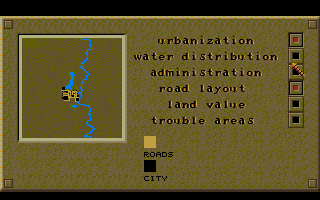
The 256-color VGA display rendered at 320x200 resolution squeezes a lot of detail into a tight frame, but navigating the interface can feel like work. The initial release suffered from a chunky, unrefined UI where checking the status of a distant neighborhood meant wading through layered menus. The updated MS-DOS release fixed some of these headaches by adding hover tooltips over icons and introducing a mini-map, though fine-tuning tax rates and military spending still takes a lot of clicks.
When reviewers at Computer Gaming World covered the title in mid-1993, they recommended it specifically to SimCity fans who wished for more buttons to push, knobs to adjust, and systems to tweak. However, German magazine Power Play hit it with a brutal 21% score, calling out the steep learning curve and punishing financial balance. That financial wall is very real: early versions featured an unforgiving tribute algorithm that swallowed all your profits, leaving almost zero margin for design errors.
Battles on the border and military integration
A thriving city inevitably attracts attention, and barbarian raids are a constant threat to your peace rating. To defend your borders, you must recruit, pay, and maintain Roman legions, taking money directly out of your civic budget. If your military funding dries up, your soldiers perform poorly, leaving farms and outlying trade routes vulnerable to burning.
Combat in standard management titles usually happens off-screen, but Impressions included a unique cross-game mechanic here. You can let the game auto-resolve border skirmishes based on unit numbers, or you can load the tactical situation directly into Cohort II, Impressions' dedicated wargame, to fight the battle manually on the field. It was an ambitious experiment for an MS-DOS game, connecting grand city management with tactical troop movement.
If you prefer to stay on the city screen, standard defense relies on wall placement, gatehouses, and positioning legions near incoming threat vectors. You can inspect your province defense network using these core steps:
- Erect perimeter walls and fortified gatehouses along key trade routes to slow incoming raids.
- Recruit infantry and cavalry legions through the military menu, keeping upkeep paid monthly.
- Position forces near vulnerable farming sectors to prevent invaders from razing food supplies.
- Evaluate your peace score after each invasion to ensure Rome remains satisfied with your border control.
Why this pioneer of the strategy genre still demands your attention
Programmer Simon Bradbury and artist Jon Baker built a management structure that established the template for an entire era of strategy tactics gaming. While later entries polished the walker pathfinding and zoomed in on individual citizens, this original release carries a stark, challenging purity. You are not managing individual happiness so much as balancing a grand ledger under the threat of imperial execution.
Audio composer Christopher J. Denman made great use of the AdLib and Sound Blaster cards of the era, giving the city ambient life through cheerful tunes and sharp warnings when trouble starts. Hearing the sound effects trigger alongside notification pop-ups meant your city was either thriving or sliding into chaos. Despite requiring 590K of free conventional RAM at launch, the engine ran smoothly once you got past the initial memory setup hurdles.
What holds up today is the absolute lack of hand-holding. A bad run teaches you real spatial discipline: you learn to build compact, efficient rings of housing served by dedicated aqueducts rather than sprawling suburban grids. It is a tough, sometimes mechanical challenge, but watching a small outpost transform into a self-sustaining capital while keeping the Emperor paid in full provides genuine satisfaction.
Fire up this classic Caesar MS-DOS game in your browser
If you enjoy complex historical simulations, this pioneer is well worth an evening of your time. The steep financial curve and interface quirks show their age, but the core engine offers a fascinating puzzle of logistics, infrastructure, and survival. It kicked off a major franchise for a reason, combining heavy economic management with Roman flavor in a way few games had attempted before.
You can play Caesar free in your browser right now, with no extra software to install or files to configure. Test your civic planning skills, build your first aqueduct, and see if you have what it takes to rise from a humble governor to the supreme ruler of Rome.