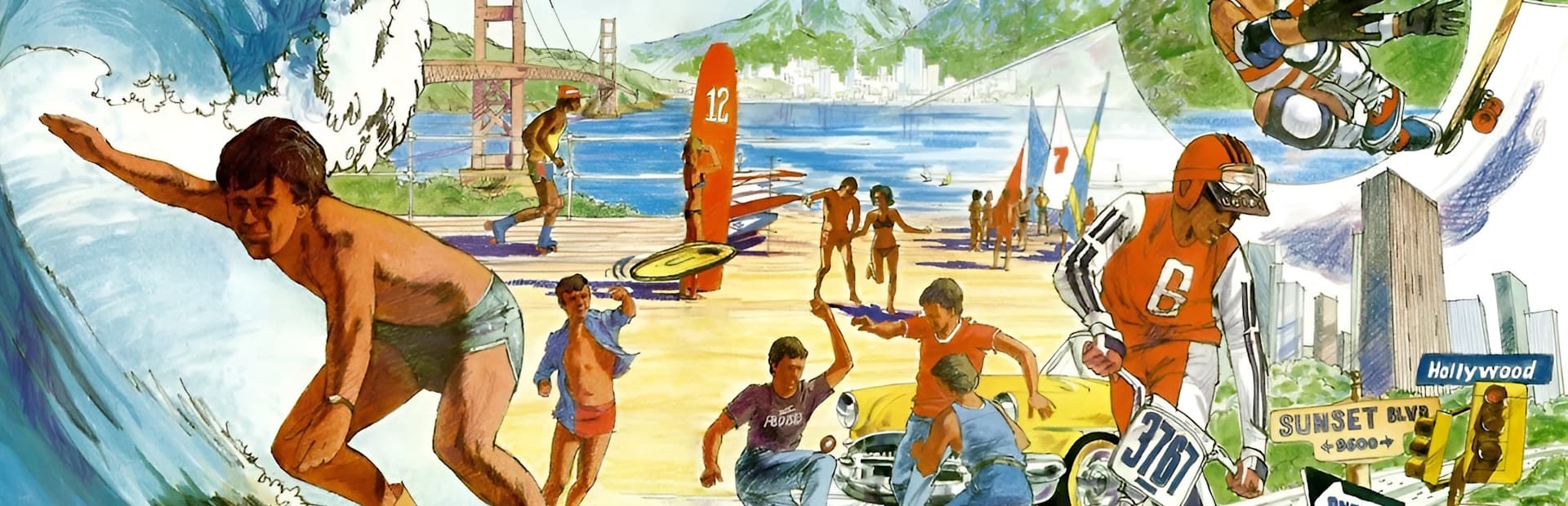
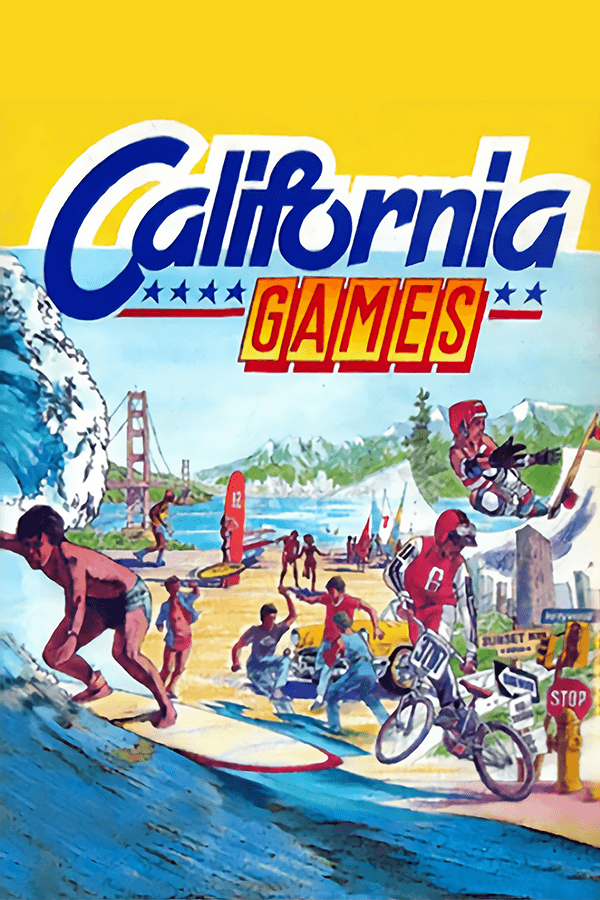

Epyx took the multi-event athletic formula that made its Olympic titles famous and moved it to the West Coast beach scene in California Games. You choose a corporate sponsor, pick a custom contender, and try to land tricks across six outdoor events without crashing into a palm tree or wiping out in the surf.
Epyx traded tracksuits for surfboards in California Games
Epyx, Inc. already knew how to build a hit multi-event sports anthology after success with track and winter disciplines, but turning those ideas toward leisure culture required a shift in design. Development took over three man-years of work, bringing together a design crew that included Chuck Sommerville for the half-pipe and Ken Nicholson for the footbag event. Nicholson later went on to develop technology that fed directly into Microsoft DirectX, while Sommerville went on to create the famous puzzle title Chip's Challenge. To get the motion of the ocean down, the team even brought in an actual surfer to consult on the wave mechanics for the surfing event.
When the MS-DOS port landed in 1988, it brought that summer aesthetic into home computer rooms, complete with bright graphics and digitized sponsor logos. Instead of representing nations, players selected a brand sponsor like Ocean Pacific or Santa Cruz. The choice was purely cosmetic, but it fit the consumer vibe of late eighties beach culture. The core loop remained tied to precise joystick and keyboard timing, asking you to learn specific button rhythms for every separate event on the roster.
Mastering the six beach events
The main menu throws six distinct disciplines at you, each demanding a completely different feel for rhythm and momentum. Success in one event rarely translates to the next, which means you have to build muscle memory for six separate control layouts.
- Half-pipe skateboarding: You kick back and forth to gain elevation on a wooden ramp, timing your turns at the exact peak of your arc to pull off aerial spins and kickturns without landing on your head.
- Footbag: A hacky sack juggling routine where you kick, knee, and header a small leather ball to keep it off the ground. Extra points kick in if you manage to hit a seagull flying across the sky.
- Surfing: You control a surfer named Rippin' Rick, carving turns along the face of a moving wave, shooting up the lip for airtime, and avoiding getting caught in the curl.
- Roller skating: A side-scrolling obstacle course along a beach boardwalk where you duck and jump past discarded shoes, beach towels, open drain covers, and patches of sand.
- Flying disc: A classic frisbee throw across a park lawn, balancing wind speed, angle, and power before switching control to a second player running to make the catch.
- BMX biking: A timed dirt track full of jumps, mounds, and sudden drops where leaning your rider forward or backward determines whether you land clean or flip over the handlebars.
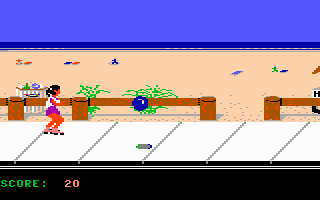
Reviewers at the time, including Computer+Video Games magazine in issue 72, highlighted the detailed graphics and realistic movement of the characters. Landing a smooth aerial spin on the ramp or catching massive air off the wave face feels earned because the physics give your character real weight. When you mess up, the game does not soften the hit; your skater slams onto the flat bottom of the pipe, or your BMX rider plows face first into a dirt mound.
Where the original California Games MS-DOS game hits a wall
For all its personality, sitting down to play the single-player mode in this release reveals a obvious void. There are no computer-controlled opponents to compete against. If you load up the tournament mode on your own, you are essentially competing against empty leaderboards, making solo practice feel hollow after you get the hang of each event's controls. To make matters worse, the game cannot save high score tables to disk, meaning every record you set vanishes the moment you turn off your computer.
The DOS conversion also brought some notorious technical bugs that plagued players on period hardware. Graphic compatibility problems with EGA and VGA setups caused frequent crashes during competition modes, often locking up the machine right as the game attempted to load the surfing transitions. Audio quality depended heavily on your sound card, ranging from sparse bleeps on the standard PC Speaker to richer musical arrangements composed by Chris Grigg and Gil Freeman if you ran the game on Tandy or AdLib hardware.
There are visual quirks that draw laughs today as well. While five of the six events take place right along the sunny coast, the BMX event takes place on a dusty brown desert track, completely abandoning the ocean backdrop for a plain dirt course that feels ripped out of a totally different project.
Hotseat competition kept the beach party alive
Where this title shines is in its hotseat multiplayer, which supports up to eight players taking turns at the same keyboard. Because none of the events feature direct head-to-head collision, the turn-based format works surprisingly well. Gathering a group of friends to pass the keyboard around creates real tension as everyone tries to outdo each other's score on the footbag or pull off one last cutback in the surf.
Compared to standard track-and-field sports games of the era, which relied on brutal button-mashing that threatened to break cheap joysticks, Epyx emphasized timing and stunt execution. Knowing when to back off the accelerator or hold a position until the right split-second gives the trick system surprising longevity in a group setting. It is easy to pick up, brutal to master, and immediate enough for anyone to understand within thirty seconds of stepping up to the controls.
You can play California Games online right now
While the lack of saved scores and absent single-player AI hold it back from perfection, the core stunt mechanics and distinct event design remain fun for a quick session. If you want to jump straight into the action without wrestling with antique display drivers or system freezes, you can play California Games online free in your browser right here. The footbag mini-game alone is worth ten minutes of your time just to see if you can pull off a triple horse-stall and hit that passing seagull.