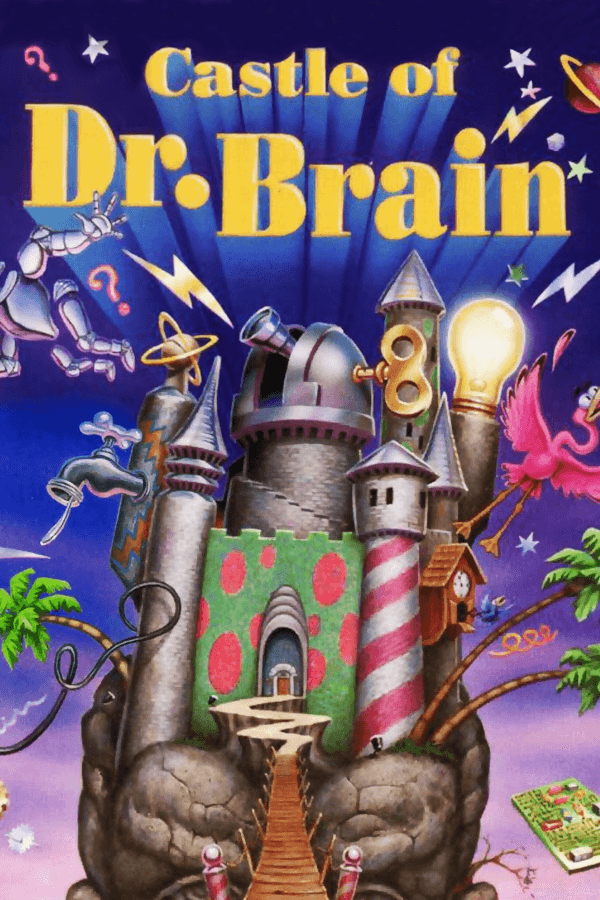
Castle of Dr. Brain
aka Castillo del Dr. Brain · Das Schloß von Dr. Brain · Dr. Brain: Puzzle no Shiro · Mathemagical Mansion
In Castle of Dr. Brain, Sierra took a break from killing players with hidden traps to ask whether you could crack a magic square instead. You play a job applicant answering a local classified ad to become an eccentric scientist's assistant, proving your intelligence by making your way to the penthouse office.
Sierra traded instant death for binary logic and magic squares
By 1991, players knew what to expect from a Sierra On-Line, Inc. release: one wrong step off a ledge or a missed item on screen three would end your run. Co-creative directors Corey Cole and Bill Davis turned that reputation on its head by building an adventure game where you cannot die, get trapped in an unwinnable state, or lose progress to an unexpected monster. Built on Sierra's SCI1 engine, the challenge comes entirely from your ability to handle cryptograms, pattern recognition, and mathematical grids.
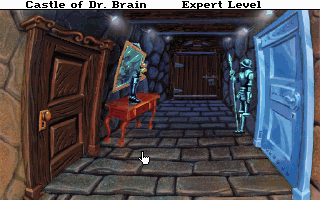
You start outside the front gate, facing a memory matching puzzle just to ring the doorbell. Once inside, every room acts as a self-contained trial that locks the doors until you solve its puzzle. Click the hand or eye icons on random background objects that have nothing to do with the solution, and the game rewards your curiosity with bad jokes and sarcastic observations written by the design team. Cole later noted that making this game was among the best times he had during his tenure at Sierra, and that playful tone comes through every time you inspect a piece of furniture.
The floor-by-floor climb makes homework feel like a castle heist
The tower is structured into distinct thematic zones that test entirely different parts of your brain. The ground floor focuses strictly on basic arithmetic and logic grids. Solving these early challenges awards inventory items like keys, circuit chips, and metal plaques that track your overall progress through the spire. Soon after, you hit word rooms full of anagrams, followed by doors locked behind musical scale puzzles where you have to match sequences by ear.
Progression relies on a clear loop: solve a room, grab the key item, and move to the next layer. Here is how the ascent breaks down across the castle floors:
- The lower levels begin with front-gate memory trials, basic magic squares, and word cipher cryptograms.
- The mid-castle introduces three multi-floor elevator mazes that force you to track movement logic across several screens.
- The upper reaches feature a surreal room where you literally reassemble reality via a jigsaw puzzle before tackling astronomy charts.
- The final floor holds Dr. Brain's penthouse office, where all the systems you learned combine into one final examination.
The pacing works because it rarely lingers on one concept long enough to get boring. Just as you finish solving word puzzles, the game throws you into a surreal jigsaw room where completing the image physically forms the floor and walls of the next hallway.
When the difficulty spikes, Castle of Dr. Brain stops playing nice
While retro reviewers praised the game for turning mathematics and logic into genuine trials without feeling like hidden schoolwork, the difficulty curve is far from smooth. The low-level puzzles feel approachable for any age, but the mid-game hits you with computer logic grids, octal math, and a binary programming challenge that caused plenty of players to give up entirely. Expecting a player to convert numbers into binary code on the fly created an intense wall for younger fans back when this was marketed as an educational title.
To keep you from staying stuck forever, the designers built in a Hint Coin system. You earn coins by solving puzzles cleanly on your own, and you can spend them whenever a puzzle leaves you baffled. Using a single coin gives a minor nudge, while dropping three coins solves the puzzle outright so you can move on. If you burn through your reserve during the chess grid or the binary rooms, though, you have to sit there and figure out the raw logic yourself.
Jerky animations take a back seat to sharp puzzle design
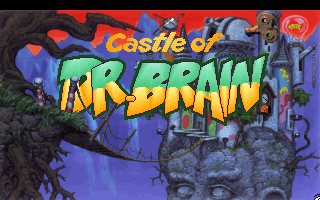
Visually, the Sierra artists gave the fortress plenty of rough charm and strange details, but the screen animation leaves a lot to be desired. Objects and door mechanisms frequently snap from one frame to another rather than showing fluid motion, a limitation that was noticeable even alongside other games on the market that year. The trade-off is that every room is rendered with rich background detail, framed by a soundtrack composed by Mark Seibert and Ken Allen that changes key to match the mood of each floor.
I found that treating this as a pure test of logic rather than a traditional narrative adventure makes its flaws easy to forgive. It does not try to tell an epic story like its fantasy siblings; it wants to test your focus. That clarity of design is why the format spawned a direct sequel, Island of Dr. Brain, and established a line of logic games that cut out inventory-combining nonsense in favor of direct problem-solving.
How to play Castle of Dr. Brain today without getting stuck
This classic holds up if you want a clean sequence of brain-teasers without light-switch hunting or obscure dialog trees. The binary rooms and late-game chess puzzles will still test your patience, but the fair hint system ensures you can always see the credits if you manage your coins carefully. If you want to sample a classic Castle of Dr. Brain MS-DOS game session, you do not need to hunt down original floppy disks or configure an old rig.
You can play Castle of Dr. Brain free in your browser right now with no setup required. Jump straight into the front gate memory puzzle, start earning your Hint Coins, and see if you have what it takes to reach the top-floor office when you play Castle of Dr. Brain online tonight.