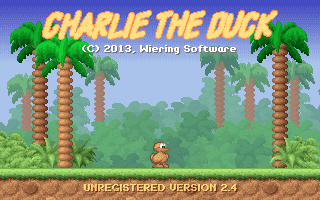
Charlie the Duck takes the standard side-scrolling platform formula and pairs it with a brutally punishing difficulty curve that hides behind its cheery VGA graphics.
You notice the deceptive simplicity the moment you launch this 1996 side-scroller. Developer Mike Wiering built a game that looks like an educational software title for young children, but playing it feels like walking through a minefield. Your primary job as Charlie is to waddle across side-scrolling environments, jump on enemies, and collect coins and diamonds scattered across 18 levels divided into distinct worlds.
Movement feels light, but precision jumping demands strict control. Holding down the Ctrl key lets Charlie run faster, which becomes mandatory when attempting to clear wide gaps or evade hazards. The standard top-to-bottom platform mechanics dictate every action: jump onto a enemy to squash it, pick up diamonds, and locate the exit sign at the far right of the map.
The visual presentation relies on smooth multi-layered parallax scrolling and clean VGA artwork. Behind the hood, Wiering coded the graphics engine in assembly and Pascal to ensure high performance even on an 80286 processor. Sound effects rely on OPL FM synthesis through a Sound Blaster card or the standard internal PC speaker, producing a collection of chirps and bleeps that accompany every bounce and gem pickup.
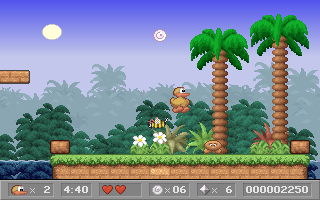
The core friction in this game comes from how fragile Charlie actually is. While games like Super Mario Bros. give you clear audio visual cues and generous grace periods after taking damage, a single collision here strips away your precious hit points with very little room for error. Staying alive requires memorizing exact enemy patrol routes across every screen.
The game features several distinct hazards that punish aggressive play:
Enemy movement AI is admittedly rudimentary, as creatures simply walk back and forth until they hit a wall or edge. Yet that simplicity makes their placements insidious. A frog positioned right at the edge of a landing platform leaves zero margin for a late jump, forcing you to master the run key to adjust your trajectory in mid-air.
Secret hunting provides the best incentive to push through the punishing level design. Many of the maps feature deep water spots and large ponds where Charlie can submerge. Diving below the water surface uncovers sprawling underwater passages, hidden stashes of diamonds, and shield power-ups that temporarily grant full invulnerability.
These aquatic detours change the pace of the standard action platforming. Navigating underwater tunnels requires managing your swimming momentum while keeping an eye out for submerged hazards. Finding a shield power-up inside a deep pond often gives you the exact cushion needed to survive the upcoming stretch of overland spikes and aggressive boss attacks.
The level structure stays consistent throughout all three levels of a world, culminating in a dramatic boss fight. While the standard levels rely on exploration and hidden items, the world bosses strip away safety nets and demand pure reflexes. Reviewers and players at release routinely cited these boss encounters as massive difficulty spikes that brought many playthroughs to a dead halt.
As a release published as Freeware and shareware, the initial package gave players a taste of the first world while enticing them to register for the full 18-level journey. It delivered high frame rates on humble hardware without requiring expensive graphics accelerators. The lack of standard background music in its original incarnation meant players explored levels accompanied only by the rhythmic bleeps of OPL sound chips or internal speakers.
What holds up today is the responsive control scheme and the satisfaction of mastering its demanding jump geometry. What plainly fails to hold up is the sudden scaling in boss fights and the frustration of bouncy box mechanics, which feel unnecessarily slick and unforgiving. It stays worth a look for anyone fascinated by solo-developed PC platformers of the mid-1990s.
If you want to experience this original Charlie the Duck MS-DOS game without hunting down vintage computer hardware or tweaking sound hardware settings, you can play Charlie the Duck online directly in your browser. The setup lets you jump straight into the action using standard keyboard controls.
When you start your first run, get comfortable holding the run key continuously to stretch your jump distance. Dive straight into the first deep pond you encounter to grab the extra coins and test out the underwater controls before the world bosses start testing your patience. You can experience the complete retro adventure with Charlie the Duck free in your browser right here.
Charlie the Duck takes the standard side-scrolling platform formula and pairs it with a brutally punishing difficulty curve that hides behind its cheery VGA graphics.
You notice the deceptive simplicity the moment you launch this 1996 side-scroller. Developer Mike Wiering built a game that looks like an educational software title for young children, but playing it feels like walking through a minefield. Your primary job as Charlie is to waddle across side-scrolling environments, jump on enemies, and collect coins and diamonds scattered across 18 levels divided into distinct worlds.
Movement feels light, but precision jumping demands strict control. Holding down the Ctrl key lets Charlie run faster, which becomes mandatory when attempting to clear wide gaps or evade hazards. The standard top-to-bottom platform mechanics dictate every action: jump onto a enemy to squash it, pick up diamonds, and locate the exit sign at the far right of the map.
The visual presentation relies on smooth multi-layered parallax scrolling and clean VGA artwork. Behind the hood, Wiering coded the graphics engine in assembly and Pascal to ensure high performance even on an 80286 processor. Sound effects rely on OPL FM synthesis through a Sound Blaster card or the standard internal PC speaker, producing a collection of chirps and bleeps that accompany every bounce and gem pickup.
The core friction in this game comes from how fragile Charlie actually is. While games like Super Mario Bros. give you clear audio visual cues and generous grace periods after taking damage, a single collision here strips away your precious hit points with very little room for error. Staying alive requires memorizing exact enemy patrol routes across every screen.
The game features several distinct hazards that punish aggressive play:
Enemy movement AI is admittedly rudimentary, as creatures simply walk back and forth until they hit a wall or edge. Yet that simplicity makes their placements insidious. A frog positioned right at the edge of a landing platform leaves zero margin for a late jump, forcing you to master the run key to adjust your trajectory in mid-air.
Secret hunting provides the best incentive to push through the punishing level design. Many of the maps feature deep water spots and large ponds where Charlie can submerge. Diving below the water surface uncovers sprawling underwater passages, hidden stashes of diamonds, and shield power-ups that temporarily grant full invulnerability.
These aquatic detours change the pace of the standard action platforming. Navigating underwater tunnels requires managing your swimming momentum while keeping an eye out for submerged hazards. Finding a shield power-up inside a deep pond often gives you the exact cushion needed to survive the upcoming stretch of overland spikes and aggressive boss attacks.
The level structure stays consistent throughout all three levels of a world, culminating in a dramatic boss fight. While the standard levels rely on exploration and hidden items, the world bosses strip away safety nets and demand pure reflexes. Reviewers and players at release routinely cited these boss encounters as massive difficulty spikes that brought many playthroughs to a dead halt.
As a release published as Freeware and shareware, the initial package gave players a taste of the first world while enticing them to register for the full 18-level journey. It delivered high frame rates on humble hardware without requiring expensive graphics accelerators. The lack of standard background music in its original incarnation meant players explored levels accompanied only by the rhythmic bleeps of OPL sound chips or internal speakers.
What holds up today is the responsive control scheme and the satisfaction of mastering its demanding jump geometry. What plainly fails to hold up is the sudden scaling in boss fights and the frustration of bouncy box mechanics, which feel unnecessarily slick and unforgiving. It stays worth a look for anyone fascinated by solo-developed PC platformers of the mid-1990s.
If you want to experience this original Charlie the Duck MS-DOS game without hunting down vintage computer hardware or tweaking sound hardware settings, you can play Charlie the Duck online directly in your browser. The setup lets you jump straight into the action using standard keyboard controls.
When you start your first run, get comfortable holding the run key continuously to stretch your jump distance. Dive straight into the first deep pond you encounter to grab the extra coins and test out the underwater controls before the world bosses start testing your patience. You can experience the complete retro adventure with Charlie the Duck free in your browser right here.
How Charlie the Duck is played — the keys the game listens to, grouped by what they do.
Highlighted keys are mapped — hover or tap one to see what it does.
Supports both standard arrow/Space/Ctrl controls and alternative single-handed keyboard controls (J/L/A/K). Joystick support is also present for movement, jump, and dash.
The on-screen keyboard and gamepad mapping the browser player uses on a phone, a tablet or a controller, as opposed to the real keys above. $PRO members make their own in the player and share them here; anyone can pick one to play with.
Cheat codes, console commands and memory pokes for Charlie the Duck — each one verified and attributed.
Sign in to submitHow Charlie the Duck is played — the keys the game listens to, grouped by what they do.
Highlighted keys are mapped — hover or tap one to see what it does.
Supports both standard arrow/Space/Ctrl controls and alternative single-handed keyboard controls (J/L/A/K). Joystick support is also present for movement, jump, and dash.
The on-screen keyboard and gamepad mapping the browser player uses on a phone, a tablet or a controller, as opposed to the real keys above. $PRO members make their own in the player and share them here; anyone can pick one to play with.
Cheat codes, console commands and memory pokes for Charlie the Duck — each one verified and attributed.
Sign in to submit