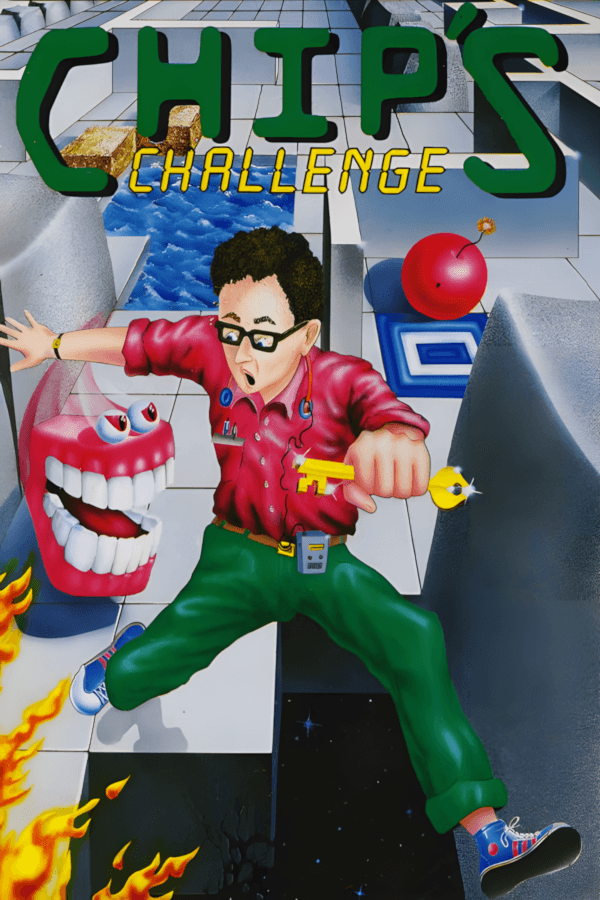

If you ever tried to join a high school club in 1990, you probably didn't have to navigate 149 grid-based death traps designed by a teenage prodigy, but Chip's Challenge insisted that level-headed tile shuffling was the ultimate test of nerd credentials.
Most action-puzzlers of the era asked for fast reflexes or careful planning, but Chuck Sommerville designed a system where those two demands constantly smashed into each other. You control Chip McCallahan from a top-down view across a sequence of tile grids, grabbing a exact count of microchips before the exit barrier will drop. Every step takes a discrete tick of time, and every tile has absolute physical rules. Water drowns you instantly unless you slide a dirt block into it to form a patch of land, or put on a pair of swimming flippers. Fire burns you to ash unless you are wearing fireproof boots. Ice tracks send you gliding uncontrollably in straight lines until you strike a solid wall, unless you slip on ice skates to regain full steering.
That strict logic turns what looks like a simple maze game into a high-pressure exercise in inventory management and path optimization. On early stages like "Lesson One" or "Brushfire", the board teaches you the raw basics in a handful of seconds. Soon enough, levels like "Tossed Salad" and "Reverse Alley" toss monsters, force floors, and toggle walls into a single crowded room. Because Chip moves at the exact same grid speed as moving hazards, a single miscalculated keypress leads directly into a patrolling bug or an open pit. The game rarely forgives a missed step, especially when the level timer is ticking down in the corner of the screen.
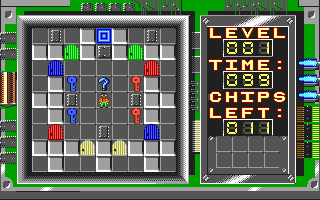
Originally cooked up for the handheld Atari Lynx, the game made its way to home PCs when developer Epyx, Inc. licensed the code to Audio Visual Magic Ltd for conversion. The 1990 Epyx release brought full 16-color graphics to PC monitors, giving the maze tiles a crisp visual layout that made hazards easy to identify instantly. That visual clarity mattered because the game demands instant recognition of force floor directions, blue key locks, and dirt block alignments. The DOS version supports a range of sound hardware from the simple squawk of the PC Speaker up to AdLib synthesis and Roland MT-32 MIDI modules, playing David Whittaker's soundtrack loops alongside clean step-by-step sound effects.
What makes the PC port curious to modern fans is how its underlying logic engine handles timing. Because Audio Visual Magic ported the game logic across to x86 assembly, subtle code timing oddities crept into the movement loops and monster AI routines. Certain monster pathing loops behave slightly differently on the PC version than on the Lynx original, opening up unintended shortcuts on stages like "Lemmings" or creating tight movement windows that were never in the initial design. Far from ruining the experience, these logic variations gave the puzzle community unique movement setups to untangle.
Nobody reaches the halfway point of the game without hitting a wall. While the initial dozen levels introduce key colors, suction boots, and pushable blocks with gentle guidance, the late game throws absolute nightmares at you. "Totally Unfair" hides essential items behind obscure tile interactions, while stages like "Jumping Swarm" force you to weave through crowds of moving enemies on narrow paths where a single frame of hesitation means death. There are no mid-level checkpoints, so making a tiny mistake 90 seconds into a complex sequence resets the entire board.
To keep players from throwing their computer out the window, the designers included a four-letter password system for every single level. If you die repeatedly on a tricky stage like "Catacombs" or "Perfect Match", the game eventually offers to let you skip ahead, or you can simply type in a password you got from a friend or a magazine. That password mechanic kept the game accessible even as the level design bordered on sadistic. It also fueled endless classroom trading of four-letter codes, letting players swap secrets for stages like "Scoundrel" and "Spooks" long before internet walkthroughs existed.
The brilliance of the design comes down to how modular the mechanics are. Four shoe types, four key colors, dirt blocks, switches, and a handful of enemy patterns generate 149 stages that almost never repeat a trick. Some boards feel like pure spatial logic problems where you move blocks into water to form bridges, while others are fast-paced reflex runs across suction-cup belts while dodging fireflies. That variety is why community designers built massive custom map sets like "CCLP2" and "CCLP5" decades after release, keeping the core tile engine alive with thousands of fresh challenges.
The only place the original PC build stumbles is in its strict grid-based movement controls, which can occasionally feel rigid if you try to tap directions too fast on a modern keyboard. Yet the core design is rock solid. If you enjoy clean logical rules mixed with high-stakes spatial planning, spending an evening working through Melinda's clubhouse is still immensely satisfying.
You can play Chip's Challenge MS-DOS game free in your browser right now with no setup required. Load up level one, slip on a pair of ice skates, and see how far you make it through the clubhouse before "Totally Unfair" forces you to rethink your strategy.
If you ever tried to join a high school club in 1990, you probably didn't have to navigate 149 grid-based death traps designed by a teenage prodigy, but Chip's Challenge insisted that level-headed tile shuffling was the ultimate test of nerd credentials.
Most action-puzzlers of the era asked for fast reflexes or careful planning, but Chuck Sommerville designed a system where those two demands constantly smashed into each other. You control Chip McCallahan from a top-down view across a sequence of tile grids, grabbing a exact count of microchips before the exit barrier will drop. Every step takes a discrete tick of time, and every tile has absolute physical rules. Water drowns you instantly unless you slide a dirt block into it to form a patch of land, or put on a pair of swimming flippers. Fire burns you to ash unless you are wearing fireproof boots. Ice tracks send you gliding uncontrollably in straight lines until you strike a solid wall, unless you slip on ice skates to regain full steering.
That strict logic turns what looks like a simple maze game into a high-pressure exercise in inventory management and path optimization. On early stages like "Lesson One" or "Brushfire", the board teaches you the raw basics in a handful of seconds. Soon enough, levels like "Tossed Salad" and "Reverse Alley" toss monsters, force floors, and toggle walls into a single crowded room. Because Chip moves at the exact same grid speed as moving hazards, a single miscalculated keypress leads directly into a patrolling bug or an open pit. The game rarely forgives a missed step, especially when the level timer is ticking down in the corner of the screen.
Originally cooked up for the handheld Atari Lynx, the game made its way to home PCs when developer Epyx, Inc. licensed the code to Audio Visual Magic Ltd for conversion. The 1990 Epyx release brought full 16-color graphics to PC monitors, giving the maze tiles a crisp visual layout that made hazards easy to identify instantly. That visual clarity mattered because the game demands instant recognition of force floor directions, blue key locks, and dirt block alignments. The DOS version supports a range of sound hardware from the simple squawk of the PC Speaker up to AdLib synthesis and Roland MT-32 MIDI modules, playing David Whittaker's soundtrack loops alongside clean step-by-step sound effects.
What makes the PC port curious to modern fans is how its underlying logic engine handles timing. Because Audio Visual Magic ported the game logic across to x86 assembly, subtle code timing oddities crept into the movement loops and monster AI routines. Certain monster pathing loops behave slightly differently on the PC version than on the Lynx original, opening up unintended shortcuts on stages like "Lemmings" or creating tight movement windows that were never in the initial design. Far from ruining the experience, these logic variations gave the puzzle community unique movement setups to untangle.
Nobody reaches the halfway point of the game without hitting a wall. While the initial dozen levels introduce key colors, suction boots, and pushable blocks with gentle guidance, the late game throws absolute nightmares at you. "Totally Unfair" hides essential items behind obscure tile interactions, while stages like "Jumping Swarm" force you to weave through crowds of moving enemies on narrow paths where a single frame of hesitation means death. There are no mid-level checkpoints, so making a tiny mistake 90 seconds into a complex sequence resets the entire board.
To keep players from throwing their computer out the window, the designers included a four-letter password system for every single level. If you die repeatedly on a tricky stage like "Catacombs" or "Perfect Match", the game eventually offers to let you skip ahead, or you can simply type in a password you got from a friend or a magazine. That password mechanic kept the game accessible even as the level design bordered on sadistic. It also fueled endless classroom trading of four-letter codes, letting players swap secrets for stages like "Scoundrel" and "Spooks" long before internet walkthroughs existed.
The brilliance of the design comes down to how modular the mechanics are. Four shoe types, four key colors, dirt blocks, switches, and a handful of enemy patterns generate 149 stages that almost never repeat a trick. Some boards feel like pure spatial logic problems where you move blocks into water to form bridges, while others are fast-paced reflex runs across suction-cup belts while dodging fireflies. That variety is why community designers built massive custom map sets like "CCLP2" and "CCLP5" decades after release, keeping the core tile engine alive with thousands of fresh challenges.
The only place the original PC build stumbles is in its strict grid-based movement controls, which can occasionally feel rigid if you try to tap directions too fast on a modern keyboard. Yet the core design is rock solid. If you enjoy clean logical rules mixed with high-stakes spatial planning, spending an evening working through Melinda's clubhouse is still immensely satisfying.
You can play Chip's Challenge MS-DOS game free in your browser right now with no setup required. Load up level one, slip on a pair of ice skates, and see how far you make it through the clubhouse before "Totally Unfair" forces you to rethink your strategy.
How Chip's Challenge is played — the keys the game listens to, grouped by what they do.
Highlighted keys are mapped — hover or tap one to see what it does.
Incomplete control scheme compiled from secondary wiki documentation.
The on-screen keyboard and gamepad mapping the browser player uses on a phone, a tablet or a controller, as opposed to the real keys above. $PRO members make their own in the player and share them here; anyone can pick one to play with.
Cheat codes, console commands and memory pokes for Chip's Challenge — each one verified and attributed.
Sign in to submitHow Chip's Challenge is played — the keys the game listens to, grouped by what they do.
Highlighted keys are mapped — hover or tap one to see what it does.
Incomplete control scheme compiled from secondary wiki documentation.
The on-screen keyboard and gamepad mapping the browser player uses on a phone, a tablet or a controller, as opposed to the real keys above. $PRO members make their own in the player and share them here; anyone can pick one to play with.
Cheat codes, console commands and memory pokes for Chip's Challenge — each one verified and attributed.
Sign in to submit