
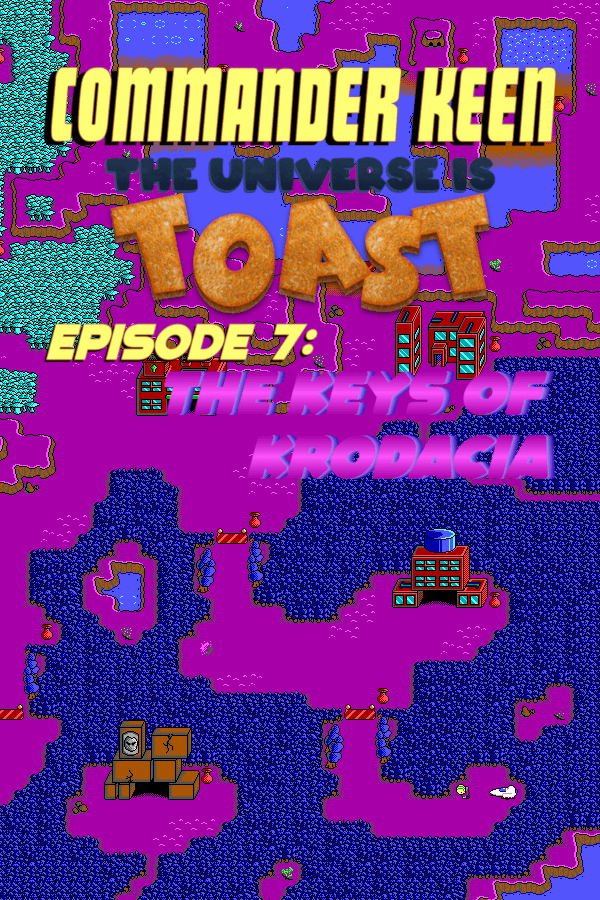
If you ever wanted to know what happened after the official series ended, Commander Keen 7: The Keys of Krodacia answers the question by throwing Billy Blaze straight onto an alien world locked behind seven hidden keys. Built as a full fan-made episode on the engine of Commander Keen 4: Secret of the Oracle, it turns classic pogo-stick platforming into a massive planetary treasure hunt to stop Mortimer McMire's Universal Toaster Cannon.
In Commander Keen 7: The Keys of Krodacia, momentum and keyhunting take center stage
The campaign kicks off right after the events of the sixth game, with Billy snooping through Mortimer's room and discovering a video tape labeled in Standard Galactic Alphabet. That tape reveals the plot to construct a Universal Toaster Cannon on the planet Krodacia, sending Keen straight into hostile territory. Once you land, you face a giant fortress gate requiring seven distinct keys scattered across the surface before you can gain entry to the final Megarocket launch site.
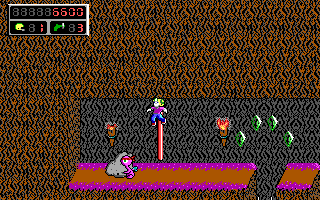
Navigating Krodacia requires mastering the familiar physics of the engine, where high jumps on the pogo stick demand precise timing to clear overhead hazard spikes and enemy patrols. Across 19 standard levels and 1 hidden stage, you explore sprawling structures like the Gem Temple, searching every nook for keycards, ammo clips, and points. The side-scrolling action keeps you on your toes because one misjudged drop onto a hazard sends you back to the level entrance.
How Ceilick built an unofficial sequel from the bones of Keen 4
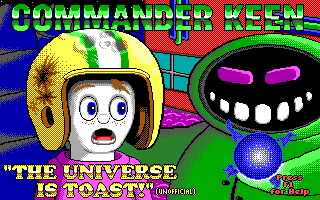
Lead developer Ceilick put this game out in 2006, launching the fan-made "The Universe Is Toast" trilogy. KeenRush wrote an original soundtrack to replace the old synth tunes, giving every zone its own music over the Sound Blaster. Using community editing tools to tweak the graphics, level designs, and enemy routines directly inside the MS-DOS executable, the team pulled off a mod that fits right alongside the official games.
A refined version arrived in 2009, bringing a revamped soundtrack, extra level details, and necessary bug fixes that smoothed out earlier progression blockers. While distributed strictly as freeware, the project set a high standard for fan-made DOS mods by delivering new art assets and custom alien sprites rather than simple level reshuffles. It established a story arc that continued directly into two subsequent fan episodes, Dead in the Desert and Battle of the Brains.
Pogo bounces, hazards, and the weight of retro controls
Controlling Keen means balancing momentum and weapon conservation. Your raygun carries finite shots, forcing you to choose between stunning standard hazards or saving your ammo for tighter bottlenecks in the later stages. The pogo stick remains your primary tool for reaching secret ledges, but its high-bouncing physics can easily fling you into ceiling hazards if you engage it beneath low overhangs.
Level design heavily rewards careful exploration over blind sprinting. You often need to hunt through side paths to hit switches that disable force fields or extend bridges, all while dodging custom alien creatures designed specifically for Krodacia. Missing a crucial key near the end of a level means retracing your steps through repopulated danger zones, making map memory just as vital as fast reflexes.
Where Commander Keen 7: The Keys of Krodacia shines and where it tests your patience
As a platformer, the campaign delivers everything fans loved about the 1990s DOS era, featuring tight movement and clever stage layouts. The primary draw lies in its level variety, as each stage presents different vertical challenges and hazard placements that keep the platforming fresh. I found that the updated 2009 audio and polished visual tiles give the entire planet a cohesive, alien atmosphere that rivals commercial releases from the era.
The difficulty curve, however, can hit hard if you enter a stage without extra lives or full ammunition. A few late-game areas feature narrow landing platforms directly adjacent to instantly lethal hazards, leading to moments of trial-and-error frustration. Despite those strict platforming demands, anyone who enjoyed the original ID Software episodes will find this unofficial continuation entirely worth their time.
Play Commander Keen 7: The Keys of Krodacia online right now
You can run the Commander Keen 7: The Keys of Krodacia MS-DOS game straight in your browser, completely free and with zero installation needed. Modern players usually expect auto-saves after every room, but this game uses the classic save system, so remember to manually save your progress on the map screen before stepping into a new level. Launch the game, line up your pogo jumps, and start collecting those seven keys today.
How Commander Keen 7: The Keys of Krodacia is played — the keys the game listens to, grouped by what they do.
- Movement
- Action
- Interface
Highlighted keys are mapped — hover or tap one to see what it does.
Keys can be redefined or switched to joystick input in the game menu. Joystick input requires configuration or calibration.
Players' controls
Touch and gamepad controls
The on-screen keyboard and gamepad mapping the browser player uses on a phone, a tablet or a controller, as opposed to the real keys above. $PRO members make their own in the player and share them here; anyone can pick one to play with.
Make your own touch controlsPRO
- 1Open the editorSign in below, then pick what to make. The game starts with the editor open over it.
- 2Place your keysAdd keys and drag them where your thumbs rest, or map a controller's buttons. Test plays the game with them; Save keeps them, and you play with them from then on.
- 3Share themShare them right after saving in the game, or name and share them here. Players vote, and the best become this game's controls for everyone.
Go PROSee how it worksSign in+20 XP for sharing · +50 XP if yours become the game's own
- The game's own controlsKeyboardGamepadWhat every player starts with.In use
2 screenshots
From the archive
No gameplay video yet
No gameplay video for Commander Keen 7: The Keys of Krodacia yet. Sign in to add one.
No reviews yet
Tell the community what you think of Commander Keen 7: The Keys of Krodacia. Reviews are public and tied to your username.
No archived manuals for Commander Keen 7: The Keys of Krodacia yet
No manuals archived for this title yet. Sign in to upload the first scan.
Cheat codes, console commands and memory pokes for Commander Keen 7: The Keys of Krodacia — each one verified and attributed.
Sign in to submitNo cheats yet for this title
Know a working cheat, poke or trainer? Add it with the button above. Moderators check every entry before it goes live.
No archived soundtrack for Commander Keen 7: The Keys of Krodacia yet
No soundtrack archived for this title yet. Sign in to upload the first rip.
No save states for Commander Keen 7: The Keys of Krodacia yet
No save states for this title yet. Sign in to share one.
Discussions
Sign in to post- Threads0
- Total posts0
- Online now6
Community · Commander Keen 7: The Keys of Krodacia
Who's contributing, and what's new
- Reviews0
- Threads0
- Uploadsapproved0
- Contributors0
Recent activity
Nothing here yet
Reviews, discussion threads and approved uploads appear here as members add them.