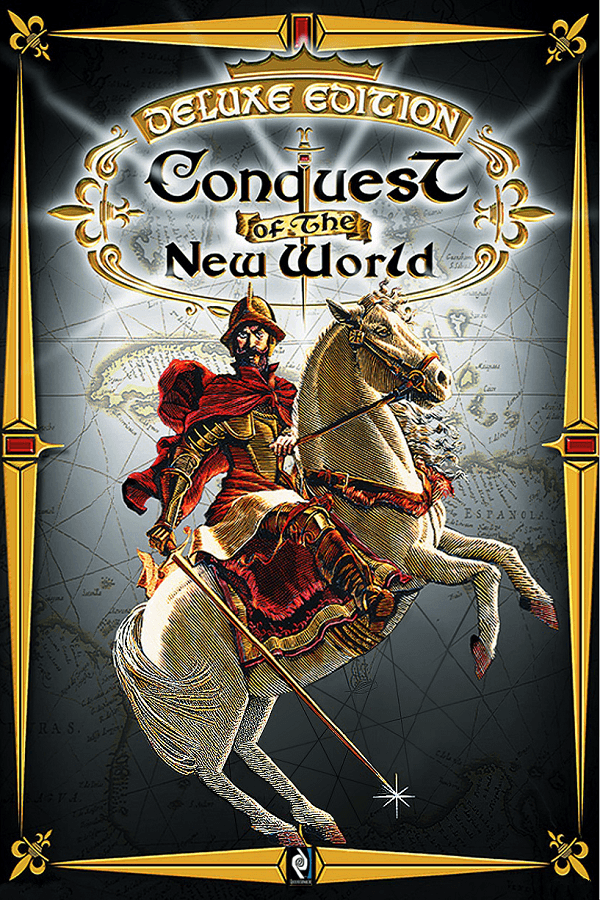
In Conquest of the New World, your journey begins on the edge of an uncharted continent with a single ship, a handful of settlers, and a dense fog masking everything beyond the coast.
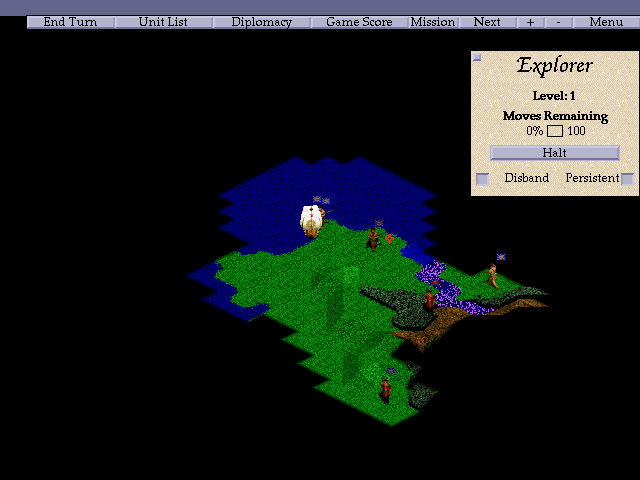
You drop anchor off an unfamiliar coast in 1493, unload an explorer and a team of colonists, and start dragging movement arrows into the blackness. Instead of moving unit by unit through standard hex grid toggles, you click a unit and draw a line directly to its destination on 3D isometric terrain, letting the pathfinder handle the march. Every hill and forest revealed brings a decision: do you clear timber for a colony center now, or send your military forward before an opposing nation or native group claims the valley?
Exploration carries a neat reward loop that sets this 1996 release apart from rival strategy titles. When your expedition finds a major river or mountain range first, a text prompt pops up allowing you to name the geographical feature yourself in exchange for victory points. Choosing between five European powers or the High Natives gives each start a distinct diplomatic tone, but the core opening loop remains focused on rapid reconnaissance and securing resource-rich river basins before your opponents arrive.
Building a successful settlement requires strict spatial management on flat terrain. Once you establish a colony center, you must surround it with farms, housing, sawmills, churches, taverns, and gold or metal mines to build a functioning economy. The camera supports full zoom, letting you drop down from the strategic overview straight into the detailed layout of your village to see which structures are active and where your settlers are working.
Before release, Computer Gaming World noted that this design previewed as everything players wanted Sid Meier's Colonization to be, largely because of how tightly tied physical resource production was to unit recruitment. If you want artillery or heavy cavalry, you need the metal, timber, and specialized buildings in place to forge cannons and equip horses. If your colony runs out of food or housing space, growth stalls instantly, leaving your frontier outposts vulnerable to raids.
Quicksilver Software, Inc., the team behind the game, built an economic web where raw gold from mountain mines fuels your trade networks, but local survival depends entirely on boring necessities like wheat and lumber. Balancing those trade routes against incoming shipping lines is essential before declaring independence late in a campaign.
When two opposing forces collide on the overland map, the perspective shifts entirely away from global strategy into a self-contained combat mini-game. Battles take place on a compact 3x5 grid reminiscent of strategic battle chess. Infantry, cavalry, and artillery units take turns maneuvering across fifteen tiles, trying to outflank the enemy commander, capture their battle flag, or completely wipe out their lines.
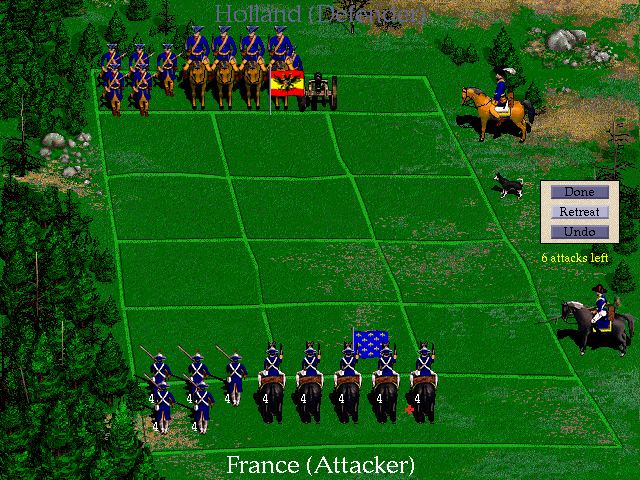
This tactical engine places heavy emphasis on troop positioning and line-of-sight artillery support. Because space is restricted, misplacing a cavalry unit by one tile can block your own infantry lines, allowing an enemy commander to corner your troops or steal your flag in a single swift move. The audio design supervised by Charles Deenen, paired with an orchestral soundtrack composed by Richard Band, gives every volley of musket fire and cannon blast an immediate impact through a classic Sound Blaster setup.
While publications like GameSpot lauded the Deluxe edition for its management depth and rendered landscapes, PC Gamer took a cooler stance with a 61% score, pointing out that the grand strategy mechanics feel shallow compared to heavier 4X games. Once you secure a handful of self-sufficient colonies and construct advanced forts, late-game turns devolve into routine maintenance. Diplomacy options are fairly basic, and high-level artificial intelligence opponents often resort to aggressive troop swarms rather than sophisticated trade warfare.
Multiplayer options exist, but setting up custom matches in this Interplay Productions, Inc. published title could get terribly tedious. Balancing technical advancements, initial resource pools, and military unit handicaps across manual lobby menus frequently took longer than the matches themselves. The lack of varied victory conditions outside of military dominance or point thresholds also means long campaigns tend to end with a drawn-out military grind across remaining enemy settlements.
For players who enjoy strategy tactics games from the mid-nineties, this title retains a lot of clever ideas that still feel fresh. One classic touch worth trying right away happens before your fleet ever lands: hold down the Shift key during map generation, and the game replaces your nation's standard starting flag on the lead ship with a skull-and-crossbones pirate flag. Small secrets like that show the personality Quicksilver Software, Inc. built into the presentation.
You can play Conquest of the New World online for free in your browser right now with no setup needed. If you want a quick run, pick an explorer faction, name your first river something absurd, and try out the chess-style combat grid to see how this 1493 simulator holds up today.
In Conquest of the New World, your journey begins on the edge of an uncharted continent with a single ship, a handful of settlers, and a dense fog masking everything beyond the coast.
You drop anchor off an unfamiliar coast in 1493, unload an explorer and a team of colonists, and start dragging movement arrows into the blackness. Instead of moving unit by unit through standard hex grid toggles, you click a unit and draw a line directly to its destination on 3D isometric terrain, letting the pathfinder handle the march. Every hill and forest revealed brings a decision: do you clear timber for a colony center now, or send your military forward before an opposing nation or native group claims the valley?
Exploration carries a neat reward loop that sets this 1996 release apart from rival strategy titles. When your expedition finds a major river or mountain range first, a text prompt pops up allowing you to name the geographical feature yourself in exchange for victory points. Choosing between five European powers or the High Natives gives each start a distinct diplomatic tone, but the core opening loop remains focused on rapid reconnaissance and securing resource-rich river basins before your opponents arrive.
Building a successful settlement requires strict spatial management on flat terrain. Once you establish a colony center, you must surround it with farms, housing, sawmills, churches, taverns, and gold or metal mines to build a functioning economy. The camera supports full zoom, letting you drop down from the strategic overview straight into the detailed layout of your village to see which structures are active and where your settlers are working.
Before release, Computer Gaming World noted that this design previewed as everything players wanted Sid Meier's Colonization to be, largely because of how tightly tied physical resource production was to unit recruitment. If you want artillery or heavy cavalry, you need the metal, timber, and specialized buildings in place to forge cannons and equip horses. If your colony runs out of food or housing space, growth stalls instantly, leaving your frontier outposts vulnerable to raids.
Quicksilver Software, Inc., the team behind the game, built an economic web where raw gold from mountain mines fuels your trade networks, but local survival depends entirely on boring necessities like wheat and lumber. Balancing those trade routes against incoming shipping lines is essential before declaring independence late in a campaign.
When two opposing forces collide on the overland map, the perspective shifts entirely away from global strategy into a self-contained combat mini-game. Battles take place on a compact 3x5 grid reminiscent of strategic battle chess. Infantry, cavalry, and artillery units take turns maneuvering across fifteen tiles, trying to outflank the enemy commander, capture their battle flag, or completely wipe out their lines.
This tactical engine places heavy emphasis on troop positioning and line-of-sight artillery support. Because space is restricted, misplacing a cavalry unit by one tile can block your own infantry lines, allowing an enemy commander to corner your troops or steal your flag in a single swift move. The audio design supervised by Charles Deenen, paired with an orchestral soundtrack composed by Richard Band, gives every volley of musket fire and cannon blast an immediate impact through a classic Sound Blaster setup.
While publications like GameSpot lauded the Deluxe edition for its management depth and rendered landscapes, PC Gamer took a cooler stance with a 61% score, pointing out that the grand strategy mechanics feel shallow compared to heavier 4X games. Once you secure a handful of self-sufficient colonies and construct advanced forts, late-game turns devolve into routine maintenance. Diplomacy options are fairly basic, and high-level artificial intelligence opponents often resort to aggressive troop swarms rather than sophisticated trade warfare.
Multiplayer options exist, but setting up custom matches in this Interplay Productions, Inc. published title could get terribly tedious. Balancing technical advancements, initial resource pools, and military unit handicaps across manual lobby menus frequently took longer than the matches themselves. The lack of varied victory conditions outside of military dominance or point thresholds also means long campaigns tend to end with a drawn-out military grind across remaining enemy settlements.
For players who enjoy strategy tactics games from the mid-nineties, this title retains a lot of clever ideas that still feel fresh. One classic touch worth trying right away happens before your fleet ever lands: hold down the Shift key during map generation, and the game replaces your nation's standard starting flag on the lead ship with a skull-and-crossbones pirate flag. Small secrets like that show the personality Quicksilver Software, Inc. built into the presentation.
You can play Conquest of the New World online for free in your browser right now with no setup needed. If you want a quick run, pick an explorer faction, name your first river something absurd, and try out the chess-style combat grid to see how this 1493 simulator holds up today.
How Conquest of the New World is played — the keys the game listens to, grouped by what they do.
Highlighted keys are mapped — hover or tap one to see what it does.
Control map is incomplete as a full function list was not available in research notes. Configuration file is CONQUEST.CFG.
The on-screen keyboard and gamepad mapping the browser player uses on a phone, a tablet or a controller, as opposed to the real keys above. $PRO members make their own in the player and share them here; anyone can pick one to play with.
Cheat codes, console commands and memory pokes for Conquest of the New World — each one verified and attributed.
Sign in to submitHow Conquest of the New World is played — the keys the game listens to, grouped by what they do.
Highlighted keys are mapped — hover or tap one to see what it does.
Control map is incomplete as a full function list was not available in research notes. Configuration file is CONQUEST.CFG.
The on-screen keyboard and gamepad mapping the browser player uses on a phone, a tablet or a controller, as opposed to the real keys above. $PRO members make their own in the player and share them here; anyone can pick one to play with.
Cheat codes, console commands and memory pokes for Conquest of the New World — each one verified and attributed.
Sign in to submit