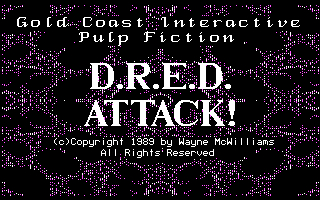
D.R.E.D. Attack!
In D.R.E.D. Attack!, you are suddenly dropped into a high-stakes emergency inside agency headquarters, typing commands into a command prompt to hold off an assault room by room.
Defending headquarters in D.R.E.D. Attack! demands sharp lateral thinking
The moment you boot up this adventure game, there is no long preamble or friendly warm-up phase. The emergency klaxons are metaphorically blaring across the text display, and your primary terminal expects immediate directions. As an operative for the D.R.E.D. agency, your home base has been breached by hostile forces, turning every hallway, office, and security depot into a potential tactical trap.
Text adventures live and die by their atmosphere and logic, and author Wayne McWilliams chose to make the home turf the battlefield. Instead of wandering through distant alien worlds or fantasy dungeons, you spend your time managing security access, searching desk drawers for keycards, and working out how to re-route elevator power while hostile intruders move through adjacent rooms. That sense of working against an active breach keeps the pressure on even when you are staring at static lines of green or white text.
Gold Coast Software stepped up the puzzle difficulty for the middle chapter
Released in 1989 as the second installment in a planned trilogy, the game sits right between Spectre Towers and City of Madness. While the first entry introduced the agency universe with relatively straightforward spatial puzzles, this chapter assumes you already know how to handle a strict text parser. Distributed through shareware channels by Gold Coast Software, it offered PC owners an affordable way to test their wits against software that did not require expensive computer rigs.
The hardware requirements were modest even for the late eighties, running smoothly on machines equipped with standard CGA or CGI display setups. That meant almost any office PC or budget home computer capable of running MS-DOS could execute the game without issue. However, the modest presentation masked a much stiffer challenge than its predecessor offered. Key items are frequently hidden behind multi-step environment puzzles, requiring you to examine details carefully before moving ahead:
- Inspect security panels and electrical breakers before attempting to unlock blast doors.
- Search office furniture and discarded maintenance gear to piece together security codes.
- Manage your active inventory space so you are not left helpless when an emergency arises.
- Save your game state frequently before entering unmapped sectors of the building.
If you miss a single detail during an initial room sweep, you can easily lock yourself out of a crucial area three floors later. That strict adherence to early text adventure conventions means trial and error is part of the experience.
Where the parser tests your patience during complex operations
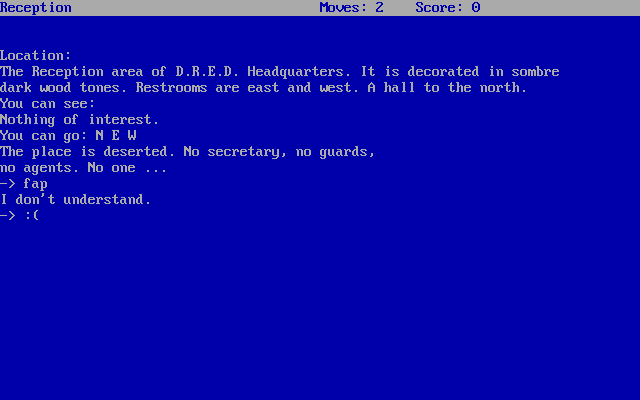
Every classic text adventure has a point where the player clashes with the parser's vocabulary, and this game is no exception. While basic actions like examining objects, opening doors, and taking inventory follow standard syntax, specific tactical actions sometimes require exact verb choices. You might know precisely what needs to be done with an item, but spending five minutes guessing whether the game expects you to apply, use, insert, or attach it can break the momentum of a close defense scenario.
When stacked alongside commercial releases of the era like Infocom's polished catalog, the raw text interface reveals its shareware roots. The environmental descriptions get straight to the point without much literary fluff, focusing entirely on practical details and available exits. For players who enjoy unravelling mechanical logic puzzles and tactical navigation, that stripped-down approach keeps the focus on clear-headed problem solving.
You can play D.R.E.D. Attack! free in your browser right now
For modern players who want to explore late-eighties shareware history, you can play D.R.E.D. Attack! online without needing to track down physical 5.25-inch floppy disks or configure custom system memory configurations. It holds value today as a crisp snapshot of how independent authors crafted intense sci-fi scenarios using little more than words and simple screen formatting.
Newcomers often assume that an eighties text adventure will be simple enough to breeze through in a single sitting, but the inventory restrictions and obscure terminal interactions will quickly set them straight. Keep a notepad nearby to sketch room maps and record security codes as you find them. You can launch this classic MS-DOS game directly in your browser with zero installation required, so step up to the terminal and see if you can clear headquarters before time runs out.