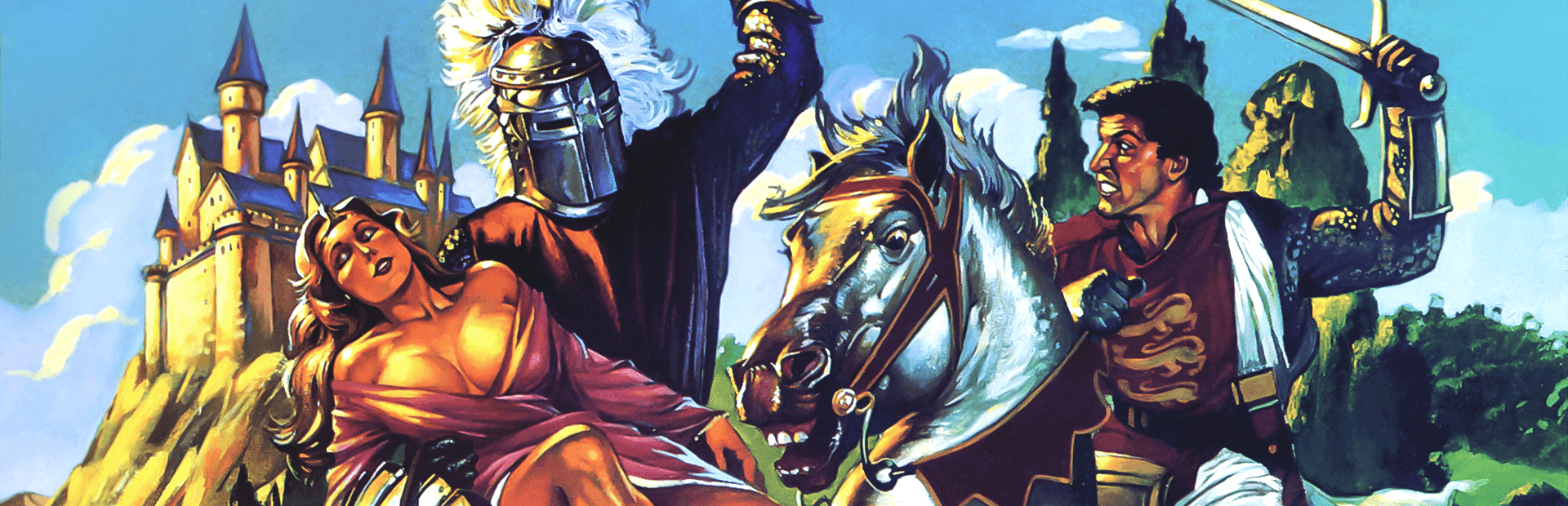
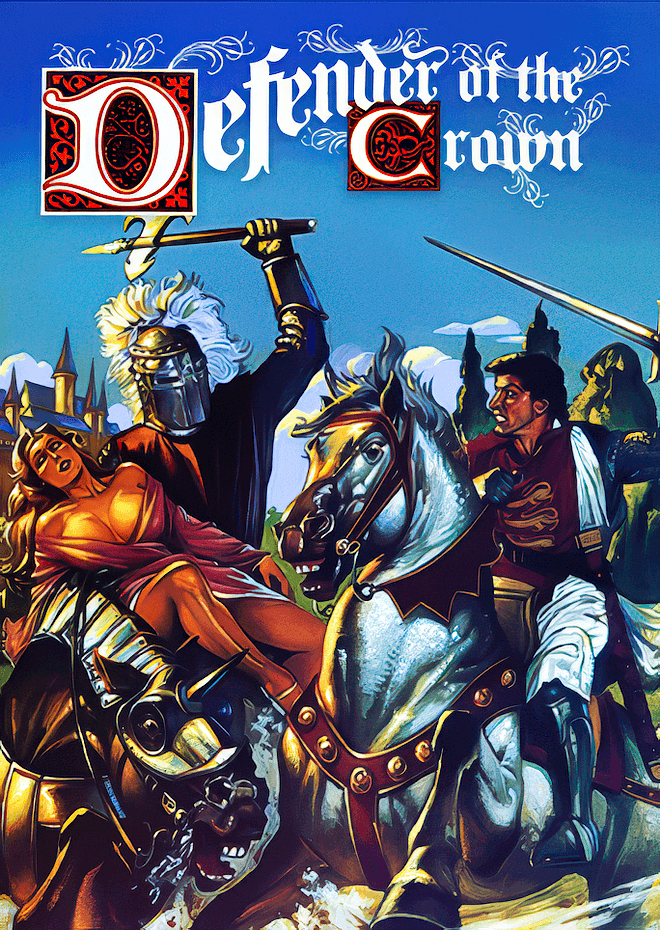
When you launch Defender of the Crown, medieval England splits into a frantic scramble between Saxon knights and Norman invaders. You pick your lord, hire your army, and trade map strategy for sword duels and jousting tournaments.
Conquering medieval England in Defender of the Crown
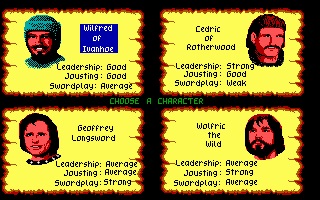
The king is dead, the crown has been stolen, and civil war burns across the countryside. You select one of four Saxon heroes: Wilfred of Ivanhoe, Cedric of Rotherwood, Geoffrey Longsword, or Wolfric the Wild. Each character brings a distinct balance of leadership, jousting skill, and swordfighting talent.
You begin your campaign holding a single castle and a modest force of ten soldiers. Surrounding your home territory is a map of divided English shires waiting for conquest. Three Norman lords threaten your survival from the east, while rival Saxon leaders contest control of the realm.
Every turn presents clear choices for your treasury. You can gather taxes from your shires, recruit regular soldiers, purchase heavily armored knights, or buy catapults for heavy siege work. When a battle turns against you, Robin Hood appears as an ally, though he will only lend his archers a handful of times per game.
Compared to other strategy games from 1987, the turn structure moves quickly. You shift from moving campaign armies across shires to triggering direct action sequences whenever forces clash.
Raid castles, aim catapults, and rescue princesses
The campaign map forms only half the experience. When you invade an enemy territory or host a tournament, the perspective drops into action minigames that demand direct timing.
Tournament jousts allow you to ride for land or personal fame. You adjust your lance sight as your horse gallops down the list. If you misjudge the alignment, you risk instantly killing your opponent's horse, costing you victory and honor.
Siege combat takes place outside enemy strongholds. You operate a catapult by adjusting the tension arm to throw boulders at stone walls. You must punch a wide breach in the ramparts before sending your army forward to storm the courtyard.
Night raids let you infiltrate enemy keeps to loot gold or rescue captured noblewomen. These raids resolve through side-scrolling sword duels. You advance and strike, driving enemy guards back down stone staircases.
- Jousting: Compete for land or glory by aiming your lance against rival knights.
- Castle Sieges: Knock down stone walls using catapult tension before launching an army attack.
- Night Raids: Duel enemy guards in sword fights to steal gold or rescue princesses.
- Territory Management: Collect income and build campaign armies to push across England.
Where the strategy layer wears thin
While the variety of action modes keeps early turns brisk, the overall depth is surprisingly light. Once you learn the specific timing for sword duels, enemy guards pose little threat.
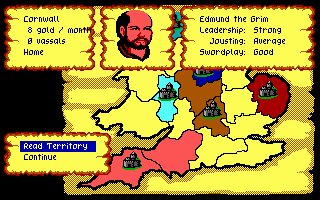
The campaign strategy layer is deliberately simple. Territorial management relies strictly on buying more troops, building garrisons, and marching toward rival castles. There are no diplomatic treaties, trade networks, or deep management trees to navigate.
Difficulty stems mostly from an uneven opening turn. Norman lords often start next to wealthier shires, allowing them to construct massive forces early in the game. If you fail to build a strong army immediately, a Norman commander will crush your army before you reach their home territory.
Controls in the action minigames can also feel sluggish. Driving your sword through enemy lines with keyboard controls requires patience, as response times feel heavy and unforgiving.
How porting to MS-DOS changed the formula
Designed and written by Kellyn Beeck with art direction by James D. Sachs, the title was originally pitched as an interactive movie. Programming credits listed Robert J. Mical for the underlying system technology.
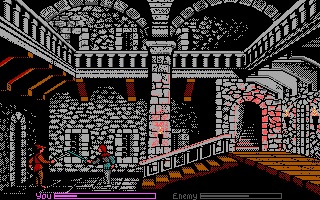
When the MS-DOS port arrived, developed by Master Designer Software, Inc. and published by Mindscape, Inc., several design tweaks altered the flow of play. Unlike earlier versions, the MS-DOS game allows you to purchase army units and pass your turn freely during your turn window.
The presentation gained immediate praise for its lavish visual design and cinematic music. Composer Jim Cuomo wrote an atmospheric score, orchestrated by Bill Williams, that gave the campaign a romantic tone even through standard internal PC speakers.
Despite limited action, the presentation carried real weight. It proved a PC title could put accurate historical detail right alongside genuine visual drama.
Play Defender of the Crown online today
The visual flair and memorable score still make this title an entertaining visit. The strategy layer is shallow and the dueling mechanics show their age, but taking over shires and tearing down castle walls remains fun.
Anyone who enjoys classic strategy tactics or wants to see early cinematic game design will find plenty to enjoy here. A full conquest run takes less than an hour once you understand the siege mechanics.
You can play Defender of the Crown online free in your browser right now. You do not need to install anything or set up old software drivers. Pick Ivanhoe as your hero, save your Robin Hood call for a tough siege, and aim your catapult high on your first castle attack.
How Defender of the Crown is played — the keys the game listens to, grouped by what they do.
- Action
Highlighted keys are mapped — hover or tap one to see what it does.
Key mappings for minigames use the numeric keypad and space bar according to available documentation.
Players' controls
Touch and gamepad controls
The on-screen keyboard and gamepad mapping the browser player uses on a phone, a tablet or a controller, as opposed to the real keys above. $PRO members make their own in the player and share them here; anyone can pick one to play with.
Make your own touch controlsPRO
- 1Open the editorSign in below, then pick what to make. The game starts with the editor open over it.
- 2Place your keysAdd keys and drag them where your thumbs rest, or map a controller's buttons. Test plays the game with them; Save keeps them, and you play with them from then on.
- 3Share themShare them right after saving in the game, or name and share them here. Players vote, and the best become this game's controls for everyone.
Go PROSee how it worksSign in+20 XP for sharing · +50 XP if yours become the game's own
- The game's own controlsKeyboardGamepadWhat every player starts with.In use
4 screenshots
From the archive
No gameplay video yet
No gameplay video for Defender of the Crown yet. Sign in to add one.
No reviews yet
Tell the community what you think of Defender of the Crown. Reviews are public and tied to your username.
No archived manuals for Defender of the Crown yet
No manuals archived for this title yet. Sign in to upload the first scan.
Cheat codes, console commands and memory pokes for Defender of the Crown — each one verified and attributed.
Sign in to submitNo cheats yet for this title
Know a working cheat, poke or trainer? Add it with the button above. Moderators check every entry before it goes live.
No archived soundtrack for Defender of the Crown yet
No soundtrack archived for this title yet. Sign in to upload the first rip.
No save states for Defender of the Crown yet
No save states for this title yet. Sign in to share one.
Discussions
Sign in to post- Threads0
- Total posts0
- Online now6
Community · Defender of the Crown
Who's contributing, and what's new
- Reviews0
- Threads0
- Uploadsapproved0
- Contributors0
Recent activity