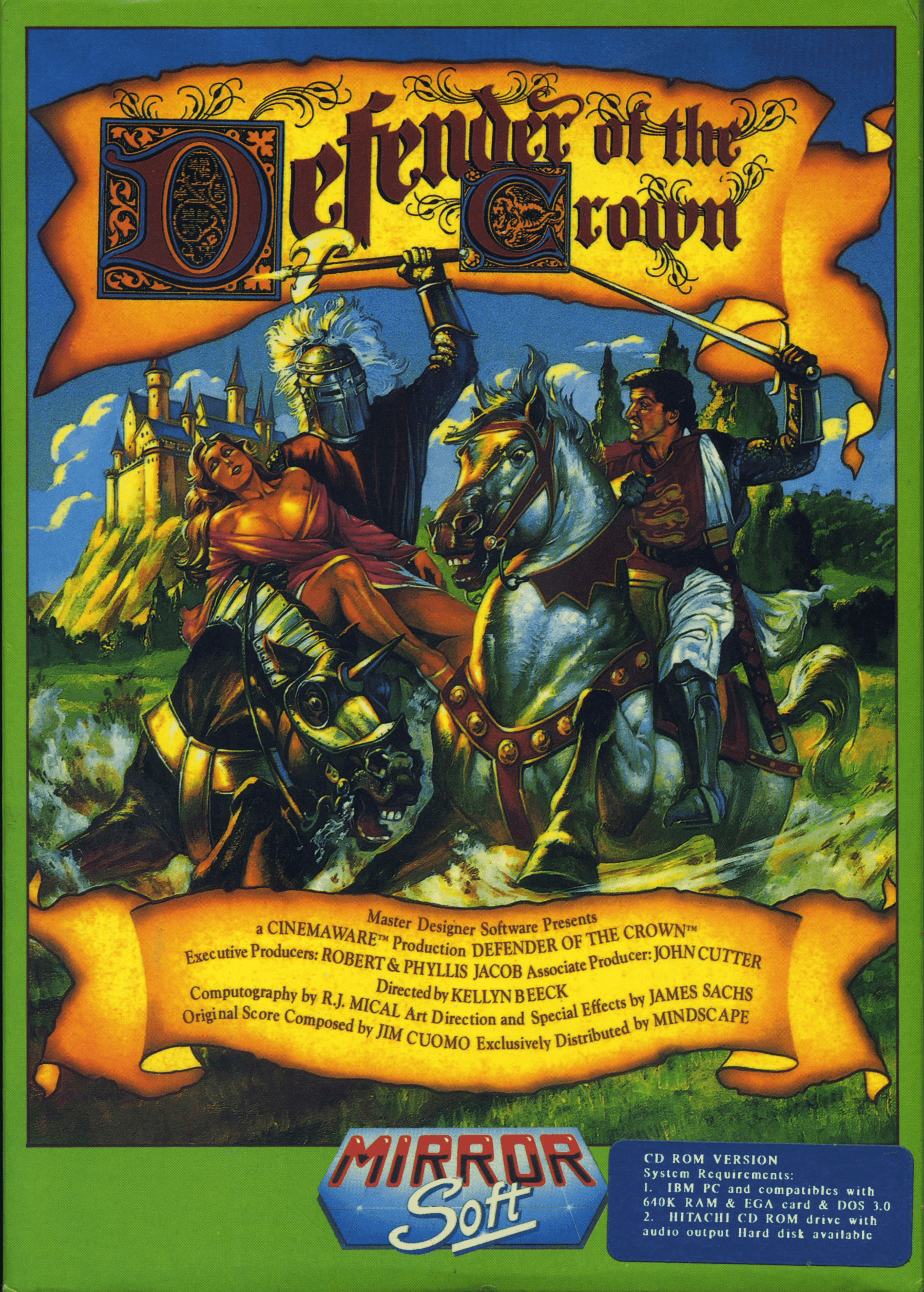
Defender of the Crown CD-ROM
Streaming build
Checking storage…191 MB
Preload in background
Playing Defender of the Crown CD-ROM today shows how cinematic presentation could mask simple mechanics in early strategy games. You play as a Saxon lord trying to unify medieval England through army management, castle sieges, and action minigames.
Choose your knight and map out your conquest
Every campaign begins on a colorful map of medieval England divided into territories. You select one of four Saxon knights: Wilfred of Ivanhoe, Cedric of Rotherwood, Geoffrey Longsword, or Wolfric the Wild. Each character brings slightly different stats for leadership, jousting, and swordplay.
Your primary goal is to wipe out three rival Norman lords before they take over the realm. You can also conquer territory held by neutral or friendly Saxons if you choose to expand aggressively. Your starting base consists of a single castle and 10 soldiers at your command.
Managing your income forms the core of the overarching map game. Every turn, income flows into your treasury based on how many territories you control. You use this gold to buy soldiers, knights, and catapults to bolster your army before sending forces across the map.
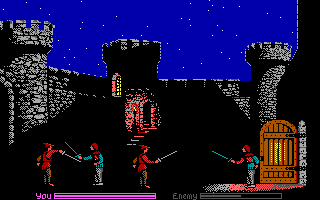
Action minigames replace traditional battle resolution in Defender of the Crown CD-ROM
When armies clash or you enter special events, the strategy mode shifts directly into action minigames. These active sequences decide the outcome of major military campaigns and personal rivalries.
The main activities you engage in include:
- Jousting tournaments: Aim your lance carefully while matching the speed of your opponent on horseback to knock him out of the saddle.
- Castle sieges: Load and launch catapult stones to smash down enemy walls before sending infantry through the breach.
- Castle raids: Cross swords with rival guards in real-time melee combat to steal gold from target vaults.
- Rescuing maidens: Fight through enemy halls during a raid to save a captive princess and secure potential political alliances.
In dire situations, you can call upon Robin of Locksley for help. Robin offers extra military support or assistance during raids up to three times per game.
Visual splendor over strategic depth
When the original 1987 release landed on PC screens, people bought it primarily for the presentation. Designer Kellyn Beck and artist James D. Sachs created artwork that looked like a painting come to life. Music composed by Jim Cuomo played over the PC speaker, giving early DOS users a distinct medieval soundtrack.
However, reviewers were split on whether the strategy held up. ACE praised the game with an 83% rating in 1988, while Happy Computer gave an early port a low 43% score in 1986. Later in 1990, Computer Gaming World assigned it a 50% rating, pointing out the overall lack of deep strategic options.
The game sold almost 750,000 copies across all platforms by late 1989. Developer Master Designer Software, Inc. and publisher Mindscape, Inc. had a commercial hit on their hands. Yet players quickly realized that once you mastered the minigame timing, holding territory became surprisingly simple.
Why minigames and save systems frustrate modern players
Action minigames sound exciting on paper, but their execution on MS-DOS relies heavily on strict timing windows. Jousting requires pixel-perfect lance placement. A slight error drops your lance too low or high, costing you land or prestige instantly.
Sword fights during raids suffer from similar control quirks. The keyboard response can feel stiff, making defensive maneuvers unpredictable when fighting past multiple guards in a castle corridor.
Early PC ports offered very limited save options, forcing long sessions without room for mistakes. If you suffer a bad run during a siege or throw away your main army in an ill-fated attack, recovery is almost impossible. The shallow mid-game loop offers few tactical fallbacks once your army strength collapses.
How to play Defender of the Crown CD-ROM online today
Despite its lightweight strategic depth, this game remains a fascinating slice of computer graphics history. Anyone looking for a classic strategy / tactics title with rich artwork will find plenty to enjoy for an evening.
You can play Defender of the Crown CD-ROM online free in your browser right here. Try picking Wilfred of Ivanhoe for your first campaign, buy a few soldiers right away, and test your aim in the catapult siege sequence to see how the classic mechanics feel without any setup needed.
Players' controls
Touch and gamepad controls
The on-screen keyboard and gamepad mapping the browser player uses on a phone, a tablet or a controller, as opposed to the real keys above. $PRO members make their own in the player and share them here; anyone can pick one to play with.
Make your own touch controlsPRO
- 1Open the editorSign in below, then pick what to make. The game starts with the editor open over it.
- 2Place your keysAdd keys and drag them where your thumbs rest, or map a controller's buttons. Test plays the game with them; Save keeps them, and you play with them from then on.
- 3Share themShare them right after saving in the game, or name and share them here. Players vote, and the best become this game's controls for everyone.
Go PROSee how it worksSign in+20 XP for sharing · +50 XP if yours become the game's own
- The game's own controlsNone yet: played with a real keyboard only.In use
2 screenshots
From the archive
No gameplay video yet
No gameplay video for Defender of the Crown CD-ROM yet. Sign in to add one.
No reviews yet
Tell the community what you think of Defender of the Crown CD-ROM. Reviews are public and tied to your username.
No archived manuals for Defender of the Crown CD-ROM yet
No manuals archived for this title yet. Sign in to upload the first scan.
Cheat codes, console commands and memory pokes for Defender of the Crown CD-ROM — each one verified and attributed.
Sign in to submitNo cheats yet for this title
Know a working cheat, poke or trainer? Add it with the button above. Moderators check every entry before it goes live.
No archived soundtrack for Defender of the Crown CD-ROM yet
No soundtrack archived for this title yet. Sign in to upload the first rip.
No save states for Defender of the Crown CD-ROM yet
No save states for this title yet. Sign in to share one.
Discussions
Sign in to post- Threads0
- Total posts0
- Online now6
Community · Defender of the Crown CD-ROM
Who's contributing, and what's new
- Reviews0
- Threads0
- Uploadsapproved0
- Contributors0
Recent activity
Nothing here yet
Reviews, discussion threads and approved uploads appear here as members add them.