

Launching Descent: Anniversary Edition throws you straight into tight, zero-gravity shafts where up and down cease to exist the moment an infected drill-bot dives from what you thought was the ceiling. Taking control of the Material Defender inside these maze-like mines demands that you unlearn every navigation habit built on flat floor plans.
Navigating full three-dimensional claustrophobia
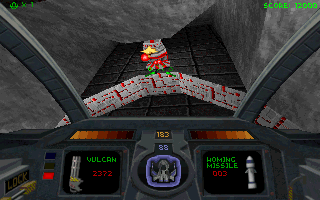
Most shooters from the middle of the decade kept your boots glued to a horizontal plane, but Parallax Software Corp. built their engine around complete freedom of movement. Founders Matt Toschlog and Mike Kulas constructed a polygon engine that allowed full pitch, roll, and yaw inside narrow off-world mining tunnels. You spin sideways to dodge plasma fire, bank hard past support beams, and slide backward up a vertical chute while tracking enemies overhead.
That freedom cuts both ways. Without a visible horizon, getting turned around inside a multi-level ore refinery happens within seconds. The wireframe automap helps, but mentally mapping a geometric labyrinth while dodging homing missiles takes work. The control scheme demands continuous adjustment of six distinct axes, which meant players in 1996 were constantly juggling keyboard strafing, joystick pitching, and mouse steering just to keep their crosshairs on target.
Blowing up reactors and sprinting for the exit tunnel
Every level follows a tight, demanding structure. You fly your craft into an off-world facility whose automated workers have been corrupted by an alien computer virus. Your job is to hunt down blue, yellow, and red keycards to open locked mine gates, clear out aggressive mechanical security, and locate the facility's central reactor.
Once you locate the main core, the game shifts gear into complete chaos. You lay into the reactor with high-energy fire until it explodes, triggering an immediate meltdown siren and a countdown timer. You then have to retrace your path through twisting tunnels toward the designated emergency exit shaft before the entire base collapses behind you. Missing the exit door by a fraction of a second destroys your ship and forfeits the level victory.
- Clear initial entry bays of automated mining bots and laser platforms.
- Navigate deep shafts to secure color-coded security keycards.
- Destroy the central reactor or defeat heavy boss units on designated levels.
- Locate and escape through the designated exit tunnel before the self-destruct timer hits zero.
What Descent: Anniversary Edition brings from the community
Published by Interplay Entertainment Corp. to mark one year since the original game debuted, this package expands the base game significantly. Alongside the complete original 30-level campaign and a selection of extra maps built directly by Parallax, it includes the Levels of the World add-on. That collection came out of an official level-design contest hosted by Computer Gaming World magazine, gathering winning levels, runners-up, and community submissions into a massive map pack.
The variety across these custom maps is immense. Because fans were pushing the engine's limits without developer constraints, you get unconventional layouts like "Paradox," a map that uses non-Euclidean geometry tricks to warp room connections in ways that confuse your sense of direction. Sorting through hundreds of user-submitted sectors lets you test your dogfighting skills against structural ideas the original developers never put into the standard campaign.
The penalty of standalone user maps
The sheer quantity of content comes with serious rough edges. Quality control across the community maps is wildly uneven. A level might follow a brilliantly designed central hub, while the very next entry dumps you into a bare, oversized cube crammed with dozens of heavy boss bots that turn the room into an unavoidable cloud of missile fire.
Technical limitations in how the expansion handles standalone user levels create another headache. When you load maps from the contest disk, the game treats every custom map as an independent single-level campaign. Your accumulated weapons, lives, and score do not carry over from one map to the next. Because the engine resets state upon loading each individual file, the background music continuously defaults back to the first level's track, which gets monotonous after a few map transitions.
Where the true 6DOF flight combat stands today
Even with those interface quirks, the core flight mechanics hold up as a pure test of reflex and orientation. The frantic rush of dropping into a dark maintenance shaft, hearing the screech of an infected driller behind you, and flipping upside down to counter-attack is just as sharp now as it was in this 1996 release. It rewards precise spatial thinking over simple twitch shooting, making it a distinct entry in the action genre.
You can play Descent: Anniversary Edition online free in your browser right now, with no setup required. Jump into the cockpit, invert your flight controls, and see if you can handle the sudden shift from horizontal corridors to full zero-gravity dogfighting without losing your bearings.