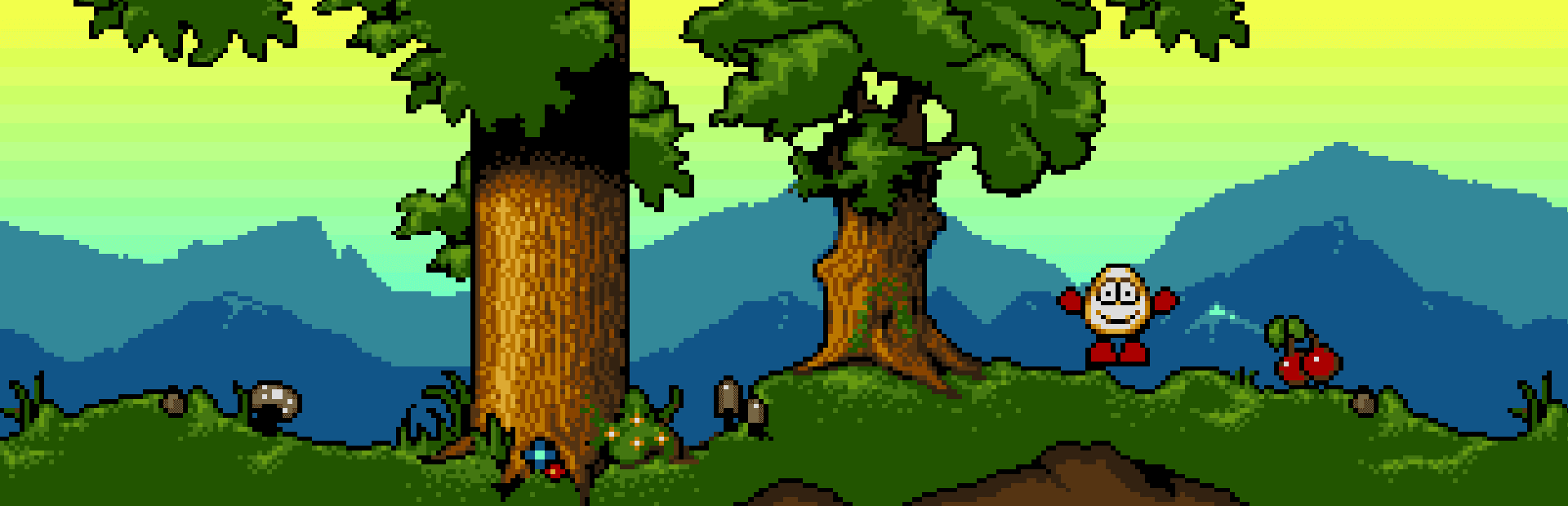
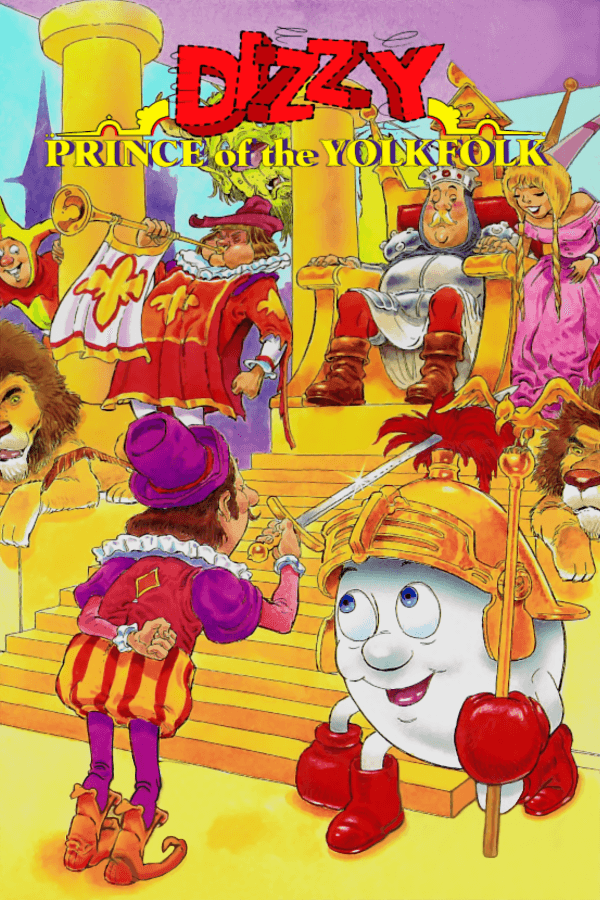

You start Dizzy: Prince of the Yolkfolk trapped in an underground dungeon cell with a three-item inventory, an uncontrollable somersault on every jump, and twenty cherries scattered across a fairytale kingdom.
The mechanics that make Dizzy: Prince of the Yolkfolk a high-stakes puzzle platformer
Every step in this game hangs off a single, unforgiving design choice: Dizzy does not merely land when he hits the floor, he rolls. Jump toward a narrow ledge and the physics engine forces your egg-shaped hero into a somersault that carries him several paces past his landing spot. One miscalculated hop near water or a drop off a cliff instantly costs a life, turning basic traversal into an exercise in spatial awareness.
That physical friction creates an unusual tension when paired with traditional inventory puzzles. Created by the Oliver Twins and outsourced to The Big Red Software Company Ltd., this entry was designed by Jon Cartwright, Peter Ranson, and Paul Ranson, with art managed by Shân Savage. It condenses the sprawling layout of earlier entries into a tighter, hit-and-run structure where almost every screen holds a tool, a character, or a hazard.
Because you can only carry three items at a time, you are constantly making tactical choices about what to haul across the map. Drop a key to pick up a bucket of water, or leave a trumpet behind while you fetch a thorn for a thorn-afflicted lion. The tight inventory limit turns the map into a logistically demanding maze, forcing you to memorize where you left crucial items on the dirt floors of the forest.
An inventory puzzle set inside an interconnected fairytale world
The adventure opens inside an underground prison cell after an errant magic spell goes sideways. Rockwart the Troll has put Daisy into an enchanted sleep slated to last a hundred years, and your job is to escape the subterranean depths, make your way through the castle, navigate the treetops of an enchanted forest, and find a way to wake her up. Along the way, hazards like the Grim Reaper, rogue fireballs, tumbling boulders, and bottomless water pits threaten to destroy your tiny egg frame.
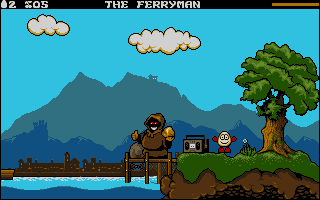
Progression is built around trading gear with non-player characters to clear obstacles. You might need to secure a rope to cross a chasm, find a lost trumpet to wake a sleeping guard, or use a key to open locked cloud cells up in the sky. If you want to sample this classic style of action platforming, checking out the 1993 Codemasters release gives a clear picture of how European microcomputer puzzle designs translated to PCs.
To help survive the gauntlet, the developers scattered 20 red cherries across the screens. Each cherry you touch refills a portion of your health bar, acting as a crucial safety net when environmental hazards chip away at your stamina. They also serve as a final completion metric, encouraging full exploration of every nook and hidden branch in the treetops.
Why the DOS conversion split critics and frustrated desktop players
When this edition hit IBM-compatible PCs, period magazines gave it a mixed reception. The UK television text magazine Digitiser awarded it an 80% rating, praising its bright visual flair and lighthearted tone. Germany's Aktueller Software Markt was far more reserved, handing down a 67% score. While reviewers consistently enjoyed the detailed visual presentation and witty character dialogue, technical flaws on the PC platform drew sharp criticism.
The speech windows in this edition were notorious for overlapping each other during conversations, scrambling the dialogue on screen into an unreadable mess. Sound was another sticking point: while PC Speaker and Sound Blaster hardware rendered the sound effects decently enough, the background tune repeated endlessly on a short loop that driven players to turn off their speakers. The lack of any save feature or password system meant that a single bad jump into a body of water late in the quest wiped out all progress, forcing players to restart from the cell.
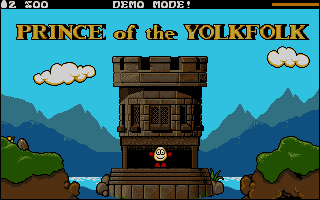
Despite these headaches, the visual conversion translates the colorful fairytale art cleanly across both VGA and EGA display modes. The detailed background brickwork in the castle dungeons and the lush leafy canopy of the forest showed off what standard PC displays could do with microcomputer graphics of the period, even if the flighty jump physics remained infamously fussy to control with a standard keyboard.
The myth of the missable cherry and a twenty-minute run
Among long-time fans, no topic sparks as much debate as the twentieth cherry. A persistent urban legend claimed that one of the twenty fruit collectibles was permanently missable if you triggered certain environment events or dropped items in the wrong order. In truth, every cherry on the map remains accessible throughout the entire run, provided you know where to walk and how to trigger the hidden paths hidden in the forest background.
Once you figure out the exact sequence of items to trade and memorize where every trap sits, the sheer brevity of the map becomes clear. A full run of this Dizzy: Prince of the Yolkfolk MS-DOS game can be finished in as little as twenty minutes by an experienced player. The real runtime comes from the trial-and-error process of discovering which item belongs to which character while attempting not to roll off a ledge into instant-death water.
That brevity works in its favor today. Rather than dragging out its mechanics across dozens of identical levels, the adventure gives you a self-contained world where every screen contains a specific puzzle piece or environmental hazard to untangle.
How to play Dizzy: Prince of the Yolkfolk online today
The appeal of this entry lies in its absolute clarity of purpose. While the fussy jump physics and complete lack of mid-game saving will test your patience, the tight world design and satisfying item chains offer a direct window into early nineties European computer design. Anyone who enjoys microcomputer puzzle adventures should put an hour into mastering its rolling jump physics.
You can play Dizzy: Prince of the Yolkfolk online right now, getting Dizzy: Prince of the Yolkfolk free in your browser without downloading files or setting up custom software. When you start your escape from the underground cell, remember to jump early when approaching ledges so that your post-landing roll does not carry you straight into the nearest pit. Grab the first key, manage your limited inventory wisely, and see if you can wake Daisy before your lives run out.
How Dizzy: Prince of the Yolkfolk is played — the keys the game listens to, grouped by what they do.
- Movement
- Action
- Interface
Highlighted keys are mapped — hover or tap one to see what it does.
Players' controls
Touch and gamepad controls
The on-screen keyboard and gamepad mapping the browser player uses on a phone, a tablet or a controller, as opposed to the real keys above. $PRO members make their own in the player and share them here; anyone can pick one to play with.
Make your own touch controlsPRO
- 1Open the editorSign in below, then pick what to make. The game starts with the editor open over it.
- 2Place your keysAdd keys and drag them where your thumbs rest, or map a controller's buttons. Test plays the game with them; Save keeps them, and you play with them from then on.
- 3Share themShare them right after saving in the game, or name and share them here. Players vote, and the best become this game's controls for everyone.
Go PROSee how it worksSign in+20 XP for sharing · +50 XP if yours become the game's own
- The game's own controlsKeyboardGamepadWhat every player starts with.In use
2 screenshots
From the archive
No gameplay video yet
No gameplay video for Dizzy: Prince of the Yolkfolk yet. Sign in to add one.
No reviews yet
Tell the community what you think of Dizzy: Prince of the Yolkfolk. Reviews are public and tied to your username.
No archived manuals for Dizzy: Prince of the Yolkfolk yet
No manuals archived for this title yet. Sign in to upload the first scan.
Cheat codes, console commands and memory pokes for Dizzy: Prince of the Yolkfolk — each one verified and attributed.
Sign in to submitNo cheats yet for this title
Know a working cheat, poke or trainer? Add it with the button above. Moderators check every entry before it goes live.
No archived soundtrack for Dizzy: Prince of the Yolkfolk yet
No soundtrack archived for this title yet. Sign in to upload the first rip.
No save states for Dizzy: Prince of the Yolkfolk yet
No save states for this title yet. Sign in to share one.
Discussions
Sign in to post- Threads0
- Total posts0
- Online now6
Community · Dizzy: Prince of the Yolkfolk
Who's contributing, and what's new
- Reviews0
- Threads0
- Uploadsapproved0
- Contributors0
Recent activity