
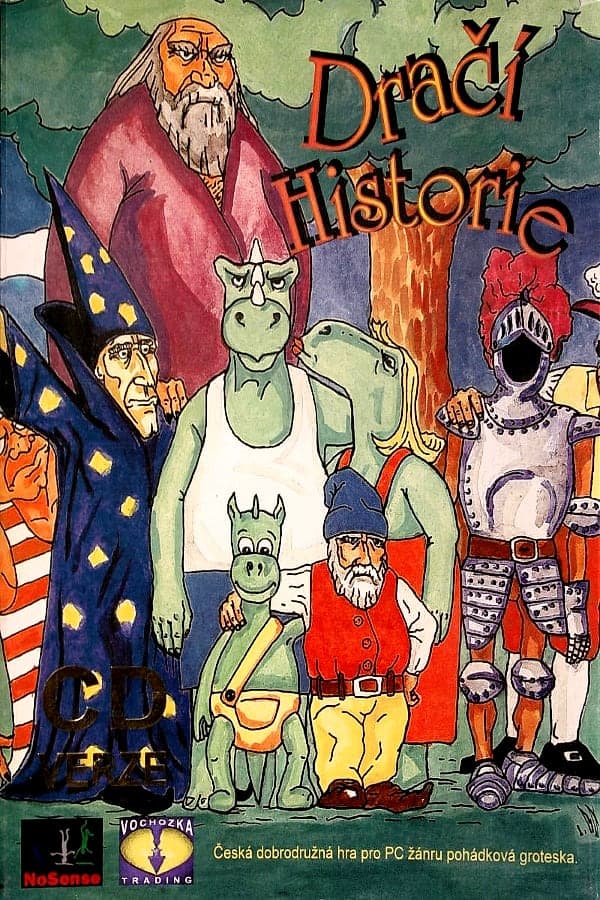
If you played Dragon History back in 1995, you probably spent hours dragging inventory items over every pixel of its forty fixed screens just to see what ridiculous reaction you would get next.
You play as Bert, a young dragon living in a peaceful fantasy land where dragons wear clothes and co-exist with humans. Your father Herbert goes missing while hunting for treasure, leaving you at home. Things quickly get worse when an evil magical wand named Evelyn tricks you into casting a petrifying spell on a troupe of theater puppets. To fix your mess, you have to pack your bag, explore the kingdom, and track down your father.
The core mechanics follow standard third-person adventure game conventions of the era. Moving your cursor to the top of the screen opens your inventory, which is styled as a brown cloth sack. Moving to the bottom opens an overhead map. Unlocking new areas automatically adds them to this map, allowing you to jump across the world without tedious backtracking.
The control scheme keeps things minimal. Left-clicking an object describes it, while right-clicking performs context-sensitive interactions. Dialogue uses classic branching topic trees at the bottom of the screen. Instead of choosing verbs from a grid, you interact directly with the environment, which keeps the screen uncluttered.
The biggest hurdle in this 1995 release is its inventory logic. While the world is full of charm, solving puzzles often requires bizarre leaps of imagination. You will meet grazing chairs, talking tree stumps, a dwarf-eating giant, and a lazy guy equipped with a bun thrower. Trying to figure out what item satisfies which surreal character leads to constant trial and error.
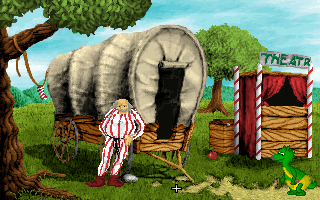
Combining items in your sack rarely feels intuitive. Contemporary reviewer Andrej Anastasov famously gave it a 60% score in Score magazine, praising the visuals while slamming its illogical puzzles. Players frequently got stuck simply because the game expected them to use items in ways no sensible person would attempt. If you do not consult a guide, expect to rub every single object against every character on the screen.
Despite the frustrating progression walls, the local world retains a distinct personality. The art team included Jakub Dvorský, who later founded Amanita Design. You can see the early seeds of his distinct artistic style in the organic, hand-drawn background landscapes.
At the time of release, NoSense and publisher Vochozka Trading pulled off a major technical milestone. This was the first Czech title to ship with full speech audio recorded onto CD-ROM. The developers used standard Sound Blaster configurations, mixing digitized speech files alongside background MIDI tracks.
The voice cast was made up of non-professional student actors from a local theater group. Among those young performers were Iva Pazderková and Jan Budař, who both went on to build successful acting careers. The dubbing gives the game a warm, homemade feel, even if the amateur delivery occasionally grates during longer conversations.
Commercial performance was strong for its home market, selling roughly 7,000 physical copies. Years after its retail run, it reached an even wider audience when local gaming magazines distributed the full game on cover CDs. In 2006, original programmer Robert Špalek released the source code under the GPLv2 license, allowing the ScummVM team to integrate it fully into modern platforms.
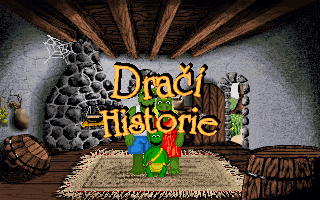
If you want to play it today, you have to accept how PC games worked back then. The detailed hand-drawn screens still look clear, and the soundtrack has a cozy synth hum. The obscure puzzle design is the main hurdle, and it will test your patience quickly.
There is plenty to dig into here if you like nineties adventures. Magazine scores swung wildly on release, from a harsh 60% up to 92% in Riki, but the presentation makes it worth a look. Just keep a walkthrough handy for when the item combinations stop making sense.
You can play Dragon History online right now. You can run this complete Dragon History MS-DOS game free in your browser with zero installation, full audio support, and instant loading. Jump straight into Bert's odd little journey and see how long you survive without looking up the solutions.
If you played Dragon History back in 1995, you probably spent hours dragging inventory items over every pixel of its forty fixed screens just to see what ridiculous reaction you would get next.
You play as Bert, a young dragon living in a peaceful fantasy land where dragons wear clothes and co-exist with humans. Your father Herbert goes missing while hunting for treasure, leaving you at home. Things quickly get worse when an evil magical wand named Evelyn tricks you into casting a petrifying spell on a troupe of theater puppets. To fix your mess, you have to pack your bag, explore the kingdom, and track down your father.
The core mechanics follow standard third-person adventure game conventions of the era. Moving your cursor to the top of the screen opens your inventory, which is styled as a brown cloth sack. Moving to the bottom opens an overhead map. Unlocking new areas automatically adds them to this map, allowing you to jump across the world without tedious backtracking.
The control scheme keeps things minimal. Left-clicking an object describes it, while right-clicking performs context-sensitive interactions. Dialogue uses classic branching topic trees at the bottom of the screen. Instead of choosing verbs from a grid, you interact directly with the environment, which keeps the screen uncluttered.
The biggest hurdle in this 1995 release is its inventory logic. While the world is full of charm, solving puzzles often requires bizarre leaps of imagination. You will meet grazing chairs, talking tree stumps, a dwarf-eating giant, and a lazy guy equipped with a bun thrower. Trying to figure out what item satisfies which surreal character leads to constant trial and error.
Combining items in your sack rarely feels intuitive. Contemporary reviewer Andrej Anastasov famously gave it a 60% score in Score magazine, praising the visuals while slamming its illogical puzzles. Players frequently got stuck simply because the game expected them to use items in ways no sensible person would attempt. If you do not consult a guide, expect to rub every single object against every character on the screen.
Despite the frustrating progression walls, the local world retains a distinct personality. The art team included Jakub Dvorský, who later founded Amanita Design. You can see the early seeds of his distinct artistic style in the organic, hand-drawn background landscapes.
At the time of release, NoSense and publisher Vochozka Trading pulled off a major technical milestone. This was the first Czech title to ship with full speech audio recorded onto CD-ROM. The developers used standard Sound Blaster configurations, mixing digitized speech files alongside background MIDI tracks.
The voice cast was made up of non-professional student actors from a local theater group. Among those young performers were Iva Pazderková and Jan Budař, who both went on to build successful acting careers. The dubbing gives the game a warm, homemade feel, even if the amateur delivery occasionally grates during longer conversations.
Commercial performance was strong for its home market, selling roughly 7,000 physical copies. Years after its retail run, it reached an even wider audience when local gaming magazines distributed the full game on cover CDs. In 2006, original programmer Robert Špalek released the source code under the GPLv2 license, allowing the ScummVM team to integrate it fully into modern platforms.
If you want to play it today, you have to accept how PC games worked back then. The detailed hand-drawn screens still look clear, and the soundtrack has a cozy synth hum. The obscure puzzle design is the main hurdle, and it will test your patience quickly.
There is plenty to dig into here if you like nineties adventures. Magazine scores swung wildly on release, from a harsh 60% up to 92% in Riki, but the presentation makes it worth a look. Just keep a walkthrough handy for when the item combinations stop making sense.
You can play Dragon History online right now. You can run this complete Dragon History MS-DOS game free in your browser with zero installation, full audio support, and instant loading. Jump straight into Bert's odd little journey and see how long you survive without looking up the solutions.
How Dragon History is played — the keys the game listens to, grouped by what they do.
Highlighted keys are mapped — hover or tap one to see what it does.
Key mapping compiled from ScummVM documentation for Dragon History on MS-DOS. SETUP.EXE handles sound configuration.
The on-screen keyboard and gamepad mapping the browser player uses on a phone, a tablet or a controller, as opposed to the real keys above. $PRO members make their own in the player and share them here; anyone can pick one to play with.
Cheat codes, console commands and memory pokes for Dragon History — each one verified and attributed.
Sign in to submitaka Dračí historie · Dračí Historie · Smocze Historie
How Dragon History is played — the keys the game listens to, grouped by what they do.
Highlighted keys are mapped — hover or tap one to see what it does.
Key mapping compiled from ScummVM documentation for Dragon History on MS-DOS. SETUP.EXE handles sound configuration.
The on-screen keyboard and gamepad mapping the browser player uses on a phone, a tablet or a controller, as opposed to the real keys above. $PRO members make their own in the player and share them here; anyone can pick one to play with.
Cheat codes, console commands and memory pokes for Dragon History — each one verified and attributed.
Sign in to submit