
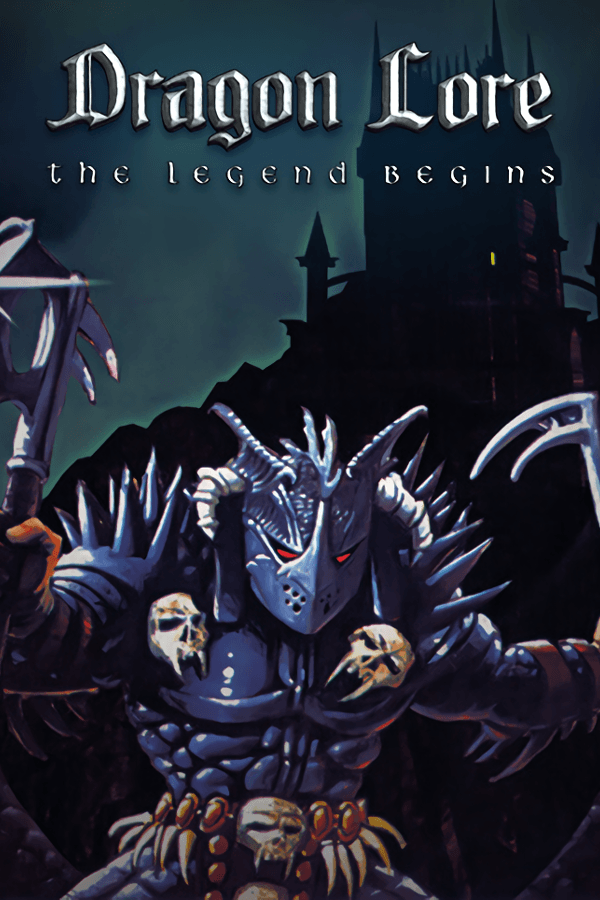

Before Myst turned pre-rendered adventure games into quiet, contemplative puzzle boxes, Cryo Interactive tried to cram full-motion video, stat-based choices, and real-time swordfighting into Dragon Lore: The Legend Begins.
In the early nineties, CD-ROM drives left developers with a massive amount of storage space and very little processing power to manipulate 3D space in real time. Most studios settled for static slides or pre-baked slideshows. Developer Cryo Interactive Entertainment chose a far more expensive path, rendering smooth, animated transitions between every step in their 1994 release, published by Mindscape, Inc.
You step into the boots of Werner von Wallenrod, a young farm hand who discovers his late father Axel was an assassinated Dragon Knight. To reclaim your estate and avenge your family, you have to cross a sprawling fantasy valley and earn the votes of 16 surviving Dragon Knights. Instead of teleporting between room nodes, every step forward plays a short FMV sequence that glides you through the environment, giving the world a surprisingly physical presence for a floppy-era engine adapted for CD.
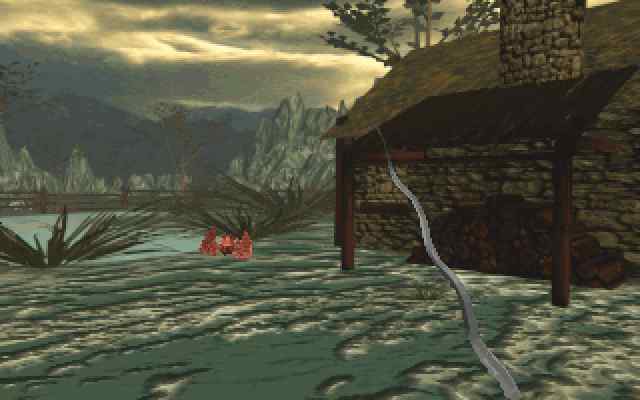
The trade-off for all those fluid transitions shows up immediately in the geometry. Textures across the terrain can look muddy, and character models are notoriously boxy, stiffness included. Still, compared to the rigid screen-swapping of contemporary point-and-click adventure games, moving through Werner's surroundings felt like walking through a tangible, continuous map.
The journey starts at Werner's home farm, which acts as a safe environment to learn the interface before sending you into dangerous territory. You collect items, manage a traditional inventory grid, and talk with local characters to figure out your path. Early on, the game introduces an alignment system split between force and wisdom. Solving problems with brute power or patient dialogue reshapes Werner's stats, which directly influences how each Dragon Knight reacts when you ask for their vote.
While the puzzle design relies on straightforward item collection and character interaction, the real-time combat is where most runs fall apart. When an enemy steps into your path, the interface shifts into a first-person melee duel using swords, maces, shields, and battle-axes. Rather than relying on tactical positioning, victory usually comes down to frantic, repetitive mouse clicking while praying your attacks land before your health bar empties.
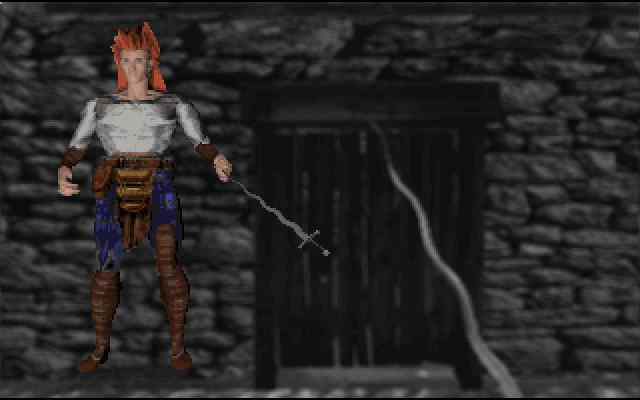
The controls make dodging almost impossible. Navigating the cursor over awkwardly shaped interface hotspots during an intense encounter frequently results in missed swings or accidental movement clicks. Anyone trying to play this Dragon Lore: The Legend Begins MS-DOS game knew the frustration of dying simply because the mouse pointer failed to register on a tiny action button.
If you played the original Version 1 release, you might remember hearing the same single music track looping endlessly across every region. Cryo quickly rectified this audio shortage with the "Gold" Version 2 release, which brought in a massively expanded soundtrack by composer Stéphane Picq. Heard through a Sound Blaster 16 or Sound Blaster Pro, Picq's synth compositions gave each district in the valley its own distinct, moody atmosphere.
Version 1 also contained a notorious bug involving a fight with an enemy named Heleynea. Instead of triggering a standard battle sequence, the software frequently defaulted to registering an automatic surrender, robbing players of a fair fight. Digging into the game's original files reveals plenty of cut content that never quite made it past the cutting room floor, including extra dialogue lines, unused map data, and FMV clips for a carnivorous plant monster.
Despite its mechanical friction, the title proved to be a commercial success, selling over 300,000 copies by 1997. Ported to the 3DO in 1995 and the PC-98 in 1996, it eventually spawned a 1996 sequel, Dragon Lore II: The Heart of the Dragon Man. Yet it is the original's strange combination of FMV exploration and heavy fantasy world-building that people remember best.
This is a game worth visiting if you want to experience a unique bridge between old-school fantasy roleplaying and mid-nineties CD-ROM tech experiments. The combat will test your patience and the cursor navigation feels deliberately heavy, but the world design and atmospheric soundtrack hold a specific charm that static slideshows never matched. If you want to see how early pre-rendered graphics tried to emulate an open world, it deserves a spot on your weekend list.
You can play Dragon Lore: The Legend Begins free in your browser right here, with no extra setup required. The pre-rendered transitions and Stéphane Picq's FM synthesis audio lose their impact in recorded videos, but launching the actual game reveals how impressive those rendered step transitions felt back in 1994. Fire up the tutorial on Werner's farm, pick up your first sword, and see if you have what it takes to earn the votes of the order. You can easily play Dragon Lore: The Legend Begins online today and experience this piece of DOS history firsthand.
Before Myst turned pre-rendered adventure games into quiet, contemplative puzzle boxes, Cryo Interactive tried to cram full-motion video, stat-based choices, and real-time swordfighting into Dragon Lore: The Legend Begins.
In the early nineties, CD-ROM drives left developers with a massive amount of storage space and very little processing power to manipulate 3D space in real time. Most studios settled for static slides or pre-baked slideshows. Developer Cryo Interactive Entertainment chose a far more expensive path, rendering smooth, animated transitions between every step in their 1994 release, published by Mindscape, Inc.
You step into the boots of Werner von Wallenrod, a young farm hand who discovers his late father Axel was an assassinated Dragon Knight. To reclaim your estate and avenge your family, you have to cross a sprawling fantasy valley and earn the votes of 16 surviving Dragon Knights. Instead of teleporting between room nodes, every step forward plays a short FMV sequence that glides you through the environment, giving the world a surprisingly physical presence for a floppy-era engine adapted for CD.
The trade-off for all those fluid transitions shows up immediately in the geometry. Textures across the terrain can look muddy, and character models are notoriously boxy, stiffness included. Still, compared to the rigid screen-swapping of contemporary point-and-click adventure games, moving through Werner's surroundings felt like walking through a tangible, continuous map.
The journey starts at Werner's home farm, which acts as a safe environment to learn the interface before sending you into dangerous territory. You collect items, manage a traditional inventory grid, and talk with local characters to figure out your path. Early on, the game introduces an alignment system split between force and wisdom. Solving problems with brute power or patient dialogue reshapes Werner's stats, which directly influences how each Dragon Knight reacts when you ask for their vote.
While the puzzle design relies on straightforward item collection and character interaction, the real-time combat is where most runs fall apart. When an enemy steps into your path, the interface shifts into a first-person melee duel using swords, maces, shields, and battle-axes. Rather than relying on tactical positioning, victory usually comes down to frantic, repetitive mouse clicking while praying your attacks land before your health bar empties.
The controls make dodging almost impossible. Navigating the cursor over awkwardly shaped interface hotspots during an intense encounter frequently results in missed swings or accidental movement clicks. Anyone trying to play this Dragon Lore: The Legend Begins MS-DOS game knew the frustration of dying simply because the mouse pointer failed to register on a tiny action button.
If you played the original Version 1 release, you might remember hearing the same single music track looping endlessly across every region. Cryo quickly rectified this audio shortage with the "Gold" Version 2 release, which brought in a massively expanded soundtrack by composer Stéphane Picq. Heard through a Sound Blaster 16 or Sound Blaster Pro, Picq's synth compositions gave each district in the valley its own distinct, moody atmosphere.
Version 1 also contained a notorious bug involving a fight with an enemy named Heleynea. Instead of triggering a standard battle sequence, the software frequently defaulted to registering an automatic surrender, robbing players of a fair fight. Digging into the game's original files reveals plenty of cut content that never quite made it past the cutting room floor, including extra dialogue lines, unused map data, and FMV clips for a carnivorous plant monster.
Despite its mechanical friction, the title proved to be a commercial success, selling over 300,000 copies by 1997. Ported to the 3DO in 1995 and the PC-98 in 1996, it eventually spawned a 1996 sequel, Dragon Lore II: The Heart of the Dragon Man. Yet it is the original's strange combination of FMV exploration and heavy fantasy world-building that people remember best.
This is a game worth visiting if you want to experience a unique bridge between old-school fantasy roleplaying and mid-nineties CD-ROM tech experiments. The combat will test your patience and the cursor navigation feels deliberately heavy, but the world design and atmospheric soundtrack hold a specific charm that static slideshows never matched. If you want to see how early pre-rendered graphics tried to emulate an open world, it deserves a spot on your weekend list.
You can play Dragon Lore: The Legend Begins free in your browser right here, with no extra setup required. The pre-rendered transitions and Stéphane Picq's FM synthesis audio lose their impact in recorded videos, but launching the actual game reveals how impressive those rendered step transitions felt back in 1994. Fire up the tutorial on Werner's farm, pick up your first sword, and see if you have what it takes to earn the votes of the order. You can easily play Dragon Lore: The Legend Begins online today and experience this piece of DOS history firsthand.
How Dragon Lore: The Legend Begins is played — the keys the game listens to, grouped by what they do.
Highlighted keys are mapped — hover or tap one to see what it does.
Control information is limited to mouse interaction from strategy guide sources.
The on-screen keyboard and gamepad mapping the browser player uses on a phone, a tablet or a controller, as opposed to the real keys above. $PRO members make their own in the player and share them here; anyone can pick one to play with.
Cheat codes, console commands and memory pokes for Dragon Lore: The Legend Begins — each one verified and attributed.
Sign in to submitHow Dragon Lore: The Legend Begins is played — the keys the game listens to, grouped by what they do.
Highlighted keys are mapped — hover or tap one to see what it does.
Control information is limited to mouse interaction from strategy guide sources.
The on-screen keyboard and gamepad mapping the browser player uses on a phone, a tablet or a controller, as opposed to the real keys above. $PRO members make their own in the player and share them here; anyone can pick one to play with.
Cheat codes, console commands and memory pokes for Dragon Lore: The Legend Begins — each one verified and attributed.
Sign in to submit