
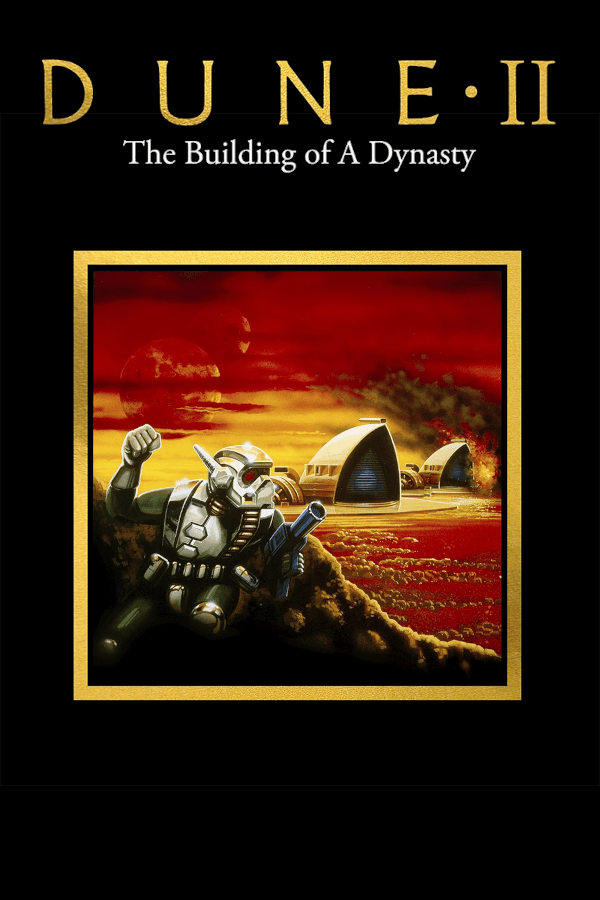

In Dune II: The Building of a Dynasty, ordering an army to attack requires selecting a single tank, clicking the Attack command on a side panel, and then clicking the target, repeated for every single vehicle in your force. That demanding control scheme defined the foundational real-time strategy design on MS-DOS, where surviving on Arrakis meant wrestling with your own command interface as much as the opposing Houses.
When you start a territory on Arrakis, your immediate concern is not the enemy base hidden behind the fog of war, but the grey rock beneath your tracks. Ground vehicles can travel across open sand, but permanent structures crumble instantly if you try to build them directly on dunes. You must drop down concrete slabs first, creating a solid foundation for windtraps to power your base and spice refineries to process your income.
The entire economy runs on spice, harvested by slow, bulky tracked harvesters that trundle out onto the open desert. Sand is also where the planet's native apex predator lives. Giant sandworms roam the dunes outside your rock outcroppings, drawn by the vibrations of heavy machinery. If a worm catches your harvester out in the open, it swallows the entire vehicle and its cargo in one bite, wiping out minutes of financial planning in a second.
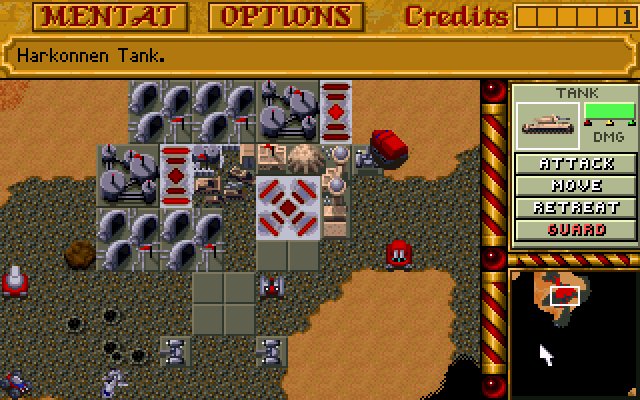
Once your refineries convert harvested spice into credits, you build radar stations to clear the map display, build repair bays to patch up damaged armor, and construct heavy factories for mechanized warfare. Combat is direct and unforgiving. Enemy forces strike early and test your perimeter turrets, forcing you to balance building economic infrastructure against pumping out light infantry and combat tanks.
Westwood Studios structured the campaign around three playable factions: the honorable Atreides, the cruel Harkonnen, and House Ordos, a faction created entirely by the developers for this game because it never appeared in Frank Herbert's original novel. Each faction shares basic buildings and standard tanks, but their late-game options diverge completely through special units and palace abilities.
The Harkonnen rely on raw brute strength, deploying massive, slow-moving Devastator tanks that take enormous punishment and explode violently when destroyed. House Ordos uses stealth and deception, building fast Deviator tanks that fire gas warheads to temporarily turn enemy units against their own allies. House Atreides relies on Sonic Tanks that blast destructive acoustic waves in a straight line, and their palace allows you to summon groups of native Fremen warriors who raid enemy positions automatically.
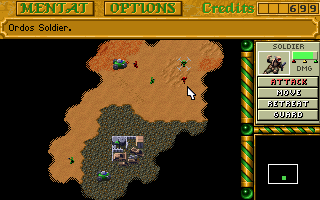
The biggest obstacle to managing these army match-ups is the control system. Westwood Studios, Inc. had not yet invented group selection or click-and-drag box selection. To move six siege tanks across a ridge, you must click the first tank, move your cursor to the command menu to select "Move" or "Attack", click the destination, and then repeat those exact steps for the other five tanks individually. When a surprise attack hits your flank, managing your army feels like fire drills carried out through a keyhole.
For a 1992 release, the technical presentation on PC was far ahead of typical top-down releases. Hearing digitized speech say "Unit reporting" or "Construction complete" through a Sound Blaster card gave the battlefield a gritty, military tactical feel. Combined with a Roland Sound Canvas card, the soundtrack composed by Frank Klepacki and Dwight Okahara delivered an incredible atmospheric backdrop to the tension on screen.
That audio setup came with an annoying quirk at launch. The original installation program did not let you pick separate hardware configurations for music and speech, meaning players who owned both a speech-capable Sound Blaster and a Roland synth card needed a separate patch utility from Virgin Interactive Entertainment, Inc. to get both working at the same time. The physical game box also relied on manual-based copy protection, forcing players to identify specific vehicle blueprints in the manual before starting a campaign.
The computer opponent is straightforward to manipulate once you understand its target priorities. The computer AI aggressively zeroes in on high-value targets like repair facilities and palaces while ignoring basic structural defenses. In early versions of the game, severe bugs let players surround enemy factories with wall segments to completely freeze computer production, while version 1.0 famously allowed the AI to place new buildings directly over your active combat units, crushing expensive tanks under concrete instantly.
If you want to understand where real-time strategy and tactics games got their basic rules, playing this title is an essential history lesson. The lack of group unit selection and drag boxes makes large combat operations feel stiff and labor-intensive compared to modern standards. Yet the core decision loop, choosing between concrete slab coverage, spice harvesting risks, sandworm threats, and house-specific super-weapons, retains its tension and strategic depth.
The punchy digitized voice clips and clean unit art carry the atmosphere. What could have been an unplayable interface mess turns into a tense tactical puzzle once you accept that small, carefully directed strike teams work far better than attempting to coordinate massive mixed armadas across open desert.
You can play Dune II: The Building of a Dynasty free in your browser right now, running the original MS-DOS version without any installation or file setup. Jump straight into the battle for Arrakis, pick House Atreides or House Harkonnen, and experience the original ground rules of real-time strategy conquest firsthand.
In Dune II: The Building of a Dynasty, ordering an army to attack requires selecting a single tank, clicking the Attack command on a side panel, and then clicking the target, repeated for every single vehicle in your force. That demanding control scheme defined the foundational real-time strategy design on MS-DOS, where surviving on Arrakis meant wrestling with your own command interface as much as the opposing Houses.
When you start a territory on Arrakis, your immediate concern is not the enemy base hidden behind the fog of war, but the grey rock beneath your tracks. Ground vehicles can travel across open sand, but permanent structures crumble instantly if you try to build them directly on dunes. You must drop down concrete slabs first, creating a solid foundation for windtraps to power your base and spice refineries to process your income.
The entire economy runs on spice, harvested by slow, bulky tracked harvesters that trundle out onto the open desert. Sand is also where the planet's native apex predator lives. Giant sandworms roam the dunes outside your rock outcroppings, drawn by the vibrations of heavy machinery. If a worm catches your harvester out in the open, it swallows the entire vehicle and its cargo in one bite, wiping out minutes of financial planning in a second.
Once your refineries convert harvested spice into credits, you build radar stations to clear the map display, build repair bays to patch up damaged armor, and construct heavy factories for mechanized warfare. Combat is direct and unforgiving. Enemy forces strike early and test your perimeter turrets, forcing you to balance building economic infrastructure against pumping out light infantry and combat tanks.
Westwood Studios structured the campaign around three playable factions: the honorable Atreides, the cruel Harkonnen, and House Ordos, a faction created entirely by the developers for this game because it never appeared in Frank Herbert's original novel. Each faction shares basic buildings and standard tanks, but their late-game options diverge completely through special units and palace abilities.
The Harkonnen rely on raw brute strength, deploying massive, slow-moving Devastator tanks that take enormous punishment and explode violently when destroyed. House Ordos uses stealth and deception, building fast Deviator tanks that fire gas warheads to temporarily turn enemy units against their own allies. House Atreides relies on Sonic Tanks that blast destructive acoustic waves in a straight line, and their palace allows you to summon groups of native Fremen warriors who raid enemy positions automatically.
The biggest obstacle to managing these army match-ups is the control system. Westwood Studios, Inc. had not yet invented group selection or click-and-drag box selection. To move six siege tanks across a ridge, you must click the first tank, move your cursor to the command menu to select "Move" or "Attack", click the destination, and then repeat those exact steps for the other five tanks individually. When a surprise attack hits your flank, managing your army feels like fire drills carried out through a keyhole.
For a 1992 release, the technical presentation on PC was far ahead of typical top-down releases. Hearing digitized speech say "Unit reporting" or "Construction complete" through a Sound Blaster card gave the battlefield a gritty, military tactical feel. Combined with a Roland Sound Canvas card, the soundtrack composed by Frank Klepacki and Dwight Okahara delivered an incredible atmospheric backdrop to the tension on screen.
That audio setup came with an annoying quirk at launch. The original installation program did not let you pick separate hardware configurations for music and speech, meaning players who owned both a speech-capable Sound Blaster and a Roland synth card needed a separate patch utility from Virgin Interactive Entertainment, Inc. to get both working at the same time. The physical game box also relied on manual-based copy protection, forcing players to identify specific vehicle blueprints in the manual before starting a campaign.
The computer opponent is straightforward to manipulate once you understand its target priorities. The computer AI aggressively zeroes in on high-value targets like repair facilities and palaces while ignoring basic structural defenses. In early versions of the game, severe bugs let players surround enemy factories with wall segments to completely freeze computer production, while version 1.0 famously allowed the AI to place new buildings directly over your active combat units, crushing expensive tanks under concrete instantly.
If you want to understand where real-time strategy and tactics games got their basic rules, playing this title is an essential history lesson. The lack of group unit selection and drag boxes makes large combat operations feel stiff and labor-intensive compared to modern standards. Yet the core decision loop, choosing between concrete slab coverage, spice harvesting risks, sandworm threats, and house-specific super-weapons, retains its tension and strategic depth.
The punchy digitized voice clips and clean unit art carry the atmosphere. What could have been an unplayable interface mess turns into a tense tactical puzzle once you accept that small, carefully directed strike teams work far better than attempting to coordinate massive mixed armadas across open desert.
You can play Dune II: The Building of a Dynasty free in your browser right now, running the original MS-DOS version without any installation or file setup. Jump straight into the battle for Arrakis, pick House Atreides or House Harkonnen, and experience the original ground rules of real-time strategy conquest firsthand.
How Dune II: The Building of a Dynasty is played — the keys the game listens to, grouped by what they do.
Highlighted keys are mapped — hover or tap one to see what it does.
Controls primarily rely on the mouse with optional hotkeys. The official documentation omits a unified single keyboard map table for all unit actions.
The on-screen keyboard and gamepad mapping the browser player uses on a phone, a tablet or a controller, as opposed to the real keys above. $PRO members make their own in the player and share them here; anyone can pick one to play with.
Cheat codes, console commands and memory pokes for Dune II: The Building of a Dynasty — each one verified and attributed.
Sign in to submitHow Dune II: The Building of a Dynasty is played — the keys the game listens to, grouped by what they do.
Highlighted keys are mapped — hover or tap one to see what it does.
Controls primarily rely on the mouse with optional hotkeys. The official documentation omits a unified single keyboard map table for all unit actions.
The on-screen keyboard and gamepad mapping the browser player uses on a phone, a tablet or a controller, as opposed to the real keys above. $PRO members make their own in the player and share them here; anyone can pick one to play with.
Cheat codes, console commands and memory pokes for Dune II: The Building of a Dynasty — each one verified and attributed.
Sign in to submit