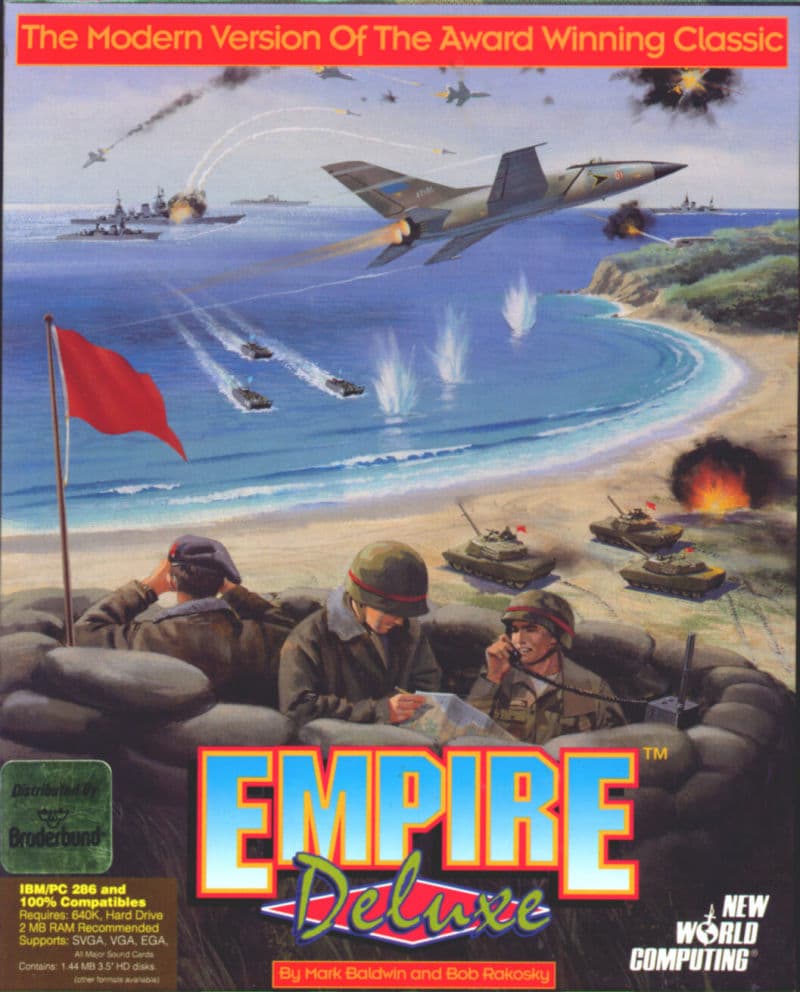
You start Empire Deluxe with a single city on an unexplored grid, producing an infantry unit while dark fog hides the rest of the world. Within twenty turns, that lone city expands into a full war machine spanning armies, battleships, and bombers.
Conquering the map in Empire Deluxe demands pure logistics
Launching a match drops you straight into a top-down view of a square grid with nothing but a lone home city. You assign that city to build an army or a transport, set its rally target, and end your turn. There are no historical storylines or named generals here. The sole objective is to claim enemy cities while defending your own production nodes.
The core loop relies on balancing unit production times with rapid expansion. Infantry and basic armies capture neutral cities to build your industrial base. Navies transport ground forces across oceans, while fighters and bombers clear sky corridors for your fleet. If your transport carrying four fully loaded armies gets intercepted by a submarine, hours of planning evaporate in a single turn.
Complexity scales across three distinct rule systems depending on how deep you want to go:
- Basic Mode: Features a fully revealed map, zero fog of war, fast movement, and minimal unit variety for quick tactical matches.
- Standard Mode: Introduces hidden map terrain, fog of war, standard unit types, and classic production limits.
- Advanced Mode: Adds terrain movement penalties, sighting restrictions, reduced city efficiency, and specialized units like air bases and super-dreadnought battleships.
Playing in Advanced Mode changes how you move across the board. Mountains slow down ground forces, while shallow water stops heavy capital ships completely. You must set up staging grounds, guard airfields, and guard your supply lines constantly. It transforms a simple map painter into a methodical exercise in land, sea, and air logistics.
How automation keeps six-player matches moving
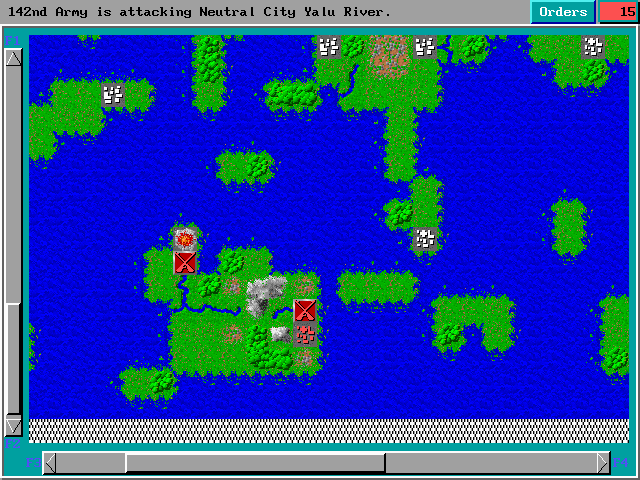
Managing fifty units individually across a massive 200x150 map usually turns turn-based strategy tactics games into a tedious slog. Programmers Mark Lewis Baldwin and Bob Rakosky solved this by building heavy automation controls directly into the order interface. You can set long-range pathfinding, establish auto-patrol loops, and stack group movement orders with a few keypresses.
That automation was vital for multi-player matches. The original release shipped with massive connectivity support for 1993, including local hotseat, serial cables, modems, local networks, and play-by-email. Sending saved turn files back and forth via email attachment became a widespread standard for long-distance matches.
The opponent computer commanders feature three AI difficulty levels. Higher settings do not cheat with invisible resources; instead, they make aggressive recon pushes and target your vulnerable transport routes. The top intelligence setting will catch empty coastal cities faster than most human players.
VGA graphics and custom map editors replaced mainframe text
Walter Bright created the original text-based mainframe game in 1977. This MS-DOS release, published by New World Computing and built by White Wolf Productions, gave that ancient core a major visual polish. It brought clear 256-color VGA graphics, dynamic map zooming, slidebar scrolling, and expansive sound support for Sound Blaster and Roland MT-32 hardware.
The included scenario editor proved to be the game's greatest secret weapon. Players could craft custom terrain grids, set starting city placements, and script specific battle scenarios. New World Computing even sold a dedicated scenario expansion pack featuring custom map designs from game creators like Will Wright and Noah Falstein.
Copy protection took a surprisingly user-friendly approach compared to contemporary releases. Instead of checking a manual word every time you booted up, the protection code prompt only appeared when running the setup configuration tool. Once configured, you could launch directly into your matches without flipping through paper manuals.
Clunky menus show their age, but the mechanics endure
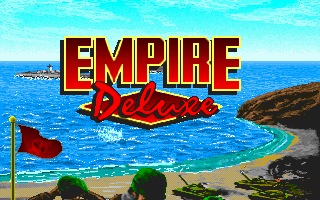
Retrospective players often note that this release felt like an incremental upgrade rather than a graphics revolution. The UI relies heavily on nested menus, keyboard shortcuts, and small icon buttons that can feel clunky on high-resolution screens. On modern hardware setups, running original saved files without proper memory configuration can trigger runtime divide-by-zero crashes.
Yet the mechanical balance holds up against modern turn-based war games. There are no bloated tech trees or complicated diplomacy systems to distract from actual strategy. You scout, you build, you position, and you attack.
If you enjoy classic grand strategy without modern filler, you can play Empire Deluxe free in your browser right now. You can play this classic Empire Deluxe MS-DOS game online directly in your browser with no installation needed. Start with Standard mode on a medium grid, turn on unit pathfinding automation early, and watch your initial lone city turn into a global empire.