
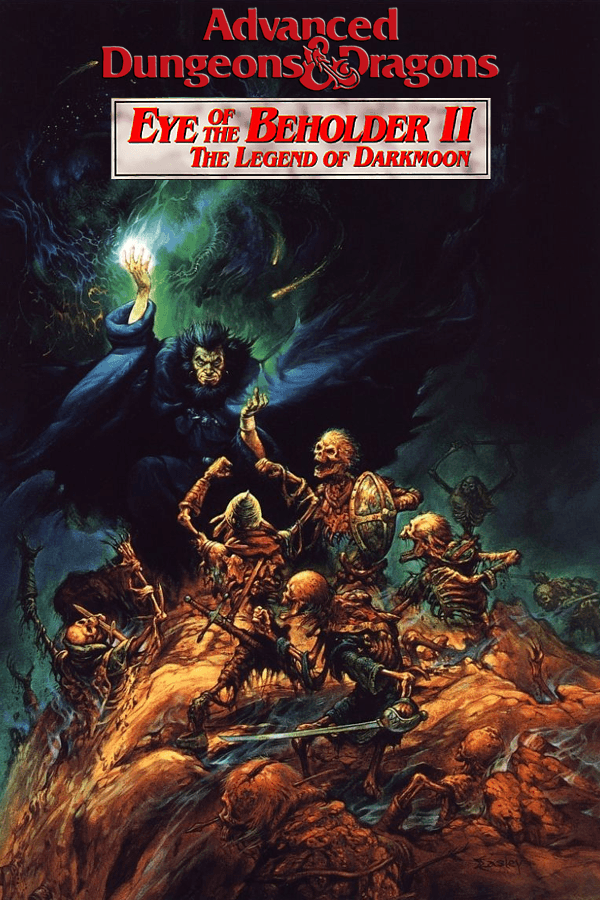
Starting Eye of the Beholder II: The Legend of Darkmoon with a fresh party instead of importing your veterans from the first game is a fast way to discover just how punishing early 90s dungeon crawlers could be. Sent by Archmage Khelben Blackstaff to investigate the suspicious disappearance of a scout named Amber, your four heroes step straight into real-time battles where missing a single weapon swing means taking a battleaxe to the face.
When Westwood Associates and Strategic Simulations, Inc. followed up their initial hit, they made a point to get players out of subterranean brick hallways right away. You begin standing under open sky in a dense forest, staring up at the stone towers of the Temple of Darkmoon. That shift in scenery changes how you navigate. Instead of following predictable dungeon corridors, you are hunting through tree lines and outdoor courtyards before ever setting foot inside the main complex.
The core layout still relies on a first-person perspective locked to a step-based grid, but the world feels vastly expanded. Moving through the temple means climbing through vertical tower levels, dealing with trick doors, and passing anacolytes' tests to access restricted inner chambers. The environment is stuffed with secret buttons, hidden pressure plates, and pit traps that drop you into lower corridors full of hostile guards. You spend as much time managing key chains and inventory slots as you do swinging broadswords.
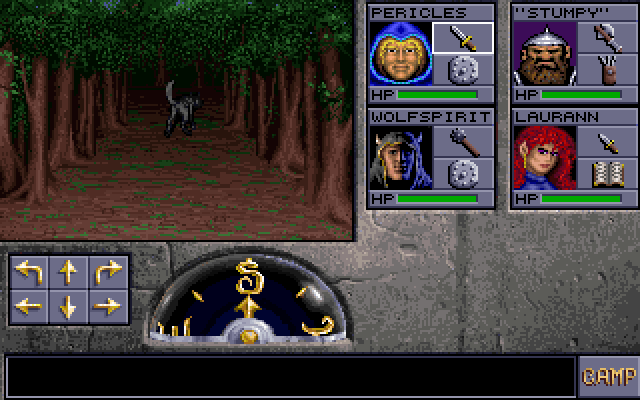
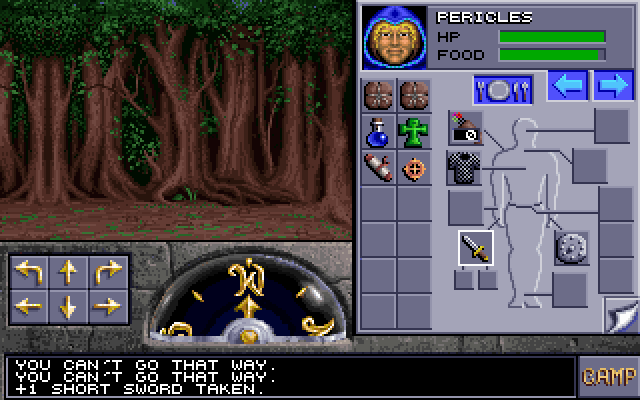
Real-time combat in this style of role-playing game demands fast hands. You attack by right-clicking on individual weapon icons held in character hand slots, waiting out a short cooldown timer, and clicking again. If you have a cleric or mage in your rear ranks, casting spells means opening their spellbook interface, clicking the spell rank, picking the specific incantation, and selecting a target grid square. As computer game reviewer Scorpia famously argued in Computer Gaming World, the real flaw with this setup is that time only pauses for you while you browse your spells, whereas the monsters keep hacking away uninterrupted.
That design flaw turns combat against fast or immune creatures into absolute chaos. Encounters with Will-o'-wisps force you to scramble through spell menus for specialized counters while your front line takes continuous damage. If you fail to prepare your magic list before opening a key room, you will be caught flipping pages while skeletal warriors surround your party. The game also lacks any form of in-game automap, so surviving the deeper levels means keeping a pad of graph paper next to your keyboard unless you use modern community mapping overlays like The All-Seeing Eye.
If you preserved your save file from the first game, you can import your party directly into the Eye of the Beholder II: The Legend of Darkmoon MS-DOS game with all their stats, levels, and high-end gear intact. Doing so gives you a massive advantage against early encounters. If you choose to build a brand-new party of level-one adventurers instead, the game hits you with an immediate difficulty wall. The early skeletons and hostile clerics outside the temple will cut down an unarmored, low-level squad before you even reach the first real puzzle.
The narrative stakes escalate alongside the combat. What begins as a simple search for missing scout Amber turns into a fight against Dran Draggore, the high priest running Darkmoon. He is secretly a red dragon quietly assembling an army of undead beneath the temple to invade Waterdeep. Reaching his inner sanctum requires clearing every floor, solving multi-stage item puzzles, and surviving encounters with elite monsters that can wipe out an unprepared party in seconds. The game rewards thorough exploration, but it rarely forgives a poor tactical position.
For players who loaded this up on PC hardware back in 1991, the presentation was a massive step forward. Composer Frank Klepacki provided soundtrack work that sounded fantastic on a Sound Blaster or AdLib card, far surpassing the primitive blips of the internal PC speaker or older Covox setups. Westwood also added far more illustrated story cutscenes and full-portrait NPC encounters, giving major plot points a theatrical feel that was rare for early computer role-playing titles.
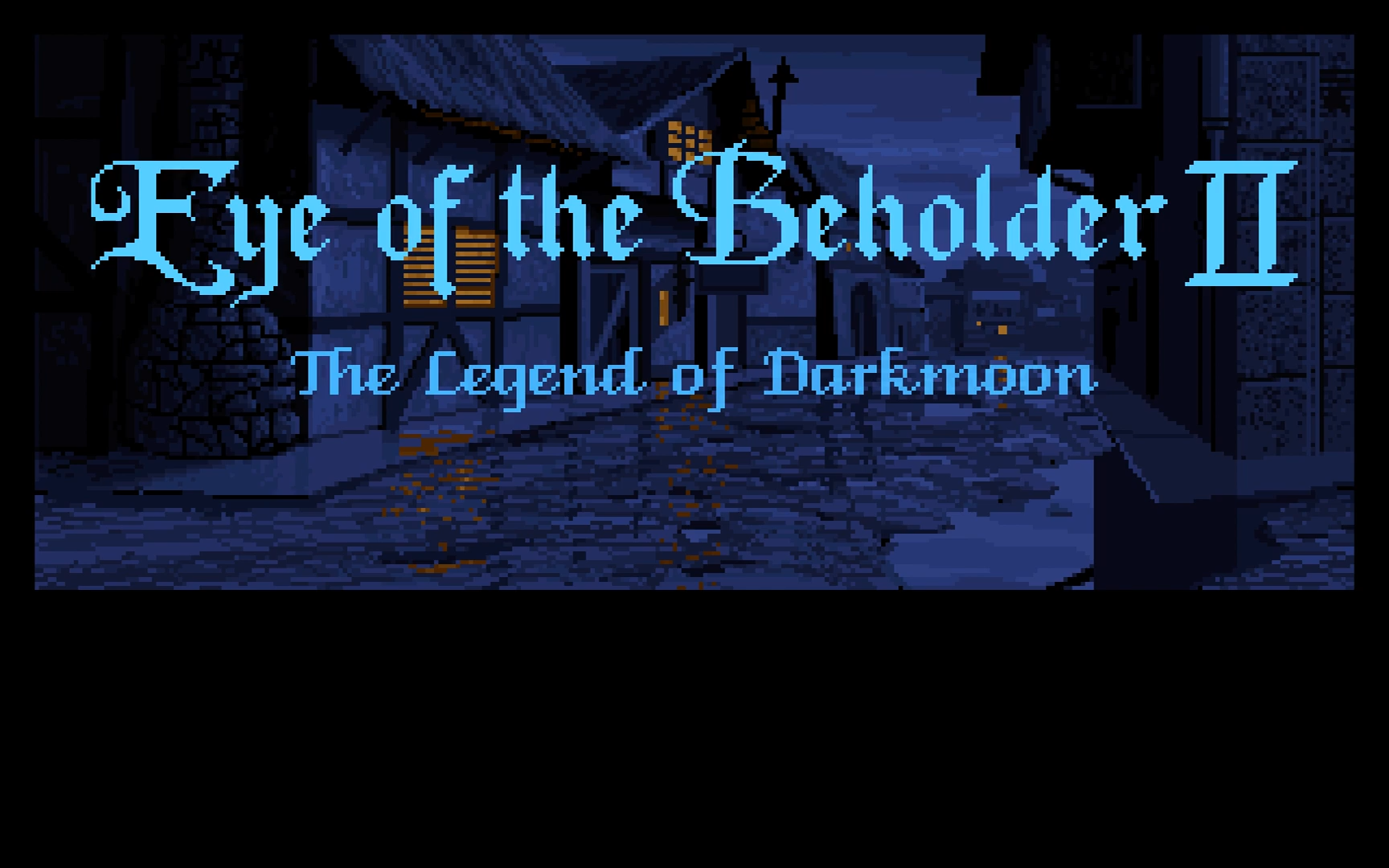
The physical box release also doubled down on copy protection. At key points in your journey, the game brings your progress to a halt and demands specific word lookups or code entries from the included paper manual before letting you proceed. It was a classic era anti-piracy measure that sent players frantically thumbing through printed booklets mid-session.
While the step-based grid movement and manual spell menus take a few minutes to get used to, the complex temple design and deep party customization hold up exceptionally well for fans of classic 2nd Edition AD&D rules. If you enjoy mapping out secret-heavy dungeons, managing spell slots under pressure, and tackling high-stakes dragon battles, this adventure delivers everything a grid-based crawler should.
You can play Eye of the Beholder II: The Legend of Darkmoon online right here in your browser with nothing to install and no complex setup required. To start your quest off right, spend a few minutes setting up a balanced party with two heavy fighters in the front row and a cleric and mage in the back. As soon as you step into the opening forest area, remember to keep your weapons ready in your hand slots and save your game often before opening any uncharted temple doors.
Starting Eye of the Beholder II: The Legend of Darkmoon with a fresh party instead of importing your veterans from the first game is a fast way to discover just how punishing early 90s dungeon crawlers could be. Sent by Archmage Khelben Blackstaff to investigate the suspicious disappearance of a scout named Amber, your four heroes step straight into real-time battles where missing a single weapon swing means taking a battleaxe to the face.
When Westwood Associates and Strategic Simulations, Inc. followed up their initial hit, they made a point to get players out of subterranean brick hallways right away. You begin standing under open sky in a dense forest, staring up at the stone towers of the Temple of Darkmoon. That shift in scenery changes how you navigate. Instead of following predictable dungeon corridors, you are hunting through tree lines and outdoor courtyards before ever setting foot inside the main complex.
The core layout still relies on a first-person perspective locked to a step-based grid, but the world feels vastly expanded. Moving through the temple means climbing through vertical tower levels, dealing with trick doors, and passing anacolytes' tests to access restricted inner chambers. The environment is stuffed with secret buttons, hidden pressure plates, and pit traps that drop you into lower corridors full of hostile guards. You spend as much time managing key chains and inventory slots as you do swinging broadswords.
Real-time combat in this style of role-playing game demands fast hands. You attack by right-clicking on individual weapon icons held in character hand slots, waiting out a short cooldown timer, and clicking again. If you have a cleric or mage in your rear ranks, casting spells means opening their spellbook interface, clicking the spell rank, picking the specific incantation, and selecting a target grid square. As computer game reviewer Scorpia famously argued in Computer Gaming World, the real flaw with this setup is that time only pauses for you while you browse your spells, whereas the monsters keep hacking away uninterrupted.
That design flaw turns combat against fast or immune creatures into absolute chaos. Encounters with Will-o'-wisps force you to scramble through spell menus for specialized counters while your front line takes continuous damage. If you fail to prepare your magic list before opening a key room, you will be caught flipping pages while skeletal warriors surround your party. The game also lacks any form of in-game automap, so surviving the deeper levels means keeping a pad of graph paper next to your keyboard unless you use modern community mapping overlays like The All-Seeing Eye.
If you preserved your save file from the first game, you can import your party directly into the Eye of the Beholder II: The Legend of Darkmoon MS-DOS game with all their stats, levels, and high-end gear intact. Doing so gives you a massive advantage against early encounters. If you choose to build a brand-new party of level-one adventurers instead, the game hits you with an immediate difficulty wall. The early skeletons and hostile clerics outside the temple will cut down an unarmored, low-level squad before you even reach the first real puzzle.
The narrative stakes escalate alongside the combat. What begins as a simple search for missing scout Amber turns into a fight against Dran Draggore, the high priest running Darkmoon. He is secretly a red dragon quietly assembling an army of undead beneath the temple to invade Waterdeep. Reaching his inner sanctum requires clearing every floor, solving multi-stage item puzzles, and surviving encounters with elite monsters that can wipe out an unprepared party in seconds. The game rewards thorough exploration, but it rarely forgives a poor tactical position.
For players who loaded this up on PC hardware back in 1991, the presentation was a massive step forward. Composer Frank Klepacki provided soundtrack work that sounded fantastic on a Sound Blaster or AdLib card, far surpassing the primitive blips of the internal PC speaker or older Covox setups. Westwood also added far more illustrated story cutscenes and full-portrait NPC encounters, giving major plot points a theatrical feel that was rare for early computer role-playing titles.
The physical box release also doubled down on copy protection. At key points in your journey, the game brings your progress to a halt and demands specific word lookups or code entries from the included paper manual before letting you proceed. It was a classic era anti-piracy measure that sent players frantically thumbing through printed booklets mid-session.
While the step-based grid movement and manual spell menus take a few minutes to get used to, the complex temple design and deep party customization hold up exceptionally well for fans of classic 2nd Edition AD&D rules. If you enjoy mapping out secret-heavy dungeons, managing spell slots under pressure, and tackling high-stakes dragon battles, this adventure delivers everything a grid-based crawler should.
You can play Eye of the Beholder II: The Legend of Darkmoon online right here in your browser with nothing to install and no complex setup required. To start your quest off right, spend a few minutes setting up a balanced party with two heavy fighters in the front row and a cleric and mage in the back. As soon as you step into the opening forest area, remember to keep your weapons ready in your hand slots and save your game often before opening any uncharted temple doors.
How Eye of the Beholder II: The Legend of Darkmoon is played — the keys the game listens to, grouped by what they do.
Highlighted keys are mapped — hover or tap one to see what it does.
Movement is permanently mapped to the arrow keys and cannot be remapped in SETUP.EXE. Mouse is the primary control method for point-and-click interactions.
The on-screen keyboard and gamepad mapping the browser player uses on a phone, a tablet or a controller, as opposed to the real keys above. $PRO members make their own in the player and share them here; anyone can pick one to play with.
Cheat codes, console commands and memory pokes for Eye of the Beholder II: The Legend of Darkmoon — each one verified and attributed.
Sign in to submitaka EOB2 · Eye of The Beholder II: Legende von Darkmoon
How Eye of the Beholder II: The Legend of Darkmoon is played — the keys the game listens to, grouped by what they do.
Highlighted keys are mapped — hover or tap one to see what it does.
Movement is permanently mapped to the arrow keys and cannot be remapped in SETUP.EXE. Mouse is the primary control method for point-and-click interactions.
The on-screen keyboard and gamepad mapping the browser player uses on a phone, a tablet or a controller, as opposed to the real keys above. $PRO members make their own in the player and share them here; anyone can pick one to play with.
Cheat codes, console commands and memory pokes for Eye of the Beholder II: The Legend of Darkmoon — each one verified and attributed.
Sign in to submit