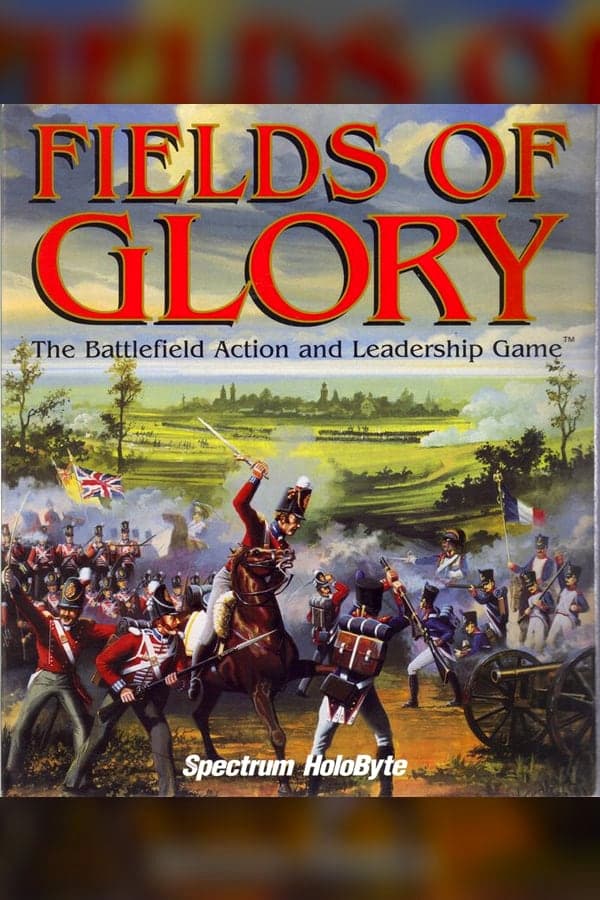
Fields of Glory
When you launch Fields of Glory, you are handed the command of thousands of French or Allied soldiers across the bloody summer days of 1815, watching sprite-based infantry lines clash in real time over mapped terrain.
Accurate databases meet chaotic real-time battlefields in Fields of Glory
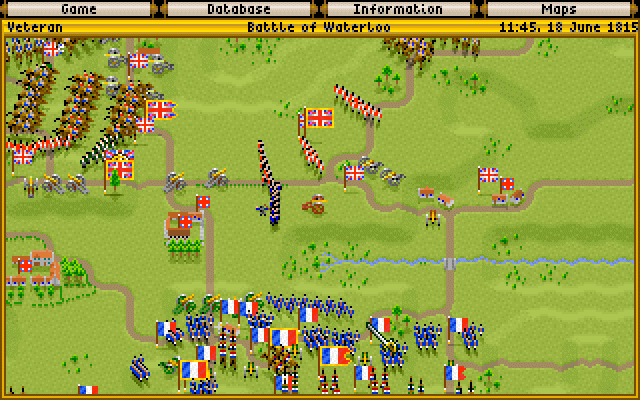
On paper, this 1993 release looks like a wargamer's dream come true. MicroProse joined forces with designer Jim Bambra, who joined the project in March 1992, to turn the 100 Days Napoleonic Campaign into a rich tactical playground. Instead of forcing players onto rigid hex grids, the team built a top-down diorama view full of tiny animated unit sprites moving across digitized countryside. If you ever spent hours reading order-of-battle books, sitting down with this strategy tactics title feels like opening an interactive encyclopedia where every regiment carries its historical designation.
The gap between historical theory and actual digital command hits you the minute the cannons open fire at Quatre-Bras. You can issue direct movement and formation choices to individual brigades, or you can hand broad directives down to corps and division commanders. Those officers possess distinct AI personalities, meaning your subordinate might follow your orders to the letter or hesitate based on their own virtual nerve. Managing morale, fatigue, line formation, and artillery line-of-sight across a moving battlefront creates an immediate sense of friction that static turn-based games rarely match.
Jim Bambra and MicroProse traded hex grids for miniature dioramas
The visual presentation took a distinct path for a 1993 DOS release. Rather than abstract counters, artists Allan Holloway, Edward Garnier, and Martin Calvert drew miniature-style figures that march, wheel, and shoot across realistic topographical maps. Coupled with audio composed by John Broomhall, the fields feel active from the moment you select your first corps. MicroProse and publisher Spectrum HoloByte delivered six distinct historical and hypothetical engagements for players to conquer:
- The Battle of Ligny: Napoleon's assault on the Prussian forces, testing your ability to manage dense infantry pushes across difficult terrain.
- The Battle of Quatre-Bras: Ney's clash against Wellington's Anglo-Allied vanguard, focused on key crossroads control.
- The Battle of Waterloo: The massive climax of the campaign, featuring full deployment of French, British, and Prussian corps.
- The Battle of Wavre: Grouchy's containment action against the retreating Prussian army.
- Nivelles & Wagnee: Two hypothetical alternative scenarios that test custom tactical choices outside historical outcomes.
The deep historical database embedded directly in the menus won high praise upon release. Computer Gaming World noted in July 1994 that the historical order of battle database was one of the best ever assembled for a computer simulation, arguing that the reference material alone almost justified buying the box. Even magazine reviews like Hyper, which awarded it 78%, recognized how seriously the developers treated historical accuracy.
The computer commander struggles when the line starts to bend
For all its historical research, sitting down to play the game today reveals where the simulation breaks down under pressure. The central problem lies in pacing and control balance. As original reviewers observed, time runs uncomfortably fast when managing units at the brigade level, yet grinds down when trying to coordinate sweeping moves at the corps level. When you try to command the full field at Waterloo, the interface rapidly becomes overwhelming as notifications flood in while sprite regiments march past their marks.
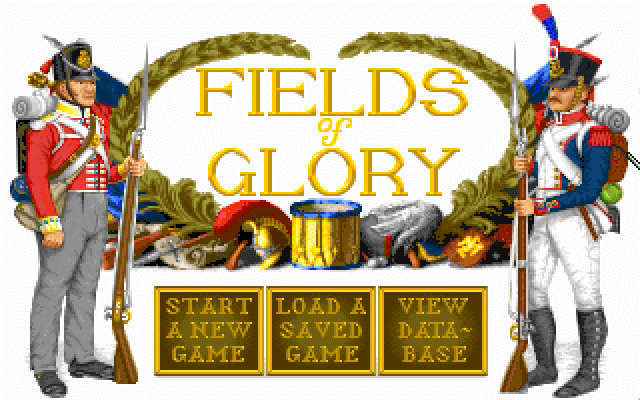
Then there is the computer opponent. Programmers Steven W. Green, Mark Lyhane, and Andrew Walrond built a complex network of officer traits, but modern retrospective players and original reviewers agree that the enemy AI is simply incapable of mounting a sustained, intelligent defense. Computer-controlled corps frequently march out of formation, blunder into canister fire, or fail to exploit obvious gaps in your line. The soldiers themselves look a bit funny in motion by modern standards, shuffling across the diorama map with stiff, repetitive frames that highlight the age of the graphic engine.
The decision loop is further complicated by unit formations. Switching a brigade from line formation into a defensive square takes precious time, and if enemy cavalry catches your men mid-reorganization, the unit collapses instantly. Because the real-time speed forces you to react quickly across multiple miles of front, you will often lose an entire flank simply because you were zoomed in elsewhere adjusting an artillery battery.
Why Napoleon's final campaign is worth commanding today
Despite the clumsy real-time speed control and shaky enemy decision-making, the core simulation holds up for wargame fans who prefer raw historical detail over flashy graphics. The built-in encyclopedia of regiments, commanders, and terrain data is a surprisingly thorough piece of software design. If you approach it as an interactive historical sandbox rather than a cutthroat competitive strategy game, organizing Wellington's ridges or directing Ney's cavalry charges delivers solid tactical fun.
You can experience this classic Fields of Glory MS-DOS game for yourself without hunting down ancient floppies or fiddling with system settings. You can play Fields of Glory online free in your browser right now, jumping straight into the command tent at Quatre-Bras or Ligny with zero setup. Test whether your tactical plan can hold the ridge at Waterloo, or simply explore the massive historical orders of battle to see how MicroProse translated nineteenth-century warfare onto PC screens.