
Laying down a strafing run over enemy positions in Flight Sim Toolkit: World War II makes you appreciate just how far pre-built expansion packs could push mid-nineties flight engines.
Before standard construction sets took over PC gaming, building your own flight simulator meant writing raw code or putting up with flat, untextured shapes. Domark Software changed that formula by offering an accessible suite of design utilities, allowing enthusiasts to craft custom terrain, edit flight models, and place targets without touching an assembly language compiler. This standalone release took those raw toolsets and bundled them into structured, historic campaigns centered around famous aerial engagements.
Instead of locking you into a single rigid campaign, the engine lets you jump into predefined historic missions or tweak the parameters yourself. You pick your plane, set the weather conditions, lay out target zones across low-polygon islands, and head straight for the runway. The balance between accessibility and physics depth was unusual for 1994 games, giving casual pilots a quick way to dogfight while giving scenario designers complete control over weapon loadouts and vehicle stats.
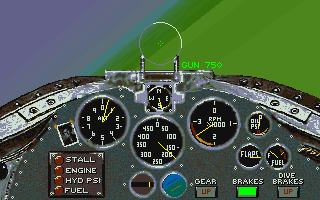
When you start up this MS-DOS simulation game, the first thing you notice is how aggressive the enemy flight patterns can be. Tracing target markers through grainy atmospheric effects takes patience, especially when throttle control on older keyboards feels step-based rather than fluid. Throwing your fighter into a tight bank requires constant rudder management, otherwise you drop out of the sky into an unrecoverable stall.
The missions take you over island chains and battlefields filled with anti-aircraft batteries that chew through your airframe if you fly straight for too long. Ground strikes require precise dives, dropping unguided ordinance before pulling up hard to clear target structures and tree lines. Winning an engagement takes more than out-shooting opponent fighters: you have to manage fuel, conserve limited machine gun ammunition, and nurse damaged engines back to home bases.
As impressive as the underlying engine was for its era, the visual presentation shows its age quickly when ground targets clutter the screen. Framerates stutter when multiple multi-engine bombers enter the render frame, and collision detection against terrain features can feel unpredictable during low-altitude runs. If your wing clips an invisible boundary on a hillside, your aircraft immediately disintegrates without much feedback.
Enemy air defense artificial intelligence also leans toward absolute precision rather than realistic human error. Flak batteries tend to lock on with lethal accuracy the moment you break vector, forcing a repetitive routine of immediate evasive maneuvers rather than tactical planning. It creates a steep difficulty curve that rewards memorizing enemy layout positions over pure flying skill.
Despite those rough edges and rigid difficulty spikes, the package shows how early desktop flight simulators worked. Published by Spectrum Holobyte, Inc. and designed by Domark Software, Inc., its modular design handed creative power back to player communities long before mission builders became standard features.
You can launch Flight Sim Toolkit: World War II free in your browser right now with zero installation required. Jumping into the cockpit reveals minor handling quirks and cockpit details that static screenshots fail to capture, like how the horizon tilts dynamically during violent maneuvers. Fire up the engines, trim your flaps, and see if you can survive your first strafing run over the Pacific.
Laying down a strafing run over enemy positions in Flight Sim Toolkit: World War II makes you appreciate just how far pre-built expansion packs could push mid-nineties flight engines.
Before standard construction sets took over PC gaming, building your own flight simulator meant writing raw code or putting up with flat, untextured shapes. Domark Software changed that formula by offering an accessible suite of design utilities, allowing enthusiasts to craft custom terrain, edit flight models, and place targets without touching an assembly language compiler. This standalone release took those raw toolsets and bundled them into structured, historic campaigns centered around famous aerial engagements.
Instead of locking you into a single rigid campaign, the engine lets you jump into predefined historic missions or tweak the parameters yourself. You pick your plane, set the weather conditions, lay out target zones across low-polygon islands, and head straight for the runway. The balance between accessibility and physics depth was unusual for 1994 games, giving casual pilots a quick way to dogfight while giving scenario designers complete control over weapon loadouts and vehicle stats.
When you start up this MS-DOS simulation game, the first thing you notice is how aggressive the enemy flight patterns can be. Tracing target markers through grainy atmospheric effects takes patience, especially when throttle control on older keyboards feels step-based rather than fluid. Throwing your fighter into a tight bank requires constant rudder management, otherwise you drop out of the sky into an unrecoverable stall.
The missions take you over island chains and battlefields filled with anti-aircraft batteries that chew through your airframe if you fly straight for too long. Ground strikes require precise dives, dropping unguided ordinance before pulling up hard to clear target structures and tree lines. Winning an engagement takes more than out-shooting opponent fighters: you have to manage fuel, conserve limited machine gun ammunition, and nurse damaged engines back to home bases.
As impressive as the underlying engine was for its era, the visual presentation shows its age quickly when ground targets clutter the screen. Framerates stutter when multiple multi-engine bombers enter the render frame, and collision detection against terrain features can feel unpredictable during low-altitude runs. If your wing clips an invisible boundary on a hillside, your aircraft immediately disintegrates without much feedback.
Enemy air defense artificial intelligence also leans toward absolute precision rather than realistic human error. Flak batteries tend to lock on with lethal accuracy the moment you break vector, forcing a repetitive routine of immediate evasive maneuvers rather than tactical planning. It creates a steep difficulty curve that rewards memorizing enemy layout positions over pure flying skill.
Despite those rough edges and rigid difficulty spikes, the package shows how early desktop flight simulators worked. Published by Spectrum Holobyte, Inc. and designed by Domark Software, Inc., its modular design handed creative power back to player communities long before mission builders became standard features.
You can launch Flight Sim Toolkit: World War II free in your browser right now with zero installation required. Jumping into the cockpit reveals minor handling quirks and cockpit details that static screenshots fail to capture, like how the horizon tilts dynamically during violent maneuvers. Fire up the engines, trim your flaps, and see if you can survive your first strafing run over the Pacific.
How Flight Sim Toolkit: World War II is played — the keys the game listens to, grouped by what they do.
Highlighted keys are mapped — hover or tap one to see what it does.
Flight Sim Toolkit creations support remapping and joystick calibration via setup options and DOS utilities. No keymap was available in the source materials.
The on-screen keyboard and gamepad mapping the browser player uses on a phone, a tablet or a controller, as opposed to the real keys above. $PRO members make their own in the player and share them here; anyone can pick one to play with.
Cheat codes, console commands and memory pokes for Flight Sim Toolkit: World War II — each one verified and attributed.
Sign in to submitHow Flight Sim Toolkit: World War II is played — the keys the game listens to, grouped by what they do.
Highlighted keys are mapped — hover or tap one to see what it does.
Flight Sim Toolkit creations support remapping and joystick calibration via setup options and DOS utilities. No keymap was available in the source materials.
The on-screen keyboard and gamepad mapping the browser player uses on a phone, a tablet or a controller, as opposed to the real keys above. $PRO members make their own in the player and share them here; anyone can pick one to play with.
Cheat codes, console commands and memory pokes for Flight Sim Toolkit: World War II — each one verified and attributed.
Sign in to submit