


In Fury of the Furries, playing as a tiny colored ball named Tiny means constantly shifting abilities mid-jump to survive hundreds of puzzle-platforming screens.
Elemental powers make Fury of the Furries an inventive puzzle platformer
Released by Atreid Concept SA and Kalisto in 1993, this DOS side-scroller took the bouncy creatures from the Skweek universe and gave them a completely new job. Your goal across Sklumph island is to rescue the captured King, beat "The Wicked One", and smash "The Machine" turning your people into mindless monsters.
Instead of relying on standard platforming jumps, you alter your abilities by passing through colored energy fields or collecting magic rings. Each color gives Tiny a distinct set of physical tools:
- Yellow (Fire): Shoots fireballs at enemies and walks straight through open flames safely.
- Green (Air/Earth): Fires a grappling line at walls or ceilings to swing over deadly hazards.
- Red (Earth): Chews directly through soft rock blocks to clear a path.
- Blue (Water): Swims easily through underwater sections and shoots defensive air bubbles.
The core design forces you to combine these powers under strict time pressure. One screen might ask you to swing over a bed of spikes as the Green form, morph into Red mid-air to bite through a hanging rock wall, and hit a Blue pool below without drowning.
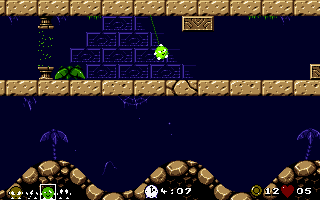
Precision physics meet unforgiving DOS platforming
What sets this game apart from standard PC platformers of the era is its momentum physics. Swinging on the Green form's vine feels weighty, requiring careful timing to build up speed before letting go. If you release the rope a fraction of a second too late, Tiny launches directly into ceiling spikes or acid pools.
The game spreads over eight distinct regions, ranging from the Desert and Pyramids to the Factory, Castle, and the final mechanical interior of The Machine. With roughly ninety individual levels to cross, the difficulty ramps up steeply after the opening zones. Later stages place color-changing fields directly in your jump arc, forcing instant tactical shifts before you land.
You can also hunting for hidden destructible blocks on each map. Finding these secret walls unlocks bonus rooms and hidden extra levels in every region, offering massive score points for thorough explorers.
Where the mechanics occasionally trip over themselves
For all its clever mechanics, the game has a few notorious irritants that PC players remember all too well. The presentation runs in 256-color VGA at 320x200 resolution, capped at 35 frames per second, but visual clarity sometimes suffers. Certain foreground hazards look identical to the background art, causing unexpected deaths because a spike pit looked like decorative stonework.
Hardware support requires 577K of conventional memory alongside 128K of EMS memory to get Sound Blaster music running alongside digital sound effects. Frédéric Motte, also known as Elmobo, composed a fantastic, jazzy soundtrack that drives every stage. However, the game famously refuses to save custom key bindings between sessions on PC. Every time you boot the game, you have to rebind your movement keys from scratch.
Progress saving is another sore point. You do not get freely available save files; instead, you get passwords awarded only after clearing five full levels. Failing a tricky jump late in a set means repeating four screens you already solved.

How it compares to its console makeover
American players might look at this layout and recognize something else entirely. Namco licensed the underlying engine and mechanics, reskinning the game for US audiences and console ports as Pac-In-Time. They stripped out the original yellow-and-green Tinies and replaced them with Pac-Man, but the level design and momentum swinging stayed virtually identical.
On native PC hardware, however, the original action game maintains a unique atmosphere thanks to its distinct character designs and offbeat soundtrack. It delivered smooth multi-directional scrolling and tight arcade physics while many PC platformers still felt stiff and clumsy compared to their console cousins.
Fire up the browser version and test your timing
Fury of the Furries holds up as a brilliant, demanding puzzle platformer that rewards patience, fast fingers, and spatial planning. While the high difficulty spikes and password system can test your sanity in the late factory levels, the sheer variety of transformations keeps the momentum going.
You can play Fury of the Furries free in your browser right now with no setup needed. Jump straight into the action, test your swinging reflexes on the early Forest levels, and see how far you get before the momentum physics take over.