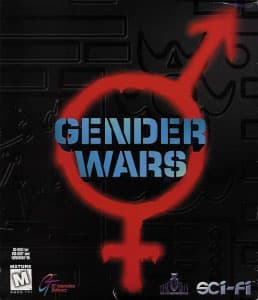
Gender Wars
Streaming build
Checking storage…297 MB
Preload in background
- 1this week
If you remember Gender Wars, you likely recall its heavy-handed satire before you remember how its squad combat actually plays on screen.
isometric tactics, corporate parodies, and heavy satire
On paper, Gender Wars promised an isometric tactical action game in the mold of Syndicate or Cannon Fodder. You choose to command either the Male faction under the Patriarch or the Female faction led by the Matriarch. Both sides treat each other as absurd caricatures, fighting through dystopian cities using genetic engineering, heavy weapons, and stolen military hardware.
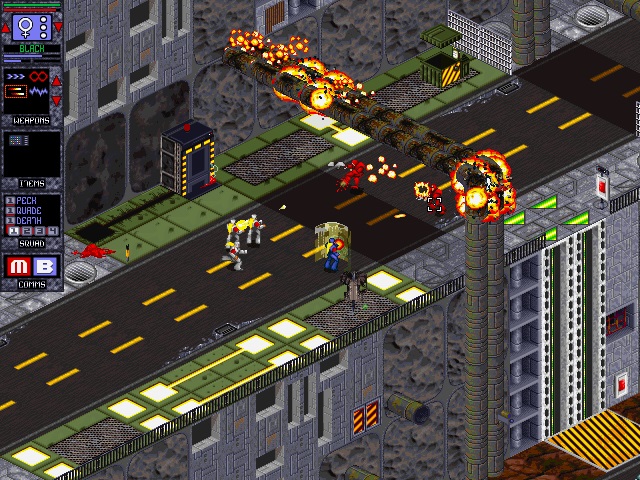
Developer The 8th Day built a campaign split between two distinct perspectives. The opening setup pitches a silly premise, but inside the missions, you run a squad of four soldiers from an isometric camera angle. You lead a squad leader while up to three squadmates follow your commands across urban battlefields.
When publisher GT Interactive Software Corp. put out this 1996 release, gaming magazines gave it mixed responses. Scores ranged from 90% in PC Team to 66% on GameSpot, with MobyGames recording an overall critic average of 63%. Some players laughed at the aggressive humor, while others found the gender stereotyping tedious and generic.
How the tactical battles in Gender Wars actually play
Every mission drops your squad into a map with specific tactical objectives. You might need to destroy an enemy egg-shed facility, steal decoding cards from senior technicians, or upload spyware into communication terminals. Other missions send you directly to target an enemy leader or liquidate defending units.
Your team starts with default firearms that carry unlimited ammunition, saving you from constant supply runs. Along the ground, you can locate specialized weapons like a stasis gun or hijack abandoned tanks to blast through barricades. The stasis gun creates a unique opportunity on certain maps: if you shoot an enemy soldier right inside a pill box spawn elevator as they emerge, they freeze permanently. That single trick completely stops new enemies from spawning out of that elevator for the rest of the stage.
The pacing moves in real-time, demanding fast target prioritization. Combat feels punchy when your four squad members concentrate fire on an enemy patrol. However, taking direct command of vehicles changes your movement dynamic completely, letting you run over infantry and shell defensive installations.
Where the pathfinding falls apart on MS-DOS
While the tactical setup offers clear targets, controlling your team creates friction almost immediately. The artificial intelligence for your squad members struggles whenever complex geometry sits between them and their target point. Squad members frequently get stuck behind walls or fail to navigate around simple urban structures on their own.
To keep everyone together, you often have to select squad members individually and guide them past basic obstacles. That micromanagement bogs down firefights that ought to feel quick and aggressive. When enemies open fire with heavy explosives, watching your troops path straight into gunfire because of bad line-of-sight routines frustrates quickly.
The campaign structure also suffers from mission repetition over longer play sessions. The basic routine of clearing out defense points, collecting keycards, and blowing up primary facilities changes very little whether you play as the Patriarch's forces or the Matriarch's armies. The narrative arc does end on an amusing note, though: a joint rebellion of both men and women overthrows whichever faction wins the final battle.
Sound cards, video drivers, and production details
Underneath the hood, the engineering team included programmers Mark Watson, Ged Keaveney, and Barry Irvine. The design was shaped by Ged Keaveney, Mark Watson, and Jerr O'Carroll, with direction from Rob Henderson and production handled by Jane Cavanagh, Steven Bishop, and Fergus McNeill. The voice cast brought in British television actors, including Paul Darrow, Jacqueline Pearce, Maria Darling, Jessica Martin, and Robert Firth.
Technically, the DOS executable relied on specific middleware for graphics and sound support. It used Universal VESA VBE drivers and SciTech Software video libraries to handle its isometric SVGA graphics. Audio drivers ran through the HMI (Human Machine Interfaces) Sound Operating System, giving Sound Blaster owners clear speech and distinct weapon blasts.
If you want to bypass the campaign grind, the developers left behind two memorable cheat codes tied to the save system:
- Save your game under the name BUY A PLAYSTATION to unlock invulnerability and infinite ammunition.
- Save your game under the name WORLD OF FISH to instantly gain access to any level in the campaign.
Why you should play Gender Wars online today
As an action game, this release hits a specific middle ground between arcade shooting and squad tactical planning. The pathfinding glitches can annoy, but the fast movement, tank combat, and strange 1990s satire give it a personality unlike rival games from the same month. If you enjoyed isometric shooters from that era, checking out a couple of missions gives you a clear look at how developers tried to reshape the squad shooter genre.
You can play Gender Wars online free in your browser right now with no setup needed. Jump straight into the first campaign mission, grab a stasis gun, and see if your squad can survive the dystopian urban grid.
How Gender Wars is played — the keys the game listens to, grouped by what they do.
- Action
Highlighted keys are mapped — hover or tap one to see what it does.
Full keymapping list was unavailable in primary sources online.
Players' controls
Touch and gamepad controls
The on-screen keyboard and gamepad mapping the browser player uses on a phone, a tablet or a controller, as opposed to the real keys above. $PRO members make their own in the player and share them here; anyone can pick one to play with.
Make your own touch controlsPRO
- 1Open the editorSign in below, then pick what to make. The game starts with the editor open over it.
- 2Place your keysAdd keys and drag them where your thumbs rest, or map a controller's buttons. Test plays the game with them; Save keeps them, and you play with them from then on.
- 3Share themShare them right after saving in the game, or name and share them here. Players vote, and the best become this game's controls for everyone.
Go PROSee how it worksSign in+20 XP for sharing · +50 XP if yours become the game's own
- The game's own controlsKeyboardGamepadWhat every player starts with.In use
2 screenshots
From the archive
No gameplay video yet
No gameplay video for Gender Wars yet. Sign in to add one.
No reviews yet
Tell the community what you think of Gender Wars. Reviews are public and tied to your username.
No archived manuals for Gender Wars yet
No manuals archived for this title yet. Sign in to upload the first scan.
Cheat codes, console commands and memory pokes for Gender Wars — each one verified and attributed.
Sign in to submitNo cheats yet for this title
Know a working cheat, poke or trainer? Add it with the button above. Moderators check every entry before it goes live.
No archived soundtrack for Gender Wars yet
No soundtrack archived for this title yet. Sign in to upload the first rip.
No save states for Gender Wars yet
No save states for this title yet. Sign in to share one.
Discussions
Sign in to post- Threads0
- Total posts0
- Online now6
Community · Gender Wars
Who's contributing, and what's new
- Reviews0
- Threads0
- Uploadsapproved0
- Contributors0
Recent activity
Nothing here yet
Reviews, discussion threads and approved uploads appear here as members add them.