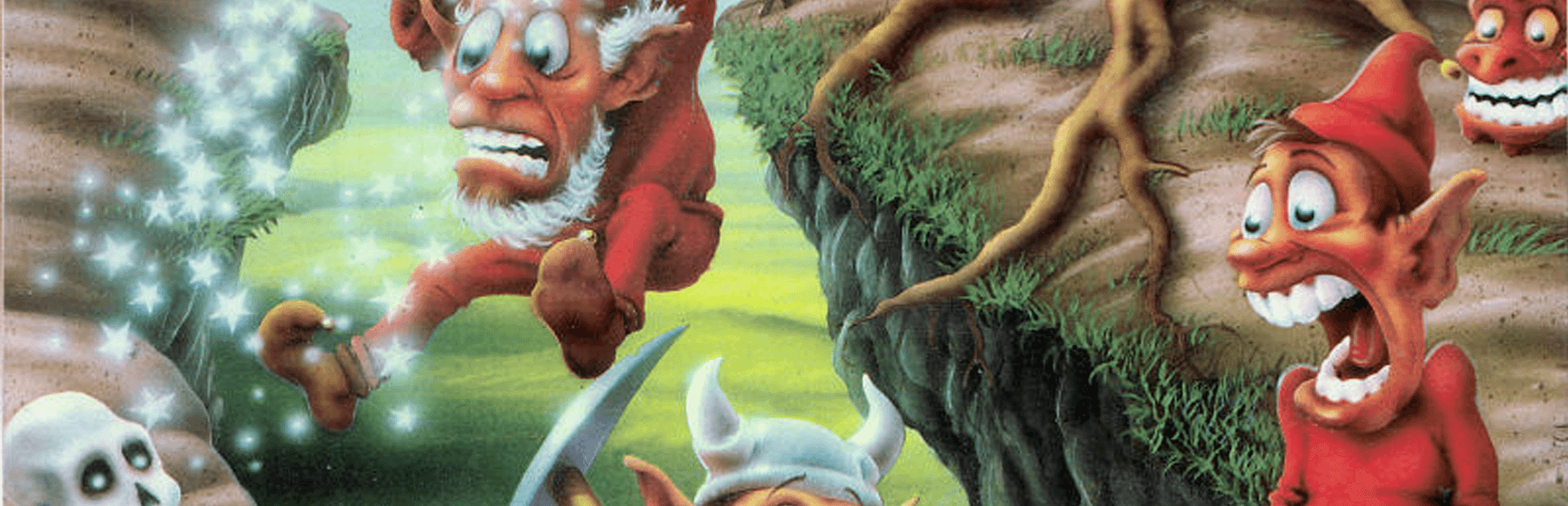
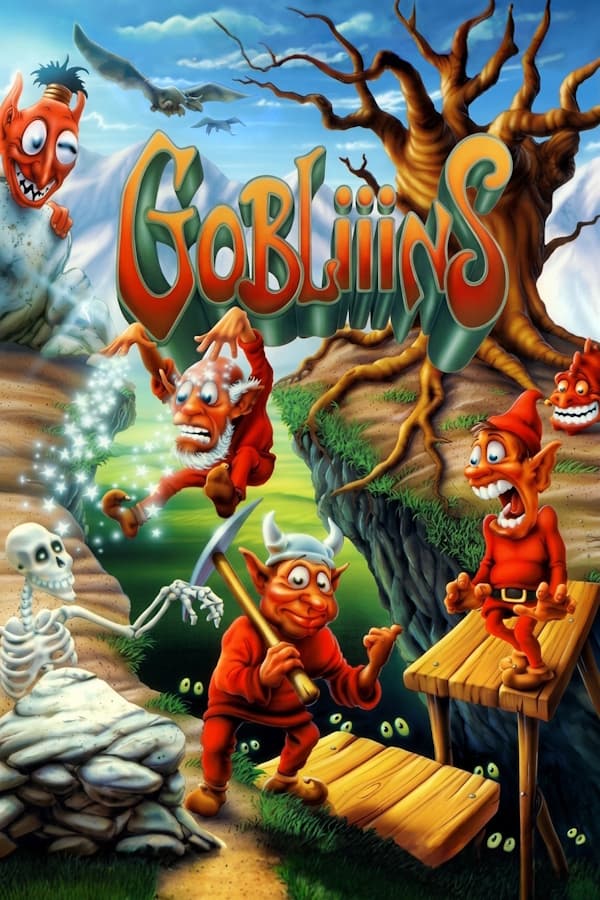
When you launch Gobliiins, you immediately notice that managing three distinct little troublemakers across twenty-two single-screen screens requires equal parts lateral thinking and patience.
Coktel Vision built a puzzle game around three gags and a shared life bar
Most adventure games in 1991 were happy to let you amble around inventory screens, collecting every dropped stick and key until you stumbled on a solution. French studio Coktel Vision took a completely different angle with designer Muriel Tramis and artist Pierre Gilhodes at the helm. Built on their proprietary Gob engine, Gobliiins abandons traditional broad exploration for twenty-two strict, single-screen room puzzles. You do not walk across a vast map; you clear a landscape, get a password, and move directly to the next nightmare setup.
Your ultimate job is to rescue King Angoulafre, who has been driven completely mad by a voodoo doll controlled by the villainous wizard Niak. To reach Niak and break the curse, you must guide a trio of goblins through subterranean caverns, carrot patches guarded by rival mages, and haunted workshops. In the original floppy disk release, the three heroes were named Oups, Ignatius, and Asgard, though North American publisher Sierra On-Line, Inc. rebranded them as Hooter, Dwayne, and BoBo. Each goblin has exactly one specialized interaction model:
- Asgard (BoBo): The brute physical worker who punches objects, climbs hanging ropes, and scales ladders.
- Ignatius (Dwayne): The local spellcaster whose magical zaps cause weird, unpredictable transformations on nearby objects.
- Oups (Hooter): The sensible technician and the only team member capable of picking up, holding, and applying inventory items.
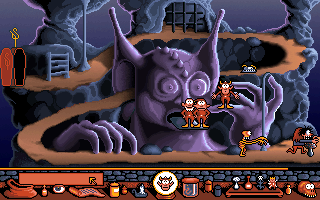
Trial, error, and the terror of the global health meter in Gobliiins
The core structural choice that haunts every minute of this 1991 release is the single global health bar running along the bottom of the display. Every time one of your goblins makes a mistake, gets hit by a trap, falls off a high ledge, or gets terrified by a failed interaction, that energy bar ticks downward. If it empties completely, you get a quick game over screen and must restart the entire single-screen layout using a stage password.
In practice, this turn-based approach to point-and-click health makes experimental play nerve-wracking. Instead of clicking every object with every goblin to see what funny animation plays out, you hesitate. Making Dwayne cast a spell on an unknown mushroom might grow a stalk you can climb, or it might create a hostile creature that slaps BoBo and drains ten percent of your shared health pool. That friction turns standard inventory testing into a tactical gamble.
When you sit down to play this classic puzzle game, you realize how harsh that penalty feels alongside early nineties puzzle design. There are no mid-level save slots anywhere in the game. If you exhaust your energy bar right at the final step of a complex screen because an action trigger timed out slightly wrong, you are forced to retype your password and re-execute every single click from scratch.
Visual charm meets opaque early nineties puzzle logic
What keeps you clicking despite the unforgiving health mechanic is Pierre Gilhodes' distinctive artistic direction. The character sprites are packed with squash-and-stretch animation, bulging eyes, and slapstick reactions. When BoBo punches a stone wall and hurts his hand, or when Hooter gets squished flat by an incoming trap, the expressive art style turns mechanical failure into a genuine cartoon gag.
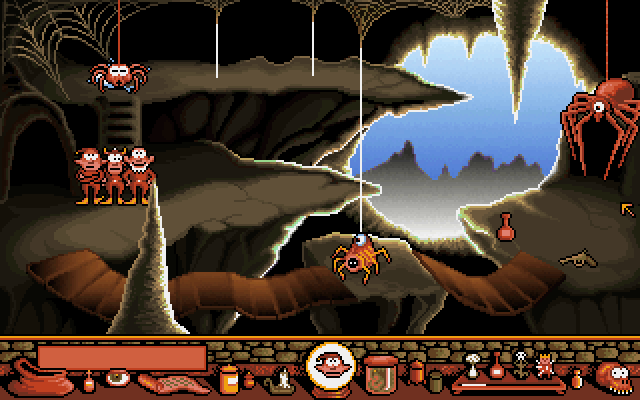
However, the actual logic driving those animations can be absurdly obscure. You will frequently find yourself pixel hunting for tiny hotspots scattered across surreal organic backgrounds. Furthermore, action timing matters far more than it usually does in graphic adventures. You often need to position one goblin on a specific spot, trigger a spell with the second goblin, and immediately switch back to the first to catch a falling object before it hits the ground. If your timing is off by a second, you lose health and get to try the entire sequence again.
A classic example occurs in the early stages, where picking up a simple stick requires using magic on a sleeping creature, hitting a branch with your brawler at the exact right moment, and positioning your inventory holder underneath. It feels brilliant when your sequence executes cleanly, but figure out the exact order without a guide often means burning through half your health bar on bad guesses.
Audio missing from the disk, censors on the CD, and where the Gobliiins went next
The production history behind the game has a few odd quirks that long-time PC gamers still talk about. On the back of the original floppy disk boxes, composer Frédéric Motte (known as Moby in the demoscene) was credited for writing a full musical score. Yet when players booted up the original floppy disk release, they were met with total silence during gameplay outside of basic Sound Blaster bleeps and comedic sound effects. The actual background music tracks, composed by Charles Callet, were only added later in the 1993 CD-ROM re-release as redbook audio audio tracks.
That CD-ROM upgrade also brought an unexpected slice of censorship. Level 13 of the original floppy release contained background art featuring a line drawing of a nude woman. For the international CD-ROM release, Sierra and Coktel Vision edited the artwork to cover the drawing, making the disk version a curious piece of vintage software history. The title itself introduced a fun naming convention that Coktel maintained for years: the number of letter "i"s in the title directly matches the number of controllable goblins. That is why the immediate sequel was titled Gobliins 2: The Prince Buffoon with two "i"s, followed later by Goblins Quest 3 with just one.
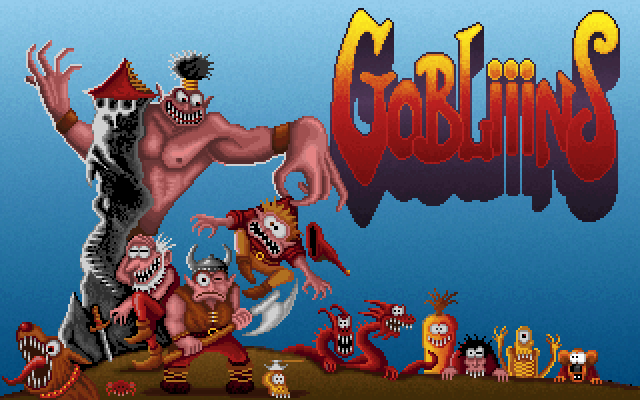
While LucasArts was establishing a philosophy where players could never die or reach an unwinnable state, Coktel Vision embraced brutal arcade-style penalties wrapped inside a brain-teaser format. It pushed the humble MS-DOS graphics card to display wildly colorful, organic fantasy art while many adventure games still relied on standard geometric tiles and static talk portraits.
Fire up this classic directly in your browser
The original Gobliiins remains a fascinating, slightly wild experiment in early nineties software design. Its health bar system aggressively punishes modern casual play, and the pixel hunting will certainly test your patience. Yet the personality packed into these three little heroes, combined with the sheer satisfaction of solving a multi-stage screen without losing a sliver of health, makes it entirely worth an afternoon of your time.
You can play Gobliiins online right now, completely free, directly in your browser window. There are no floppy images to mount, no sound card IO ports to guess in a setup utility, and no config files to tweak before launching the classic Gobliiins MS-DOS game. If you want to experience the exact original release that had nineties gamers scribbling passwords on the back of manual booklets, you can load up Gobliiins free in your browser today and start punching trees immediately.