

Grand Prix Circuit brought high-speed Formula One racing to home PCs in 1988, asking players to wrestle three distinct turbocharged beasts through tight city streets and sweeping historical tracks.
Mastering three distinct cars in Grand Prix Circuit
By the late 1980s, driving games were transitioning from pure arcade impulse into home simulation. Developers had to figure out how to convey the bone-rattling speeds of open-wheel racing using systems that struggled to draw simple filled polygons. Distinctive Software, Inc. and publisher Accolade, Inc. answered that challenge with Grand Prix Circuit, a first-person racer built around fast sprite-scaling algorithms, tight cornering lines, and an accurate roster of late-eighties chassis.
When you start up this 1988 release, you select between three real-world machines:
- McLaren MP4/4 with its Honda V6 turbo engine, offering supreme raw speed but incredibly sensitive handling.
- Williams FW12 running a Renault V10, balancing acceleration with reliable cornering stability.
- Ferrari F1/87/88C powered by a screaming Ferrari V12, built for solid grunt on power circuits.
Once inside the driver's seat, you might notice an odd design shortcut: all three vehicles use the exact same dashboard artwork. The game only swaps out the small gear shifter graphic beside the rev counter to reflect your choice. Yet beneath the hood, the physics models tell a completely different story. The McLaren is notoriously difficult to tame, snapping sideways on turn entry if you apply power too early, while the Williams provides a far more forgiving baseline for learning track braking points.
The brutal reality of track positions and tight pileups
The campaign structure lets you jump into Practice, a Single Event, or a full Championship season. The schedule features eight historical venues, taking you from Jacarepaguá in Brazil and the walls of Monaco to the street maze of Detroit, alongside Silverstone, Hockenheim, Monza, Montreal, and Suzuka. Every grand prix forces you to run a qualifying lap first to establish your place on the starting grid.
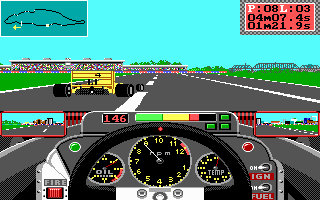
Racing itself is a exercise in nerve. You share the asphalt with nine fictitious AI drivers who tend to run on rigid, tightly packed racing lines. Passing them creates the primary difficulty wall in this racing game. Because rivals frequently cluster together in long trains through chicanes, attempting a dive-bomb pass usually ends in disaster. Clipping another vehicle or sliding off the grass instantly fills the damage meter mounted right above your steering wheel. Fill that bar, and your suspension breaks, handing you an instant retirement and game over.
Pitting adds another layer of race control. While late-eighties F1 regulations meant no mid-race refueling, high tire degradation forces you into the pit lane on longer heats. Successfully navigating into your pit box for fresh rubber requires clean entry speeds, as overshooting costs precious seconds in the standings.
Sound Blaster tunes and life behind the wheel
Designed by Don Mattrick and Brad Gour, the game pushed sprite animation on modest MS-DOS hardware. On an IBM PC XT with basic graphics, the horizon and turn markers slide by without stuttering. The sound was ambitious, pushing screeching tire engine sounds through the PC speaker while supporting early Sound Blaster hardware for richer chiptune melodies. Audio composer Krisjan Hatlelid even hid a famous musical reference in the game over and high score screen, which plays a rendered version of the 1969 pop hit "Na Na Hey Hey Kiss Him Goodbye" by Steam.
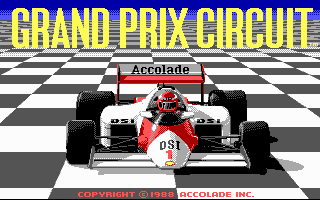
The code and menu structures Distinctive Software established here laid the groundwork for their next big release, The Duel: Test Drive II. Interestingly, the game left an impact far outside North America. In a 2010 interview with BBC Top Gear, Kazunori Yamauchi, the creator of the Gran Turismo series, cited this specific PC title as his initial introduction to racing simulations, noting how its emphasis on vehicle weight transfer inspired his own career in game design.
Why Grand Prix Circuit still tests your reflexes
Certain aspects of the presentation show their age. The roadside scenery can feel monotonous across tracks, with green grass and grey barriers looking identical in Germany and Japan alike. The strict collision punishment can also frustrate players expecting rub-is-racing forgiveness. Still, hitting your braking points, managing engine revs, and timing overtaking maneuvers keeps every lap tense.
You can play Grand Prix Circuit online free in your browser right here on this page. If you want to experience a classic Grand Prix Circuit MS-DOS game session without setting up old hardware, select the Williams FW12, clear qualification at Monza, and see if you can survive ten laps without wrecking your front wing against the AI train.
How Grand Prix Circuit is played — the keys the game listens to, grouped by what they do.
- Movement
- Action
- Interface
- Other
Highlighted keys are mapped — hover or tap one to see what it does.
Press Ctrl-J in-game to calibrate joystick controls. To launch, use GP.EXE or direct graphics executables like GPEGA.EXE.
Players' controls
Touch and gamepad controls
The on-screen keyboard and gamepad mapping the browser player uses on a phone, a tablet or a controller, as opposed to the real keys above. $PRO members make their own in the player and share them here; anyone can pick one to play with.
Make your own touch controlsPRO
- 1Open the editorSign in below, then pick what to make. The game starts with the editor open over it.
- 2Place your keysAdd keys and drag them where your thumbs rest, or map a controller's buttons. Test plays the game with them; Save keeps them, and you play with them from then on.
- 3Share themShare them right after saving in the game, or name and share them here. Players vote, and the best become this game's controls for everyone.
Go PROSee how it worksSign in+20 XP for sharing · +50 XP if yours become the game's own
- The game's own controlsKeyboardGamepadWhat every player starts with.In use
2 screenshots
From the archive
No gameplay video yet
No gameplay video for Grand Prix Circuit yet. Sign in to add one.
No reviews yet
Tell the community what you think of Grand Prix Circuit. Reviews are public and tied to your username.
No archived manuals for Grand Prix Circuit yet
No manuals archived for this title yet. Sign in to upload the first scan.
Cheat codes, console commands and memory pokes for Grand Prix Circuit — each one verified and attributed.
Sign in to submitNo cheats yet for this title
Know a working cheat, poke or trainer? Add it with the button above. Moderators check every entry before it goes live.
No archived soundtrack for Grand Prix Circuit yet
No soundtrack archived for this title yet. Sign in to upload the first rip.
No save states for Grand Prix Circuit yet
No save states for this title yet. Sign in to share one.
Discussions
Sign in to post- Threads0
- Total posts0
- Online now6
Community · Grand Prix Circuit
Who's contributing, and what's new
- Reviews0
- Threads0
- Uploadsapproved0
- Contributors0
Recent activity
Nothing here yet
Reviews, discussion threads and approved uploads appear here as members add them.