In Heroes of Might and Magic, you start with a single castle, a handful of low-tier troops, and an overland map covered in fog that hides gold mines, magic shrines, and roving bands of hostile monsters.
Conquering Enroth one hex at a time
Before Jon Van Caneghem combined the turn-based strategy of King's Bounty with his dungeon-crawling RPG setting, fantasy strategy games tended to focus either on abstract troop movements or granular party management. Heroes of Might and Magic struck a balance by letting you run an empire through individual heroes who collect experience, learn spells, and haul magic items across a top-down kingdom map. Released for MS-DOS in 1995 by New World Computing, it established a rhythm of turn-by-turn territorial expansion that kept players telling themselves they would log off after just one more day.
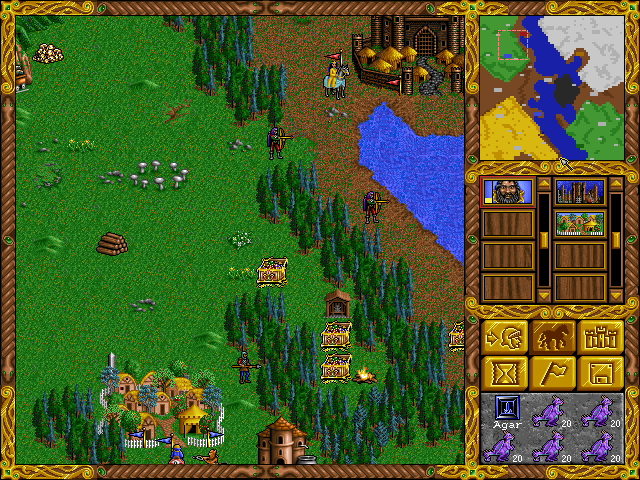
The campaign kicks off with Lord Morglin Ironfist fleeing through a portal into the untested land of Enroth, where four distinct warlord factions battle for total control. You choose between four hero classes: the martial Knight and Barbarian, or the spell-heavy Sorceress and Warlock. Each class controls specific unit types, ranging from simple goblins and archers to expensive hydras, dragons, and phoenixes. Your hero travels the overland map using daily movement points, capturing lumber mills and ore mines to supply the central stronghold.
Early scenarios like "Gateway" teach you the core loop quickly. You spend your early turns gathering loose chests of gold and capturing immediate wood and ore resources, because without income, your town hall produces nothing. If you spend three turns wandering the wrong direction without securing a stone quarry or sulfur pit, your army development halts completely while computer opponents grow unchecked.
Castle building and the brutal economy of early expansion
Managing your castle feels like a race against an invisible clock. Every day brings fresh gold into your treasury if you built the right structures, while every Monday morning resets the recruitment pools for your creature dwellings. Upgrading buildings unlocks higher-tier units, turning basic sword-wielders into armored paladins or transforming basic spellcasters into lethal artillery. However, luxury resources like mercury, crystals, and gems restrict top-tier recruits, forcing you to push deeper into contested lands to secure specialized mines.
Tactical battles trigger whenever your hero steps onto a tile occupied by an enemy lord or a neutral creature stack. Combat shifts to a close-up hex-grid view where unit turn order relies on speed stats. Flying units can swoop clear across the grid to disrupt archers on turn one, while slow infantry can get picked apart before they cross the middle hexes. Your hero does not stand on the grid as a physical target, but their attack and defense stats boost every stack under their banner, and their personal spell book can turn a losing battle with a timely fireball or haste spell.
Balancing spellcasting and army composition demands constant attention. The four factions rely on distinct mechanical advantages:
- The Knight relies on cheap, high-defense foot soldiers and early leadership bonuses to win quick skirmishes.
- The Barbarian ignores terrain penalties across rough wilderness maps, allowing rapid early territory claims.
- The Sorceress dominates long-range engagements with potent archers and sea navigation perks.
- The Warlock sacrifices early economic speed to build up devastating high-tier dragons and dark magic spells.
Where Heroes of Might and Magic punishes passive play
The main complaint players had back in 1995, and still talk about today, is how aggressively the game penalizes defensive play style. If you sit behind your castle walls trying to build a massive garrison before exploring, you lose. The AI map roaming creates a snowball mechanic: the hero who aggressively takes risks, loses half their army to secure a gold mine, and immediately hires fresh troops will outpace a defensive player within two weeks of game time.
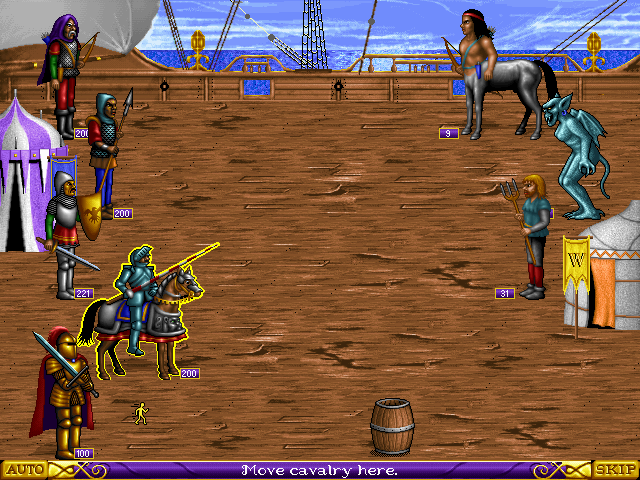
Neutral army encounters on the map introduce genuine hazards, particularly wandering bands of Genies, Nomads, Rogues, or unrecruitable Ghosts. Ghosts are infamous for ruining good map runs because of their unique trait: every enemy unit they kill is added directly to their own stack count. A misplaced army of basic peasants can feed a group of ten Ghosts until they become an unkillable swarm of hundreds, wiping out your primary hero in a single combat phase.
The campaign design leaves little room for defensive errors. Lead programmer Phil Steinmeyer and designer Jon Van Caneghem built an AI that constantly probes your borders for unguarded castles. Leaving a stronghold without a defensive garrison is an invitation for an enemy hero to sneak around your main force, take your town in a single turn, and cut off your daily income.
Sound Blaster audio, cheat codes, and hex-grid tactics
The technical presentation set a high benchmark for MS-DOS games in 1995. The soundtrack composed by Paul Anthony Romero, Rob King, and Steve Baca delivered operatic, suite-like themes for each castle type. Sound setups allowed players to configure audio output for 8-bit Mono, 16-bit Mono, or crisp 16-bit Stereo soundtracks depending on their Sound Blaster card capabilities, giving each town screen a rich auditory identity.
For players struggling through brutal map scenarios, New World Computing left numeric cheat codes active on the top keyboard row. Typing 101495 reveals the complete map, while 101496 drops extra gold into your treasury. If your units lag behind on the grid, 101111 casts Haste across your whole army, and specific resource codes like 844690 or 899101 give instantly needed crystals or diamonds. Launching the executable with the /d1 command line switch opens developer debug shortcuts for instantly testing scenario victories.
Compared to late-90s entries in the strategy genre, this initial entry focuses on fast, digestible maps. Games of the period often bogged players down in heavy micro-management, but here the decision loop stays crisp: move your hero, capture a mine, build one castle upgrade, end turn.
What holds up today and how to play Heroes of Might and Magic online
Thirty years on, the original game retains an immediate, highly playable appeal. While later sequels expanded the skill trees and town management options, this original release delivers a lean, fast-paced turn-based campaign where every decision matters on day one. The ghost unit mechanics and aggressive computer AI can feel harsh during your first few runs, but learning to manage spell books and map momentum remains thoroughly rewarding for anyone who enjoys fantasy tactics.
You can play Heroes of Might and Magic online directly in your browser without setting up complex configuration files or tracking down old installation discs. Running the classic Heroes of Might and Magic MS-DOS game in a browser tab lets you sample the fast unit movement animations and full operatic stereo audio within seconds. Launch a game, pick the Knight or Warlock, and see if you can take your first enemy castle before week two ends.