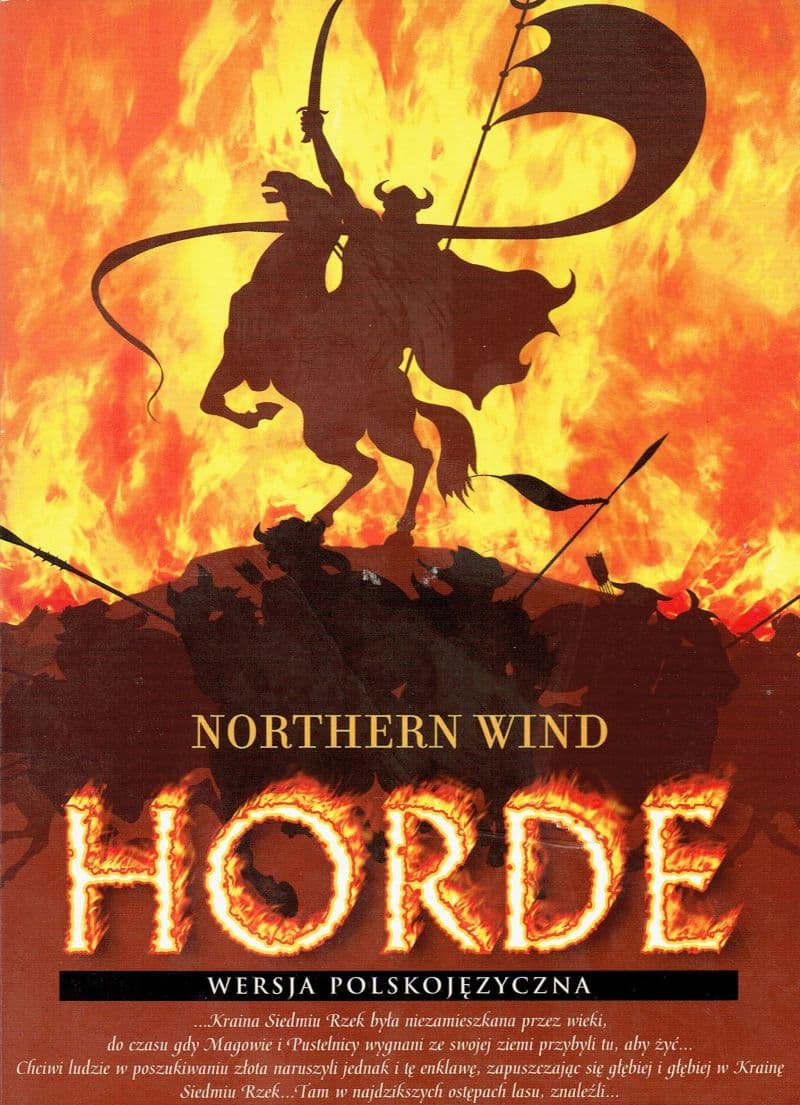
In Horde: The Northern Wind, you take command of a tribe in the land of Semirechye and manage an interconnected world instead of isolated strategy missions. Dropping your hero onto a new map leaves your previous base in the hands of an AI governor while you hunt for a mythical dragon.
An open world replaces standard RTS missions
Orda: Severnyi Veter, known in English as Horde: The Northern Wind, looks like a standard clone of Warcraft II at first glance. It sets its campaign in Semirechye, the Land of the Seven Rivers, drawing heavily on Slavic folk tales. You play as a tribal leader who must build settlements, manage regional diplomacy, and explore the landscape.
Instead of self-contained scenarios, the map layout is a connected three-by-three grid of nine large regions. Units pass freely between these areas as long as border paths remain clear. The central goal is to locate and slay a dragon, but the game leaves the exact path entirely to you.
The moment your hero unit moves into an adjacent territory, control of your original base shifts to an AI governor. This mechanic keeps economic expansion moving across borders, but it means handing your hard-earned infrastructure to computer scripts. Managing multiple sectors requires careful planning before your leader steps across the map boundary.
Wind, fire, and wildlife alter your battle tactics
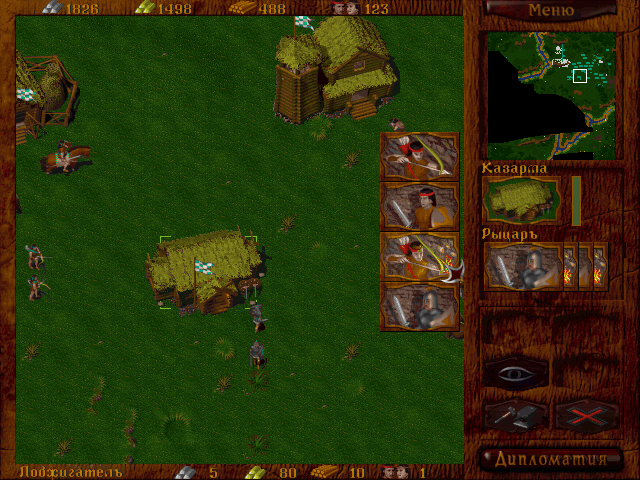
Environmental mechanics directly influence combat and base defense. Buildings do not merely show damage meters when hit; flaming arrows and ballista bolts ignite actual fires on wooden roofs. Wind direction dictates how these blazes spread to neighboring structures, which can burn down an entire settlement if ignored.
Forest fires are a constant hazard when catapult fire hits woodland borders. Animated flags on buildings react to shifts in wind direction, giving you a visual clue about fire risks. Foot units also leave visible tracks on sandy riverbanks, letting attentive players track enemy troop movements across open ground.
Infantry can move through dense forests to bypass choked passes, though at a lower movement speed. Traversing the woods carries real risk, as wild bears and wolves lurk among the trees. Unwary squads of weak soldiers will quickly get picked apart by local fauna before ever reaching an enemy base.
Resource management in Horde: The Northern Wind demands extra care
The economy in this 1999 title requires far more oversight than typical strategy games of the late nineties. You manage four distinct resources: wood, ore, gold, and overall population. Collecting wood or ore follows standard routines, though you must construct a functional mine directly over a deposit before extracting metals.
Population acts as a strict bottleneck for both military and civilian expansion. Constructing farms increases your population growth rate rather than raising a hard supply cap. Training a worker or soldier drains living citizens directly from your town center, and operating advanced buildings requires assigned manpower.
Taxes generate your main income across three resource types, calculated from total population size. A portion of that revenue automatically covers salaries for active soldiers and workers in gold. Balancing tax revenue against military upkeep forms the core economic loop in this 7th BitLabs title published by Buka Entertainment.
- Castle foundation: Functions as both your primary town hall and the sole construction builder.
- Building radius: Standard structures must be built within range of the local castle.
- Radius extension: Barracks and factories slightly extend the valid placement zone for new buildings.
- Castle relocation: Destroying a castle lets you rebuild elsewhere, but stranded buildings slowly decay.
Diplomacy and large-scale warfare balance out exploration
Meeting neighboring factions does not force immediate bloodshed. Encountered nations begin in a neutral state, opening up simple diplomatic actions. You can issue declarations of war, propose alliances, or surrender to become a vassal when facing overwhelming military force.
Diplomatic options are straightforward, yet peaceful resolutions often prove necessary when flat extermination costs too many units. Battles turn chaotic quickly when dozens of soldiers clash along border riverbanks. You can select up to 400 units simultaneously, using group filtering clicks to exclude specific unit types from a messy melee.
Units cannot be upgraded through research buildings, but individual troops gain experience through surviving combat. Experienced veterans gain higher damage resistance, stronger attacks, and passive health regeneration. Exploration also reveals magical artifacts, ancient stone inscriptions with hints, and cages holding neutral creatures that either assist you or attack on sight.
How to play Horde: The Northern Wind free in your browser today
This RTS title took a real risk on an open-world campaign map. Your AI governors will sometimes ruin your settlements, but balancing weather, taxation, and non-linear map movement keeps the pressure on. The sprite work is dense too, packed with thousands of individual animation frames for soldiers and monsters.
You can play Horde: The Northern Wind online right now inside your web browser. The standard Horde: The Northern Wind MS-DOS game executable often struggles on modern operating systems, but running it here skips configuration issues entirely. Set up your first castle, monitor the wind before building flammable structures, and see if you can track down the dragon.