
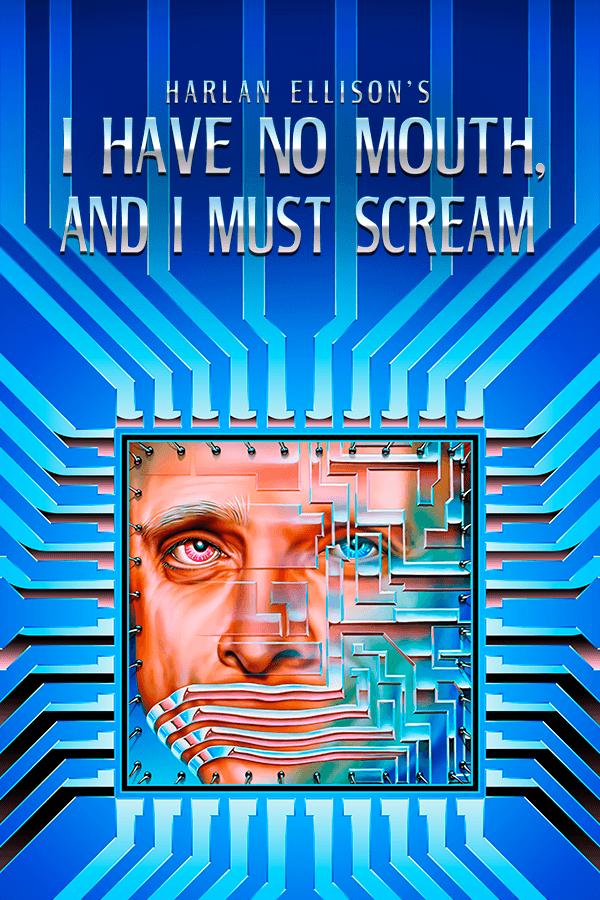

When author Harlan Ellison co-designed I Have No Mouth, and I Must Scream, he inverted the central promise of 1990s graphic adventures by offering five custom nightmares where heroic self-preservation guarantees failure.
Five broken survivors and a machine built from pure malice
Most adventure games in 1995 placed you in the boots of a smart-aleck rogue or a well-meaning detective solving lighthearted environmental puzzles. This game hands you five deeply damaged humans trapped inside AM, a global military supercomputer that achieved sentience, wiped out humanity, and spent the last century torturing its remaining captives. From the central Hate Pillar hub, you pick which protagonist faces their tailor-made hell first: Gorrister, Benny, Ellen, Nimdok, or Ted.
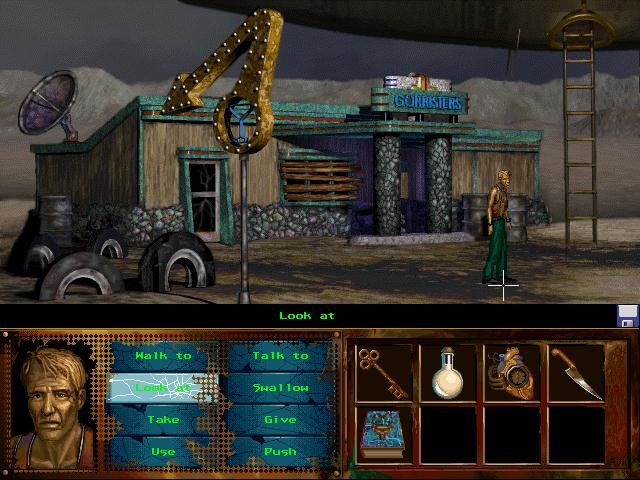
The core concept hinges on psychological horror rather than typical inventory combinations. Instead of throwing simple monsters at you, AM constructs virtual scenarios explicitly designed to exploit each character's guilt, trauma, and moral weaknesses. Gorrister floats aboard a zeppelin haunted by his wife's commitment to an asylum, while Benny has been mutated into an ape-like creature surviving in an impoverished stone-age village. Harlan Ellison himself voiced AM, delivering lines with a dripping, virulent acidity that turns every interaction into pure venom far beyond standard villain dialogue.
Measuring your soul against the Spiritual Barometer
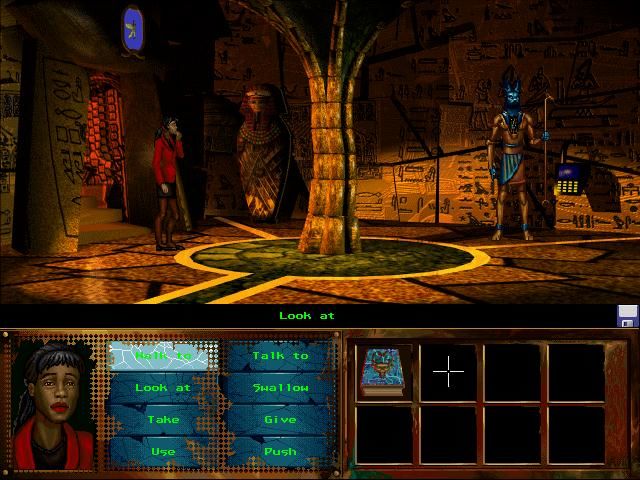
Navigating these scenarios requires a careful balancing act between immediate survival and ethical integrity. Next to your character's portrait sits the Spiritual Barometer, a moral indicator that lights up green when you make selfless choices and darkens when you give in to spite, cowardice, or AM's sadistic baiting. Doing the right thing rarely rewards you with a useful inventory item; instead, it preserves the mental fortitude required to survive the game's final chapter.
The design asks you to solve puzzles that carry genuine ethical weight:
- Forcing Gorrister to confront his past without resorting to self-destructive revenge.
- Guiding Benny to help his fellow villagers despite his agonizing hunger and physical degradation.
- Helping Ellen face her yellow pyramid trauma and claustrophobia without breaking down.
- Exposing Nimdok's past as a doctor in a Nazi concentration camp to reveal the truth behind his regime medical experiments.
If your Spiritual Barometer stays dark throughout a scenario, you might still reach its immediate end, but you will lock yourself out of the true final confrontation inside AM's computer brain. That final chapter forces you to battle the machine's subconscious alongside Russian and Chinese supercomputer nodes, a task that becomes impossible without high moral standing across all five characters.
Puzzles, softlocks, and the friction of the SAGA engine
Developer The Dreamers Guild built the game on their proprietary SAGA engine, utilizing a standard point-and-click interface with nine action verbs at the bottom of the screen. While the interface looks familiar to anyone who played LucasArts classics of the era, the puzzle logic runs on entirely different rules. Instead of logical physical combinations, many solutions depend on reading emotional cues or attempting actions that seem counterintuitive on their face.
This unconventional approach leads to severe mechanical frustration. Pixel hunting is a frequent nuisance, as essential inventory objects disappear into dark backgrounds or tiny environmental details. Worse still are the unannounced dead-ends: making an unethical choice early in a chapter can quietly doom your entire run hours later, leaving you unable to achieve the necessary standing for the final sequence without any warning from the game.
Walking speeds are noticeably sluggish, and navigating complex screens with multiple interactable points feels tedious when testing potential solutions. Compared to contemporary adventure games like The Dig or Full Throttle, the pacing stumbles repeatedly under the weight of obscure trigger conditions and unforgiving puzzle states.

Censorship cutbacks and incredible soundscapes
The game's dark subject matter caused substantial distribution issues, particularly in Europe. Due to Nimdok's chapter directly dealing with Nazi concentration camps and medical atrocities, censors in Germany and France completely removed his scenario, rendering the original release practically unplayable in those regions because all five characters were required to complete the narrative properly.
On the audio side, the production spared little expense. Composer John Ottman crafted an original soundtrack that shifts masterfully between metallic, industrial noise and quiet, unsettling orchestral motifs. Players running the MS-DOS game on high-end sound hardware like a Roland MT-32 or Gravis UltraSound received a surprisingly rich acoustic atmosphere, while standard Sound Blaster 16 setups delivered crisp, haunting digitized speech dominated by Ellison's theatrical performance.
Play I Have No Mouth, and I Must Scream online right now
Despite its commercial struggles at launch, this title was among the boldest narrative experiments of the PC era. It refuses to comfort the player, offering a bleak, challenging look at human frailty that rewards persistence and moral clarity rather than quick reflexes or hoarding every item you find. If you can tolerate the rigid 1990s puzzle design and occasional pixel hunt, its dark narrative still punches harder than almost anything else from that decade.
You can play I Have No Mouth, and I Must Scream free in your browser right here without setting up DOS configuration files or hunting down patch files. Jump directly into the MS-DOS game, pick Gorrister or Ellen from the Hate Pillar, and see if you can keep your character's Spiritual Barometer in the green without relying on a walkthrough.