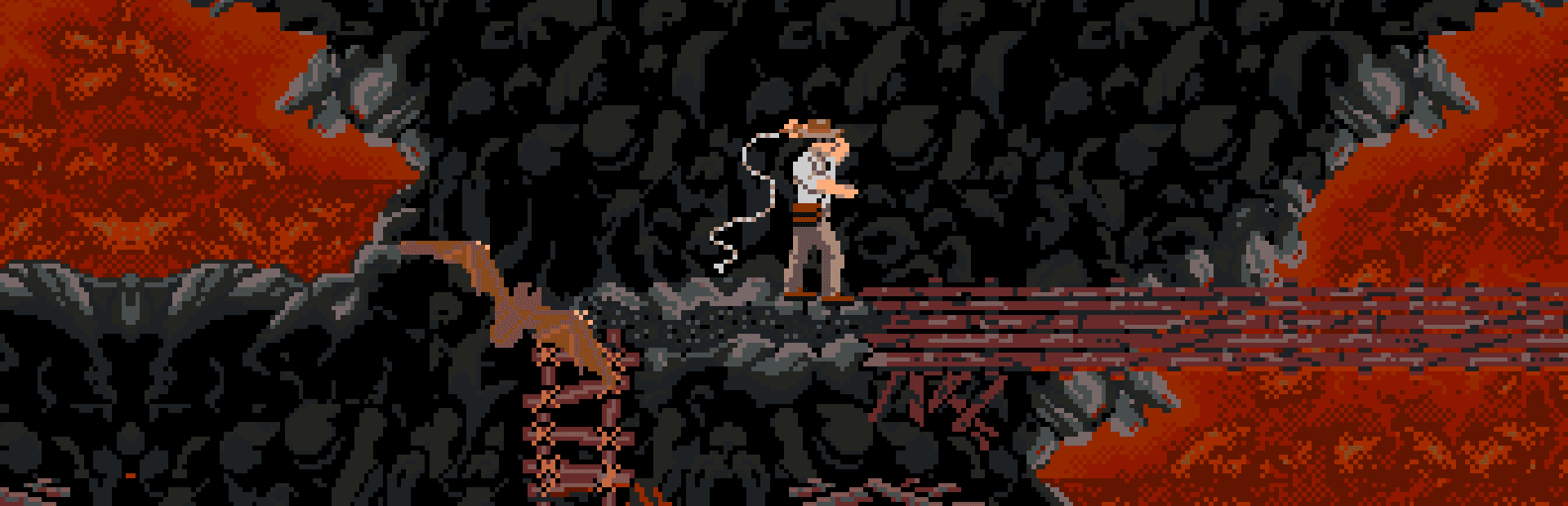

Indiana Jones and the Temple of Doom on MS-DOS brings Peter Lipson's 1985 Atari arcade machine to PC hardware, complete with whip-cracking action, perilous mine cart chases, and lava-filled altars.
Atari Games designed the original arcade cabinet in 1985 around System 1 hardware. That hardware allowed for fast screen scrolling and detailed character sprites. Porting that experience to home machines required shrinking complex arcade visuals to fit humble PC hardware. Mindscape, Inc. brought the game to PC computers in 1988 with the help of Paragon Programming.
The goal was straightforward. Players wanted the thrill of the film on their monitor at home. You step into Indy's brown fedora to rescue kidnapped children, recover three sacred Sankara Stones, and defeat the Thuggee cult leader Mola Ram. The PC version preserves the structure of the arcade original by dividing the action into distinct repeating stages.
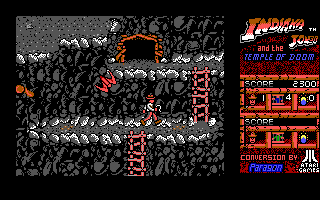
The game cycles through three distinct stages before reaching the final showdown on the rope bridge. Each loop raises the difficulty with tighter paths, faster hazards, and more aggressive enemies.
The core rotation breaks down into three clear objectives:
The mine sections require you to check every side path for trapped children. You use your whip to swing over open drops and lash out at oncoming guards. Once you rescue all captives on the screen, an open mine cart appears to take you to the next phase.
The original coin-op used a specialized controller, which made steering carts and aiming whip strikes feel natural. Keyboard controls in this DOS conversion feel significantly stiffer. You must align Indy precisely with ladders or conveyor belts to move safely.
One hit from an enemy or a single dip into a lava pit immediately costs you a life. That strict penalty makes every room a tense ordeal. Thuggee cultists throw knives and block pathways, while bats drop from ceilings without warning. The mine cart sequences demand rapid decision-making. You must pick the correct rail fork while tilting your cart sideways to cross gaps in the track.
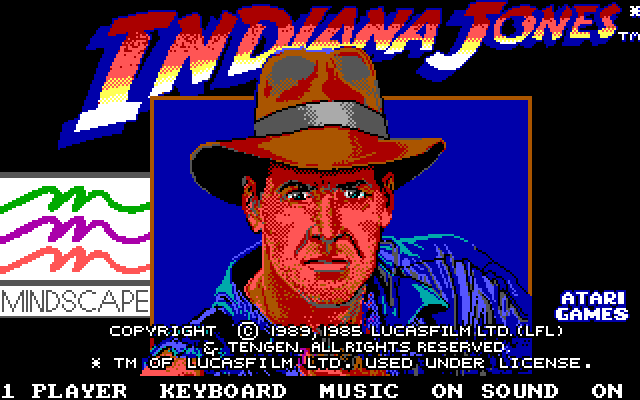
Graphics support includes standard CGA and EGA display modes. CGA displays the game in four high-contrast colors, while EGA gives the underground caverns richer detail and deeper browns. Sound comes through the PC speaker, playing a chip rendition of the John Williams theme music on the main menu.
While the initial run through the mines captures genuine excitement, the loop reveals structural flaws early on. The layout of the temple levels remains nearly identical across cycles. Only the number of hazards increases as you progress.
Because Indy dies from a single mistake, progress relies heavily on trial and error. Memorizing track layouts becomes essential for surviving the mine cart rides. The rope bridge showdown at the end provides a memorable climax against Mola Ram, but reaching it requires grinding through repetitive stage patterns.
Compared to other action games from Atari, Inc. of the same period, this conversion prioritizes faithful arcade layout over fine-tuned PC playability. Missing arcade secrets and simplified level transitions mean it falls slightly short of the original cabinet experience. Yet the core loop of whipping enemies and riding carts retains its basic appeal.
If you want a quick hit of classic film-licensed platforming, this conversion delivers authentic late-eighties action. Navigating a mine cart at high speeds or snatching a glowing stone off a altar yields a genuine thrill. The harsh difficulty will challenge your reaction times from the very first level.
You can play Indiana Jones and the Temple of Doom online free in your browser right now. Fire up the game, crank up the PC speaker theme music, and see if you can clear the mine shafts without losing your hat.
Indiana Jones and the Temple of Doom on MS-DOS brings Peter Lipson's 1985 Atari arcade machine to PC hardware, complete with whip-cracking action, perilous mine cart chases, and lava-filled altars.
Atari Games designed the original arcade cabinet in 1985 around System 1 hardware. That hardware allowed for fast screen scrolling and detailed character sprites. Porting that experience to home machines required shrinking complex arcade visuals to fit humble PC hardware. Mindscape, Inc. brought the game to PC computers in 1988 with the help of Paragon Programming.
The goal was straightforward. Players wanted the thrill of the film on their monitor at home. You step into Indy's brown fedora to rescue kidnapped children, recover three sacred Sankara Stones, and defeat the Thuggee cult leader Mola Ram. The PC version preserves the structure of the arcade original by dividing the action into distinct repeating stages.

The game cycles through three distinct stages before reaching the final showdown on the rope bridge. Each loop raises the difficulty with tighter paths, faster hazards, and more aggressive enemies.
The core rotation breaks down into three clear objectives:
The mine sections require you to check every side path for trapped children. You use your whip to swing over open drops and lash out at oncoming guards. Once you rescue all captives on the screen, an open mine cart appears to take you to the next phase.
The original coin-op used a specialized controller, which made steering carts and aiming whip strikes feel natural. Keyboard controls in this DOS conversion feel significantly stiffer. You must align Indy precisely with ladders or conveyor belts to move safely.
One hit from an enemy or a single dip into a lava pit immediately costs you a life. That strict penalty makes every room a tense ordeal. Thuggee cultists throw knives and block pathways, while bats drop from ceilings without warning. The mine cart sequences demand rapid decision-making. You must pick the correct rail fork while tilting your cart sideways to cross gaps in the track.
Graphics support includes standard CGA and EGA display modes. CGA displays the game in four high-contrast colors, while EGA gives the underground caverns richer detail and deeper browns. Sound comes through the PC speaker, playing a chip rendition of the John Williams theme music on the main menu.

While the initial run through the mines captures genuine excitement, the loop reveals structural flaws early on. The layout of the temple levels remains nearly identical across cycles. Only the number of hazards increases as you progress.
Because Indy dies from a single mistake, progress relies heavily on trial and error. Memorizing track layouts becomes essential for surviving the mine cart rides. The rope bridge showdown at the end provides a memorable climax against Mola Ram, but reaching it requires grinding through repetitive stage patterns.
Compared to other action games from Atari, Inc. of the same period, this conversion prioritizes faithful arcade layout over fine-tuned PC playability. Missing arcade secrets and simplified level transitions mean it falls slightly short of the original cabinet experience. Yet the core loop of whipping enemies and riding carts retains its basic appeal.
If you want a quick hit of classic film-licensed platforming, this conversion delivers authentic late-eighties action. Navigating a mine cart at high speeds or snatching a glowing stone off a altar yields a genuine thrill. The harsh difficulty will challenge your reaction times from the very first level.
You can play Indiana Jones and the Temple of Doom online free in your browser right now. Fire up the game, crank up the PC speaker theme music, and see if you can clear the mine shafts without losing your hat.
How Indiana Jones and the Temple of Doom is played — the keys the game listens to, grouped by what they do.
Highlighted keys are mapped — hover or tap one to see what it does.
F2 switches control modes between joystick and keyboard. Key mappings are not fully documented in the base manual.
The on-screen keyboard and gamepad mapping the browser player uses on a phone, a tablet or a controller, as opposed to the real keys above. $PRO members make their own in the player and share them here; anyone can pick one to play with.
Cheat codes, console commands and memory pokes for Indiana Jones and the Temple of Doom — each one verified and attributed.
Sign in to submitHow Indiana Jones and the Temple of Doom is played — the keys the game listens to, grouped by what they do.
Highlighted keys are mapped — hover or tap one to see what it does.
F2 switches control modes between joystick and keyboard. Key mappings are not fully documented in the base manual.
The on-screen keyboard and gamepad mapping the browser player uses on a phone, a tablet or a controller, as opposed to the real keys above. $PRO members make their own in the player and share them here; anyone can pick one to play with.
Cheat codes, console commands and memory pokes for Indiana Jones and the Temple of Doom — each one verified and attributed.
Sign in to submit