
Indiana Jones in Revenge of the Ancients
Starting up Indiana Jones in Revenge of the Ancients on an IBM PC in 1987 meant staring at a blank text screen, but behind that prompt lay a surprisingly punchy 1936 adventure involving Mexican ruins and airborne Nazi fights.
The box artwork lies, but the 1936 Nazi hunt is genuine
If you picked up the original Mindscape box off a shop shelf, you saw Harrison Ford amidst lava and thuggies right out of Temple of Doom. It was a complete trick by the marketing team. The game inside has nothing to do with India, Sankara stones, or underground cults. Instead, Angelsoft crafted an original tale set in 1936, sending Indy into the dense Mexican jungle to locate the Tepotzteco Pyramid before a Nazi commander named Plebinheim grabs the Mazatec Power Key.
Developer Ann Watson described Angelsoft's goal clearly at the time, stating they stripped away heavy literary descriptions to focus entirely on direct action and player involvement. Instead of long paragraphs describing ancient masonry, the text moves fast. One moment you are slashing through jungle vines, and soon after you find yourself dangling from the wing of an airborne World War I DeHavilland airplane while fighting off SS thugs.
For an early attempt at bringing the franchise to computers, this focused approach fits the serial style well. You spend less time pondering philosophical riddles and far more time dealing with immediate physical hazards. The threat list hits every standard trope: venomous snakes, swarms of vicious bats, marauding local bandits, and armed soldiers who shoot the moment you linger in a room.
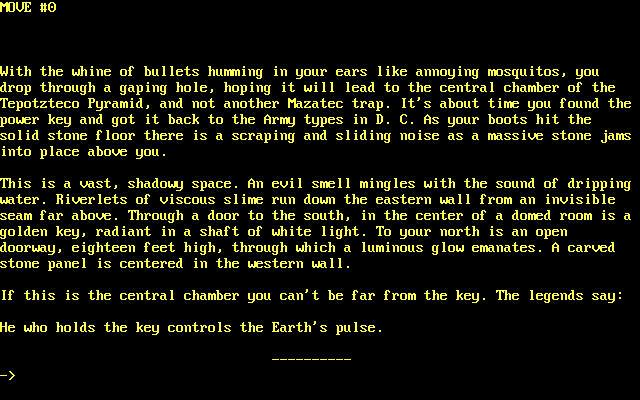
Fighting the strict parser inside the Tepotzteco Pyramid
The core struggle in this adventure game is not finding the logical solution to a puzzle, but convincing the command parser to accept what you want to do. Text parser games fromInfocom were famous for handling complex English sentences, but Angelsoft built a far more rigid engine. If you do not guess the exact two or three words the writer had in mind, the game simply refuses to understand you.
A notorious early obstacle highlights this friction perfectly. When facing a high ledge near a rock formation, typing "lasso shelf" or "lasso rock shelf" yields nothing but generic confusion from the parser. The only phrasing that works is the strict syntax "lasso rock". If you have played other interactive fiction from 1987, you know how frustrating this guessing game can get. You spend five minutes figuring out what item to use, and another ten minutes trying to guess the verb structure the programmer wanted.
The manual came with a reference card specifically to help players parse commands and manage disk formatting procedures for saving progress. You need those saves constantly because the game features several mechanics designed to kill you without warning:
- Instant death timers that trigger if you enter three unrecognized inputs in a dangerous zone.
- Sudden traps inside the Tepotzteco Pyramid that activate if you move without inspecting the floor first.
- Surprise attacks from Plebinheim's forces if you re-enter an area without your weapon drawn.
- Arbitrary environmental kills, including famous instances where looking around a room too many times causes an instant game over.
Why three mistyped commands mean immediate death
Punishing mechanics were common in early PC titles, but this parser takes fatal impatience to an extreme. When you enter a room with an active threat, such as a venomous snake or an armed soldier, the game effectively puts you on an invisible turn timer. If you make three typing errors or enter three commands the parser fails to understand, the game assumes you stood there frozen in confusion and kills you on the spot.
This design decision turns simple typos into fatal errors. If you mean to type "shoot guard" but accidentally hit a wrong key, that counts as one of your three allowed mistakes. Combine that with ambient threats where basic actions turn fatal, and you end up reloading your save file every few minutes. It forces a tedious playstyle where you save before typing near any potential hazard.
Retrospective critics have noted this cruel design repeatedly. When Computer Gaming World previewed the title in March 1987, the premise seemed promising. Modern reviews from outlets like Retro Gamer and author Christopher Carton point out that while the narrative catches the spirit of the films, the unforgiving presentation and narrow dictionary make it a tough sell for anyone lacking extreme patience.
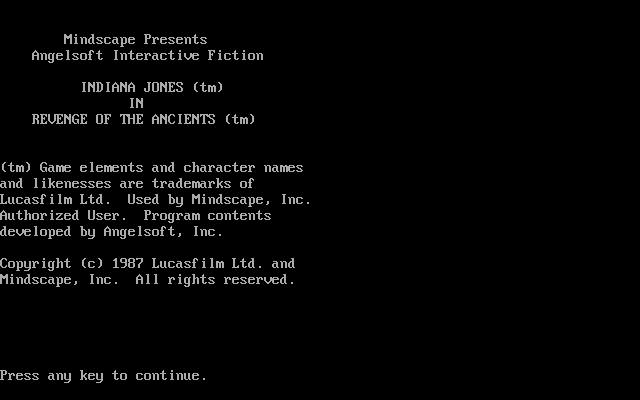
Text-only pulp action on an 8088 PC
Published by Mindscape, Inc. and crafted by Angelsoft, Inc., the MS-DOS release contains zero graphics or sound card tricks. While PC speaker beeps announce a few key events, the experience relies entirely on your monochrome or CGA text display. Compared to the lavish parser titles on the market at the time, it looks completely spartan.
Yet if you view it alongside other text games of the mid-1980s, the pacing moves with noticeable speed. Descriptions stay brief so you can move rapidly between rooms, provided you know the layout. The plot weaves through set pieces that feel genuinely cinematic in concept, even if they are delivered entirely through plain white ASCII characters on a black background.
I find that the story itself holds up surprisingly well as a piece of period fiction. It captures the pulpy, cliffhanger tone of classic 1930s matinee serials far better than many action titles that came later. The problem remains that enjoying that story requires wrestling with an uncompromising engine that punishes curiosity with immediate death screens.
Grab your whip and play Indiana Jones in Revenge of the Ancients free in your browser
If you want to experience one of the earliest official computer adaptations of Indy's adventures, you do not need an old DOS machine or original floppy drives. You can play Indiana Jones in Revenge of the Ancients online, free in your browser right now with no setup needed. Keep a notebook handy for syntax guesses, save your position before entering any dark temple corridor, and see if you can outsmart Plebinheim before his thugs catch you off guard.