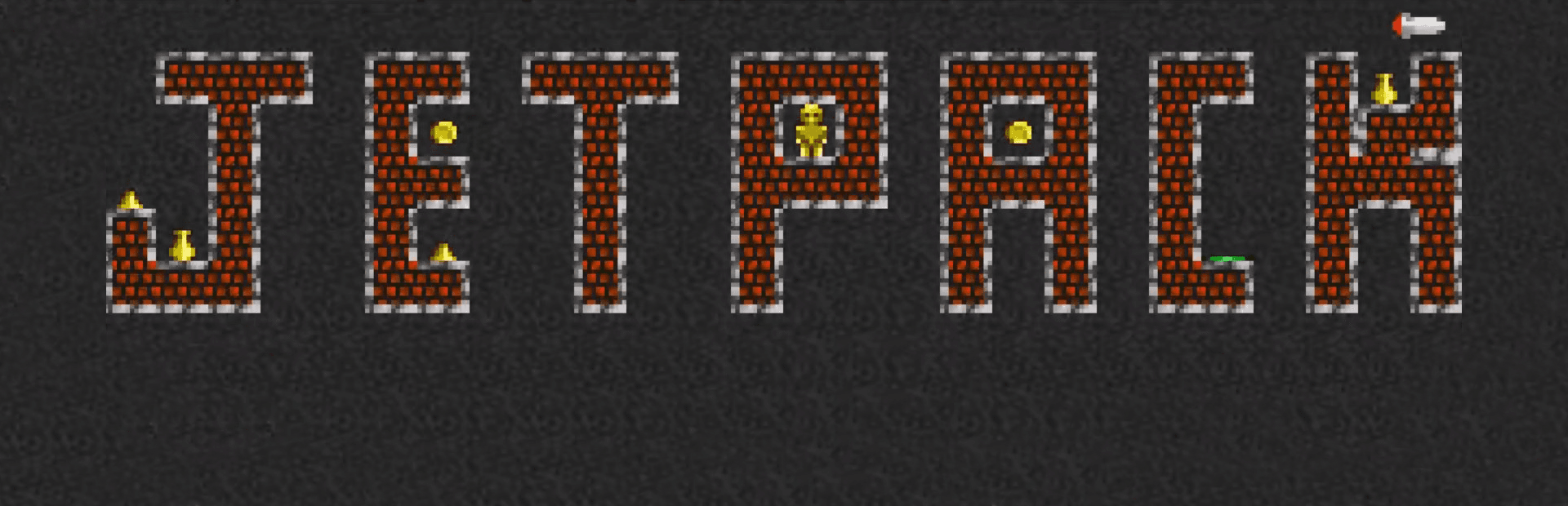
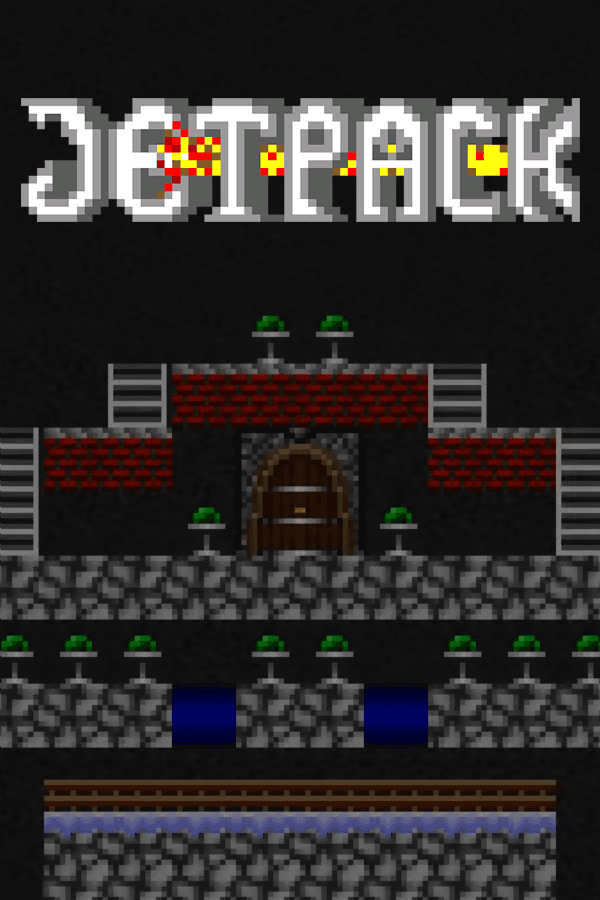

Jetpack Christmas Special! swaps out the sci-fi protagonist of Adam Pedersen's main arcade puzzle game for a jetpack-wearing Santa Claus collecting gifts across ten tight levels. Software Creations distributed this freeware release in 1993, coupling smooth VGA flight with sudden-death spike traps and an absurd eight-player local hotseat mode.
The core loop sounds gentle enough for a holiday promo. You guide Santa through a single-screen maze, pocketing scattered presents until the double exit doors click open to let you into the next stage. In practice, the flight physics demand absolute respect for momentum. Tapping the thrust key lifts Santa into the air, but coasting near jagged rocks or force fields usually ends in a fiery crash. Managing your thrust while lining up tight turns is the central tension of every map.
Santa comes equipped with a phase shifter beam, a tool that temporarily disintegrates specific brick walls to reveal hidden gifts or bypass dead ends. Because those dissolved walls rebuild themselves after a few seconds, you cannot linger inside a freshly cut tunnel. You have to burst through, grab the item, and zip out before the solid rock seals you inside. That timed element turns simple maze navigation into quick risk-assessment puzzles.
Environmental obstacles keep you recalculating your flight path constantly. Frictionless ice platforms deny you fine ground control, sliding Santa straight into spike pits if you land without scrubbing off speed first. Teleport pads instantly pop you into unfamiliar pockets of the stage, while static force fields block off whole corridors until you clear the surrounding hazards. If you enjoy precision action games from this period, the tight movement and instant feedback loop feel immediately responsive.
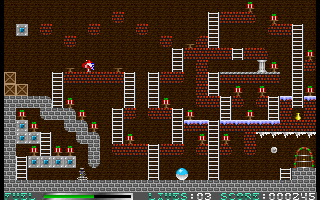
Fuel control is where Adam Pedersen built his real trap. Your thrusters draw from an active fuel meter, requiring regular pit stops at fuel tanks or mounted grid chargers scattered across the room. Running dry midway through a wide drop leaves Santa plummeting like a stone. Players often complain about the abrupt difficulty curve, and they have a point: a single touch against a hazard instantly strips away a life, forcing a full reset of the stage regardless of how many presents you already picked up.
That strict penalty turns the search for the final present into a nerve-wracking chore. Sweating through nine tricky maneuvers only to clip a wall pixel right in front of the open exit doors will make you reach for the keyboard reset. The 320x200 256-color VGA mode 13h visual style keeps every hazard clearly readable, using bright reds and greens against dark backdrops so you can never blame the graphics for a bad collision.
Audio feedback was equally direct. If your PC housed an active Sound Blaster card, the game rewarded you with digitized sound effects for thrusting, phase shifting, and picking up items, giving every action a pleasant audio crunch that outclassed basic PC speaker beeps. The small details, from the hum of force fields to the snap of the phase beam, gave the budget spin-off the polish of a commercial arcade release.
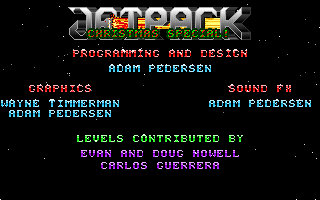
While the main game offers only ten distinct levels compared to the hundred found in the original base release, the package included a complete level editor. With extra design input credited to Wayne C. Timmerman and Evan Howell, the editor allowed players to drop custom fuel grids, phase-able walls, and spike hazards into custom holiday maps. Creating a nightmarish gauntlet for a friend took only a few minutes in the clean grid layout.
The local multiplayer option is a strange inclusion for a side-view puzzle platformer. Up to eight players can register profiles and rotate turns on the same machine, taking turns on keyboard or attached joysticks to set high scores across custom maps. Retrospective reviews from sites like Abandonware DOS pointed to this straightforward treasure-hunting loop as the best part of the game, while DOSGames.com handed the title a 5 out of 5 rating for taking a solid shareware engine and giving it away completely free.
Looking back at 1993 DOS releases published by Software Creations, this free edition worked as an effective piece of holiday marketing. It gave players a complete sample of the core mechanics without asking for a credit card, relying on tight level geometry and high difficulty to keep people retrying levels well past the holiday season.
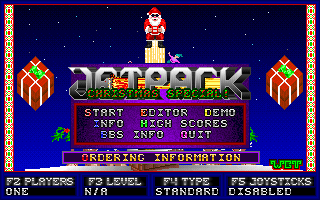
The original ten stages do not take hours to work through, but their steep hazard placement keeps the experience brisk and demanding. What holds up best is the raw movement feel: hovering around spike corners while watching your fuel gauge tick down to zero delivers genuine arcade tension. The primary design flaw is the brutal collision detection around tight exits, which can make fine maneuverability feel unfair when precision inputs fail by a single pixel.
If you want to test your reflexes against Santa's thrusters, you can play Jetpack Christmas Special! online, free, right here in your browser, with nothing to install and no setup. Jump straight into level three, burn through a wall with your phase beam, and try to grab the floating presents near the top fuel grid before your jetpack runs out of air.
Jetpack Christmas Special! swaps out the sci-fi protagonist of Adam Pedersen's main arcade puzzle game for a jetpack-wearing Santa Claus collecting gifts across ten tight levels. Software Creations distributed this freeware release in 1993, coupling smooth VGA flight with sudden-death spike traps and an absurd eight-player local hotseat mode.
The core loop sounds gentle enough for a holiday promo. You guide Santa through a single-screen maze, pocketing scattered presents until the double exit doors click open to let you into the next stage. In practice, the flight physics demand absolute respect for momentum. Tapping the thrust key lifts Santa into the air, but coasting near jagged rocks or force fields usually ends in a fiery crash. Managing your thrust while lining up tight turns is the central tension of every map.
Santa comes equipped with a phase shifter beam, a tool that temporarily disintegrates specific brick walls to reveal hidden gifts or bypass dead ends. Because those dissolved walls rebuild themselves after a few seconds, you cannot linger inside a freshly cut tunnel. You have to burst through, grab the item, and zip out before the solid rock seals you inside. That timed element turns simple maze navigation into quick risk-assessment puzzles.
Environmental obstacles keep you recalculating your flight path constantly. Frictionless ice platforms deny you fine ground control, sliding Santa straight into spike pits if you land without scrubbing off speed first. Teleport pads instantly pop you into unfamiliar pockets of the stage, while static force fields block off whole corridors until you clear the surrounding hazards. If you enjoy precision action games from this period, the tight movement and instant feedback loop feel immediately responsive.

Fuel control is where Adam Pedersen built his real trap. Your thrusters draw from an active fuel meter, requiring regular pit stops at fuel tanks or mounted grid chargers scattered across the room. Running dry midway through a wide drop leaves Santa plummeting like a stone. Players often complain about the abrupt difficulty curve, and they have a point: a single touch against a hazard instantly strips away a life, forcing a full reset of the stage regardless of how many presents you already picked up.
That strict penalty turns the search for the final present into a nerve-wracking chore. Sweating through nine tricky maneuvers only to clip a wall pixel right in front of the open exit doors will make you reach for the keyboard reset. The 320x200 256-color VGA mode 13h visual style keeps every hazard clearly readable, using bright reds and greens against dark backdrops so you can never blame the graphics for a bad collision.
Audio feedback was equally direct. If your PC housed an active Sound Blaster card, the game rewarded you with digitized sound effects for thrusting, phase shifting, and picking up items, giving every action a pleasant audio crunch that outclassed basic PC speaker beeps. The small details, from the hum of force fields to the snap of the phase beam, gave the budget spin-off the polish of a commercial arcade release.

While the main game offers only ten distinct levels compared to the hundred found in the original base release, the package included a complete level editor. With extra design input credited to Wayne C. Timmerman and Evan Howell, the editor allowed players to drop custom fuel grids, phase-able walls, and spike hazards into custom holiday maps. Creating a nightmarish gauntlet for a friend took only a few minutes in the clean grid layout.
The local multiplayer option is a strange inclusion for a side-view puzzle platformer. Up to eight players can register profiles and rotate turns on the same machine, taking turns on keyboard or attached joysticks to set high scores across custom maps. Retrospective reviews from sites like Abandonware DOS pointed to this straightforward treasure-hunting loop as the best part of the game, while DOSGames.com handed the title a 5 out of 5 rating for taking a solid shareware engine and giving it away completely free.
Looking back at 1993 DOS releases published by Software Creations, this free edition worked as an effective piece of holiday marketing. It gave players a complete sample of the core mechanics without asking for a credit card, relying on tight level geometry and high difficulty to keep people retrying levels well past the holiday season.

The original ten stages do not take hours to work through, but their steep hazard placement keeps the experience brisk and demanding. What holds up best is the raw movement feel: hovering around spike corners while watching your fuel gauge tick down to zero delivers genuine arcade tension. The primary design flaw is the brutal collision detection around tight exits, which can make fine maneuverability feel unfair when precision inputs fail by a single pixel.
If you want to test your reflexes against Santa's thrusters, you can play Jetpack Christmas Special! online, free, right here in your browser, with nothing to install and no setup. Jump straight into level three, burn through a wall with your phase beam, and try to grab the floating presents near the top fuel grid before your jetpack runs out of air.
How Jetpack Christmas Special! is played — the keys the game listens to, grouped by what they do.
Highlighted keys are mapped — hover or tap one to see what it does.
Joysticks can be adjusted or disabled in the main menu using [F5] or in-game with [J] if movement is erratic.
The on-screen keyboard and gamepad mapping the browser player uses on a phone, a tablet or a controller, as opposed to the real keys above. $PRO members make their own in the player and share them here; anyone can pick one to play with.
Cheat codes, console commands and memory pokes for Jetpack Christmas Special! — each one verified and attributed.
Sign in to submitaka Jetpack: Christmas Special! · Jetpack: Christmas Special
How Jetpack Christmas Special! is played — the keys the game listens to, grouped by what they do.
Highlighted keys are mapped — hover or tap one to see what it does.
Joysticks can be adjusted or disabled in the main menu using [F5] or in-game with [J] if movement is erratic.
The on-screen keyboard and gamepad mapping the browser player uses on a phone, a tablet or a controller, as opposed to the real keys above. $PRO members make their own in the player and share them here; anyone can pick one to play with.
Cheat codes, console commands and memory pokes for Jetpack Christmas Special! — each one verified and attributed.
Sign in to submit