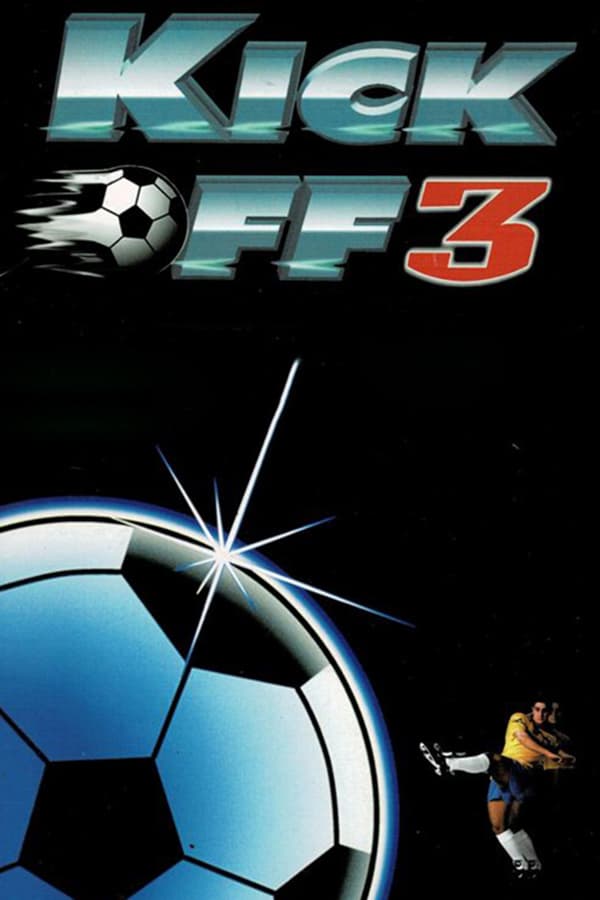

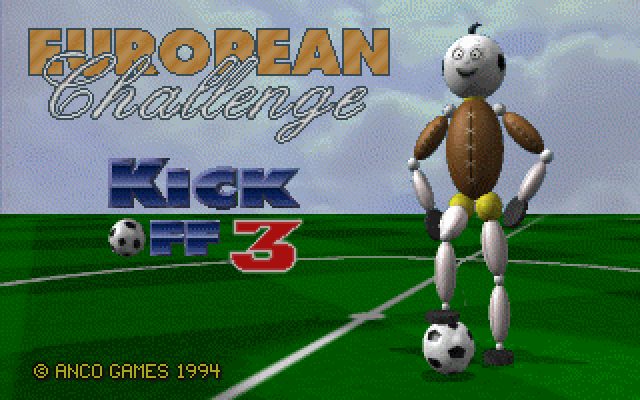
When Anco Software Ltd. released Kick Off 3 in 1994, they abandoned the top-down perspective that made the franchise famous and moved the action to a side-on camera packed with large player sprites. The result replaced lightning-fast arcade reactions with sluggish movement, mandatory joystick controls, and a whole new set of pitch-level headaches.
By the time work began on the third main entry, original designer Dino Dini had walked away from the studio entirely. Designer Steve Screech took the wheel for this installment, while programmer Terry Owen handled the DOS port. Screech wanted to move away from the tiny, pinball-like figures seen from high above the stadium and replace them with detailed, side-on player animations. It was a massive visual shift intended to give matches a broadcast feel, but it altered the fundamental physics of the series.
Booting the MS-DOS release on a 386 33MHz processor with 4MB of RAM presented PC players with an immediate surprise before a single match even loaded. Keyboard controls were completely unsupported, making a plugged-in joystick mandatory just to navigate the menus. If your Sound Blaster card was configured properly, you got crisp referee whistles and crowd noise, but no amount of audio flair could hide how heavily the new graphics engine weighed on the PC hardware.
Once you kick off, the shift in pace hits immediately. The frantic ball movement of earlier entries gives way to a surprisingly slow crawl across the turf. Computer gaming magazine Génération 4 summed up the sheer lack of speed in October 1994 with a blunt complaint: "Mon dieu que c'est lent!" Players take forever to turn, accelerate, or track down a loose pass, leaving you feeling like you are fighting against the physics rather than directing a clean attack.
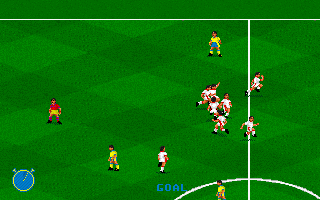
The control layout creates its own share of self-inflicted turnovers. Because a single action button handles both sliding tackles and kicking, defensive plays frequently turn into accidental giveaways. You dive to steal possession, your player retrieves the ball, and before you can release the stick, the game registers the same button press as a kick, launching the ball straight back to the opposition. Combined with tight dribbling hitboxes that let opponents strip the ball while you run unimpeded, holding possession requires constant, painstaking adjustments.
To help balance team setups, Kick Off 3 introduces specialized player roles alongside standard tactical formations. Assigning key players as Wingers or Liberos changes how your squad handles transitions between defense and attack. You can also pick between two primary play styles:
Beyond standard Friendlies, the main single-player draw is "The Challenge" mode. Here, you take your chosen country through a grueling ladder of 30 international squads, culminating in a final showdown against a fictional dream team called the Anco All Stars. Alternatively, you can play through full World Cup Finals, Leagues, or traditional Knock-Out Cups.
The visual angle introduces a severe camera problem during defensive scrambles. Because the side-on view limits your overall field of view, the game frequently switches your active defender to an opponent who is entirely off-screen. You suddenly find yourself pushing the joystick blindly, hoping your player is sprinting in the right direction to intercept a cross you cannot actually see.
Licensing real athlete names was another hurdle at release. Standard rosters featured recognizable real-world stars hidden behind thin misspellings like "Rommario", "Haggi", and "Coeman". Anco included a built-in roster editor so you could manually correct the names, provided you had the patience to type out entire national squads using your joystick interface.
Compared to other 1994 sports games on DOS, this entry struggles under the weight of its own ambitious perspective. The sprite art looks clean in still screenshots, but the moment the pitch starts scrolling, the sluggish movement and narrow viewing angles drag the action down. Retrospective reviews like the one on A Force For Good landed on a tough 4 out of 10 score for good reason: while the visual upgrade was noticeable, fighting the controls spoiled the rhythm of play.
For 16-bit computer football fans, it was a strange experiment in design. Bigger sprites and detailed animations meant very little once the pitch controls lost their crisp responsiveness. Trying to break the mold set by Dino Dini only proved how difficult it was to move classic top-down action into a side-on simulation.
You can play Kick Off 3 online, free in your browser, with no setup required. Running the game directly in your browser lets you test the side-on pitch camera and experience its unique control scheme without needing an original 1994 PC setup.
Once the game loads, start a quick Friendly match to get a feel for the momentum. Try toggling between Arcade and Simulation modes to see how much forgiving refereeing changes the pace of your tackles, and test your patience against the shared kick and slide button before taking on the Challenge ladder.
When Anco Software Ltd. released Kick Off 3 in 1994, they abandoned the top-down perspective that made the franchise famous and moved the action to a side-on camera packed with large player sprites. The result replaced lightning-fast arcade reactions with sluggish movement, mandatory joystick controls, and a whole new set of pitch-level headaches.
By the time work began on the third main entry, original designer Dino Dini had walked away from the studio entirely. Designer Steve Screech took the wheel for this installment, while programmer Terry Owen handled the DOS port. Screech wanted to move away from the tiny, pinball-like figures seen from high above the stadium and replace them with detailed, side-on player animations. It was a massive visual shift intended to give matches a broadcast feel, but it altered the fundamental physics of the series.
Booting the MS-DOS release on a 386 33MHz processor with 4MB of RAM presented PC players with an immediate surprise before a single match even loaded. Keyboard controls were completely unsupported, making a plugged-in joystick mandatory just to navigate the menus. If your Sound Blaster card was configured properly, you got crisp referee whistles and crowd noise, but no amount of audio flair could hide how heavily the new graphics engine weighed on the PC hardware.
Once you kick off, the shift in pace hits immediately. The frantic ball movement of earlier entries gives way to a surprisingly slow crawl across the turf. Computer gaming magazine Génération 4 summed up the sheer lack of speed in October 1994 with a blunt complaint: "Mon dieu que c'est lent!" Players take forever to turn, accelerate, or track down a loose pass, leaving you feeling like you are fighting against the physics rather than directing a clean attack.
The control layout creates its own share of self-inflicted turnovers. Because a single action button handles both sliding tackles and kicking, defensive plays frequently turn into accidental giveaways. You dive to steal possession, your player retrieves the ball, and before you can release the stick, the game registers the same button press as a kick, launching the ball straight back to the opposition. Combined with tight dribbling hitboxes that let opponents strip the ball while you run unimpeded, holding possession requires constant, painstaking adjustments.
To help balance team setups, Kick Off 3 introduces specialized player roles alongside standard tactical formations. Assigning key players as Wingers or Liberos changes how your squad handles transitions between defense and attack. You can also pick between two primary play styles:
Beyond standard Friendlies, the main single-player draw is "The Challenge" mode. Here, you take your chosen country through a grueling ladder of 30 international squads, culminating in a final showdown against a fictional dream team called the Anco All Stars. Alternatively, you can play through full World Cup Finals, Leagues, or traditional Knock-Out Cups.
The visual angle introduces a severe camera problem during defensive scrambles. Because the side-on view limits your overall field of view, the game frequently switches your active defender to an opponent who is entirely off-screen. You suddenly find yourself pushing the joystick blindly, hoping your player is sprinting in the right direction to intercept a cross you cannot actually see.
Licensing real athlete names was another hurdle at release. Standard rosters featured recognizable real-world stars hidden behind thin misspellings like "Rommario", "Haggi", and "Coeman". Anco included a built-in roster editor so you could manually correct the names, provided you had the patience to type out entire national squads using your joystick interface.
Compared to other 1994 sports games on DOS, this entry struggles under the weight of its own ambitious perspective. The sprite art looks clean in still screenshots, but the moment the pitch starts scrolling, the sluggish movement and narrow viewing angles drag the action down. Retrospective reviews like the one on A Force For Good landed on a tough 4 out of 10 score for good reason: while the visual upgrade was noticeable, fighting the controls spoiled the rhythm of play.
For 16-bit computer football fans, it was a strange experiment in design. Bigger sprites and detailed animations meant very little once the pitch controls lost their crisp responsiveness. Trying to break the mold set by Dino Dini only proved how difficult it was to move classic top-down action into a side-on simulation.
You can play Kick Off 3 online, free in your browser, with no setup required. Running the game directly in your browser lets you test the side-on pitch camera and experience its unique control scheme without needing an original 1994 PC setup.
Once the game loads, start a quick Friendly match to get a feel for the momentum. Try toggling between Arcade and Simulation modes to see how much forgiving refereeing changes the pace of your tackles, and test your patience against the shared kick and slide button before taking on the Challenge ladder.
How Kick Off 3 is played — the keys the game listens to, grouped by what they do.
Highlighted keys are mapped — hover or tap one to see what it does.
The game requires a joystick to play on MS-DOS as keyboard pitch controls are not supported.
The on-screen keyboard and gamepad mapping the browser player uses on a phone, a tablet or a controller, as opposed to the real keys above. $PRO members make their own in the player and share them here; anyone can pick one to play with.
Cheat codes, console commands and memory pokes for Kick Off 3 — each one verified and attributed.
Sign in to submitaka Kick Off 3: Out of This World · Kick Off 3: European Challenge
How Kick Off 3 is played — the keys the game listens to, grouped by what they do.
Highlighted keys are mapped — hover or tap one to see what it does.
The game requires a joystick to play on MS-DOS as keyboard pitch controls are not supported.
The on-screen keyboard and gamepad mapping the browser player uses on a phone, a tablet or a controller, as opposed to the real keys above. $PRO members make their own in the player and share them here; anyone can pick one to play with.
Cheat codes, console commands and memory pokes for Kick Off 3 — each one verified and attributed.
Sign in to submit