
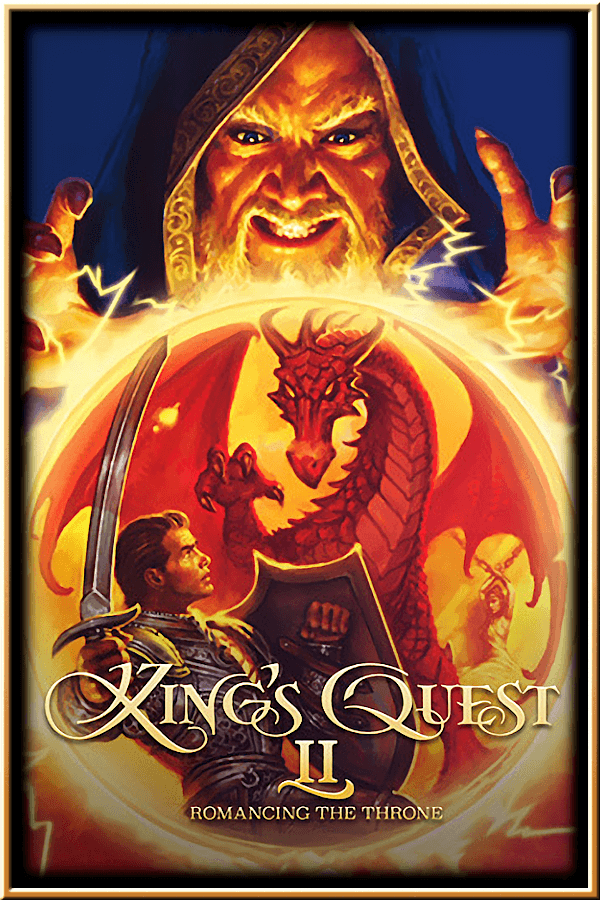

King's Quest II: Romancing the Throne sends King Graham stepping through a magic mirror into the realm of Kolyma to collect three golden keys and rescue his future bride from a quartz tower.
The moment you step onto the screen in King's Quest II: Romancing the Throne, you are greeted by the classic screen-by-screen flip design of Sierra On-Line's Adventure Game Interpreter (AGI) engine. You direct Graham with the arrow keys and type commands into a command parser at the bottom of the display. Navigating Kolyma means dealing with a map that loops infinitely from east to west, bordered by ocean water to the west and impassable mountains to the east. If you walk off the right edge of the world, you wrap right back around to the left, which made drawing a paper map on grid paper both necessary and strangely confusing for early players.
The screen presentation relies on low-resolution, hand-drawn pixel graphics where every individual tree trunk and rock edge can be a collision boundary. Moving Graham around standard hazards requires precision. A single misstep near a steep cliff or a deep body of water results in a quick death sequence accompanied by a brief text window explaining your mistake. The game wastes no time punishing sloppy movement. Randomly spawned threats like a thieving dwarf or a poisonous snake can cross your path without warning, forcing you to react quickly before you lose your inventory or your life.
While the visual presentation featured subtle animation improvements over its predecessor, the core mechanics remained unchanged. You walk Graham up to an object, type LOOK AT THE TREE or TAKE BASKET, and hope the parser recognizes your intent. When it works, Graham bends down and adds the item to his inventory. When it fails, you spend minutes typing synonyms to figure out whether an item on screen is interactive scenery or just decorative background art.
If you play through this 1987 release without a guide, you will encounter game design choices that infuriated players upon launch. Chief among them is the infamous wooden rope bridge leading across a chasm. The bridge is structurally unsound and collapses after Graham crosses it a finite number of times. If you cross back and forth to explore without grabbing every essential item on the far side first, the bridge snaps, leaving you trapped with no way to complete your quest.
This creates a classic text adventure deadlock, often referred to by players as a "walking dead" state. The game does not inform you that you have failed. You can continue walking around Kolyma for hours, solving minor puzzles and collecting items, only to discover much later that the game became unwinnable the moment that bridge gave way. To reach the ending, you must collect three distinct keys in a strict, unyielding sequence to open a magic door high in the mountains. Miss a step early on, and you are forced to restore an earlier save file or restart entirely.
The puzzle logic shifts wildly between traditional fairy-tale tropes and absurd trial-and-error mechanics. At one point, interacting with Little Red Riding Hood yields a reward, while elsewhere you must wear a silver cross and carry a wooden stake to survive an encounter in Count Dracula's castle. Some solutions require exact item usage, such as giving soup to a sick grandmother or using a genie's lamp, while other sequences require you to ride a seahorse down to an underwater kingdom. The arbitrary nature of these interactions meant that early players spent hours typing every verb in their vocabulary at every object on screen.
Despite the rigid puzzle structures, Sierra On-Line, Inc. packed a surprising amount of detail into the game's code. Designed rapidly by Roberta Williams following the commercial breakthrough of the original title, the development team included key figures like programmer Ken Williams and artist Mark Crowe. Music was arranged by Al Lowe, who programed multi-channel audio arrangements of 16th-century folk tunes like Greensleeves to take advantage of the 3-voice sound chips found inside Tandy and PCjr systems. Compared to the single-channel blips of the standard internal PC speaker, hearing three-part musical harmony on a dedicated sound card was a revelation for home computer owners.
The developers also hid lighthearted easter eggs throughout Kolyma to reward observant players. If you navigate Graham to the exterior of Hagatha the witch's cave and wait or search carefully, you can spot the Batmobile parked outside in the brush. In another location, peeking into a Pegasus hole reveals a small promotional graphic advertising Sierra's upcoming sci-fi title Space Quest. Even the location name "Kolyma" was a quiet real-world joke by the design team, poking fun at the infamous Siberian river region.
By the time this standalone MS-DOS version arrived in stores, the first three installments of the series had collectively sold over 500,000 copies, establishing Sierra as a dominant force in the PC gaming market. Yet reviews at the time were sharply divided. While some writers praised the hand-drawn backgrounds and animated character sprites, others slammed the release with low scores, calling out the non-sensical puzzle chains and lack of mechanical evolution. It was clear that while the formula was popular, the tolerance for unannounced deadlocks was beginning to wear thin.
The game is an unyielding example of early graphic adventure games design. It does not hold your hand, it does not auto-save before dangerous drops, and it will happily let you break your save state without telling you. Yet for players who appreciate the tension of strict parser input, precise movement, and mapping out a fantasy kingdom grid by grid, navigating Graham's quest still hits hard.
You do not need to hunt down ancient floppy disks or set up complex system emulators to experience Kolyma's hazards for yourself. You can play King's Quest II: Romancing the Throne online, free, right here in your browser, with nothing to install and no setup. Simply launch the game, keep your fingers near the cursor keys when walking near cliffs, save your progress in multiple slots, and remember to think twice before crossing that fragile rope bridge one time too many.
How King's Quest II: Romancing the Throne is played — the keys the game listens to, grouped by what they do.
Highlighted keys are mapped — hover or tap one to see what it does.
Movement can be controlled via arrow keys or numeric keypad. Typing commands using the text parser requires ENTER to execute.
The on-screen keyboard and gamepad mapping the browser player uses on a phone, a tablet or a controller, as opposed to the real keys above. $PRO members make their own in the player and share them here; anyone can pick one to play with.
Cheat codes, console commands and memory pokes for King's Quest II: Romancing the Throne — each one verified and attributed.
Sign in to submitHow King's Quest II: Romancing the Throne is played — the keys the game listens to, grouped by what they do.
Highlighted keys are mapped — hover or tap one to see what it does.
Movement can be controlled via arrow keys or numeric keypad. Typing commands using the text parser requires ENTER to execute.
The on-screen keyboard and gamepad mapping the browser player uses on a phone, a tablet or a controller, as opposed to the real keys above. $PRO members make their own in the player and share them here; anyone can pick one to play with.
Cheat codes, console commands and memory pokes for King's Quest II: Romancing the Throne — each one verified and attributed.
Sign in to submit