
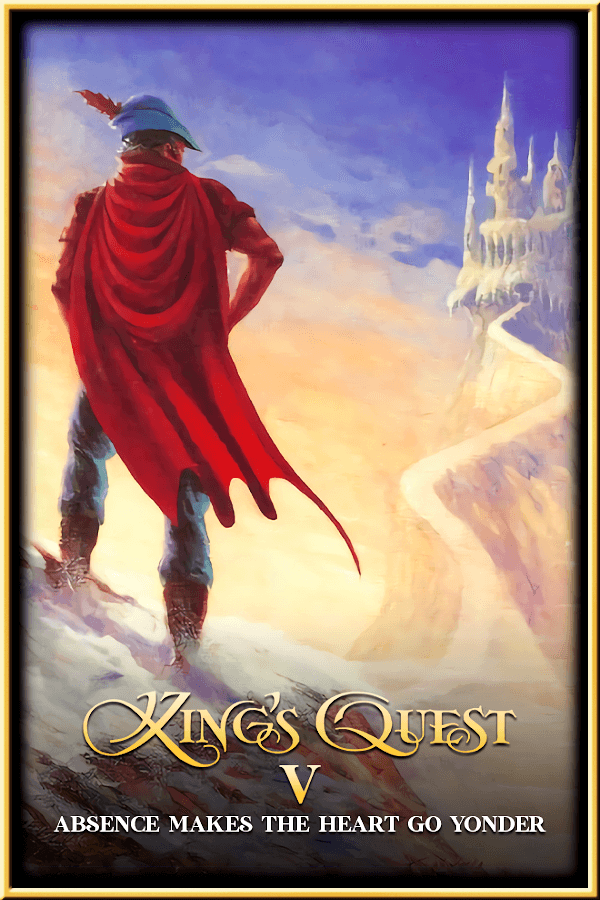

King's Quest V: Absence Makes the Heart Go Yonder!
Streaming build
Checking storage…137 MB
Preload in background
When Sierra On-Line shipped King's Quest V: Absence Makes the Heart Go Yonder! in late 1990, it traded the traditional keyboard parser for a point-and-click icon bar, pairing gorgeous painted visuals with some of the most punishing dead ends ever put on disk.
Dropping the text parser for point-and-click control
Before King Graham took his first step across the kingdom of Serenia, adventure players spent years typing "get key" and "look tree" into text prompts. Sierra overhauled that format by building this release on their SCI1 engine, swapping command lines for a top-screen interface featuring Walk, Look, Action, and Talk icons. That technical shift allowed the art team to fill screens with 256-color VGA backgrounds scanned directly from hand-painted artwork, making the 1990 title look like a living fairy tale book compared to the blocky EGA worlds that came before it.
You play as Graham, returning home to find your castle vanished into thin air. Guided by a chatty owl named Cedric, you trek through burning deserts, dark forests, and snowy peaks to track down the evil wizard Mordack. The new mouse interface makes moving around much simpler, but it also creates fresh mechanical headaches. Precision clicking becomes an issue when interactive hot-spots are reduced to a cluster of four pixels, forcing you to sweep your cursor back and forth across every screen just to find essential tools.
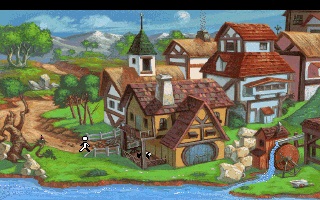
Where King's Quest V: Absence Makes the Heart Go Yonder! tests your patience with dead ends
For all its visual updates, designer Roberta Williams kept Sierra's merciless design philosophy intact. The early desert section presents a harsh maze where taking a few wrong turns leads to death by dehydration. Worse than immediate death are the soft-locks hidden throughout the journey. If you fail to rescue a trapped rat early on, or forget to grab a single pie from a bakery shelf, you will still make it to Mordack's island fortress hours later, only to discover the game is mathematically impossible to finish.
Item usage leans heavily on trail-and-error logic rather than real-world sense. You spend your trip trading items across Serenia, handing a tambourine to a band of robed gypsies or pitching a pouch of coins to buy trinkets. Yet the endgame asks you to power down a deadly magical machine by throwing a piece of moldy cheese into its gears. The trial is not figuring out what makes sense, but systematically opening your bag and testing every object against every pixel on screen.
The sequence of survival challenges requires specific preparation:
- Stocking up on water before venturing into the open desert grid.
- Distracting a giant eagle and soothing a weeping willow tree during your mountain ascent.
- Escaping the domain of Ice Queen Icebella after earning her mercy.
- Luring a Yeti off a cliff edge before it reaches King Graham.
- Combining a brass key, a magic wand, and your scavenged food inside Mordack's labyrinth.

The unbearable wisdom of Cedric the owl
No discussion of this adventure game is complete without mentioning Cedric. The feathered companion acts as your guide, yet his primary function in practice is shrieking warnings right after you step into danger. When Sierra published the CD-ROM "talkie" re-release, complete with full voice acting recorded by company employees, Cedric's squeaky, high-pitched delivery made him a notorious nuisance across the entire gaming scene.
Sierra's own developers were well aware of how much players grew to resent the owl. Internal comedy poked fun at Cedric for years afterward. In Space Quest IV, Roger Wilco earns points for shooting a bird that looks suspiciously like him, while Freddy Pharkas: Frontier Pharmacist shows vultures picking over his remains in the desert. Despite the constant mocking, Cedric is still the character everyone remembers from this trip.
A landmark hit that demands a walkthrough
Despite the frustrating dead ends and erratic puzzle logic, this Sierra On-Line, Inc. product became a massive commercial triumph. It went on to sell over half a million copies, setting sales records for PC entertainment at the time. Commercial success did not erase its design flaws, but the colorful presentation and sense of discovery proved potent enough to hook an entire generation of computer owners.
If you plan to run through this Sierra On-Line, Inc. classic today, go in with realistic expectations. The visual craft holds up, but playing blind without consulting a puzzle guide or saving every three minutes is a recipe for heartbreak. It sits right at a fascinating transition point where modern graphical interfaces met old-school PC cruelty.
You can play King's Quest V: Absence Makes the Heart Go Yonder! free in your browser right now without downloading a thing. Fire up this King's Quest V: Absence Makes the Heart Go Yonder! MS-DOS game, save your progress on multiple slots before entering the desert, and see if you can save Daventry without losing your mind to Cedric's squeaky warnings.
How King's Quest V: Absence Makes the Heart Go Yonder! is played — the keys the game listens to, grouped by what they do.
- Movement
- Action
- Interface
- Left click — Interact or move
- Right click — Cycle cursors
Highlighted keys are mapped — hover or tap one to see what it does.
Pressing a direction key again while moving stops Graham's movement.
Players' controls
Touch and gamepad controls
The on-screen keyboard and gamepad mapping the browser player uses on a phone, a tablet or a controller, as opposed to the real keys above. $PRO members make their own in the player and share them here; anyone can pick one to play with.
Make your own touch controlsPRO
- 1Open the editorSign in below, then pick what to make. The game starts with the editor open over it.
- 2Place your keysAdd keys and drag them where your thumbs rest, or map a controller's buttons. Test plays the game with them; Save keeps them, and you play with them from then on.
- 3Share themShare them right after saving in the game, or name and share them here. Players vote, and the best become this game's controls for everyone.
Go PROSee how it worksSign in+20 XP for sharing · +50 XP if yours become the game's own
- The game's own controlsKeyboardGamepadWhat every player starts with.In use
3 screenshots
From the archive
No gameplay video yet
No gameplay video for King's Quest V: Absence Makes the Heart Go Yonder! yet. Sign in to add one.
No reviews yet
Tell the community what you think of King's Quest V: Absence Makes the Heart Go Yonder!. Reviews are public and tied to your username.
No archived manuals for King's Quest V: Absence Makes the Heart Go Yonder! yet
No manuals archived for this title yet. Sign in to upload the first scan.
Cheat codes, console commands and memory pokes for King's Quest V: Absence Makes the Heart Go Yonder! — each one verified and attributed.
Sign in to submitNo cheats yet for this title
Know a working cheat, poke or trainer? Add it with the button above. Moderators check every entry before it goes live.
No archived soundtrack for King's Quest V: Absence Makes the Heart Go Yonder! yet
No soundtrack archived for this title yet. Sign in to upload the first rip.
No save states for King's Quest V: Absence Makes the Heart Go Yonder! yet
No save states for this title yet. Sign in to share one.
Discussions
Sign in to post- Threads0
- Total posts0
- Online now6
Community · King's Quest V: Absence Makes the Heart Go Yonder!
Who's contributing, and what's new
- Reviews0
- Threads0
- Uploadsapproved0
- Contributors0
Recent activity
Nothing here yet
Reviews, discussion threads and approved uploads appear here as members add them.