
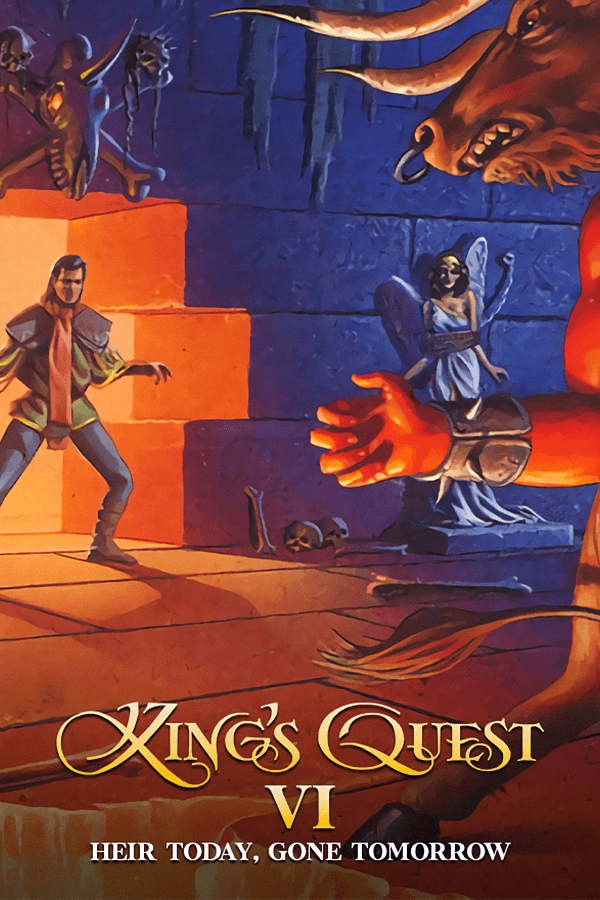

Typing text commands to guide Prince Alexander across the Land of the Green Isles in King's Quest VI AGI Demake turns a polished 1992 point-and-click adventure back into an authentic 1980s text parser challenge.
Translating 1992 point-and-click into typing commands
The moment you step onto the shore of the Isle of the Crown, the immediate shift in interface dictates how you play. Sierra On-Line built the original 1992 release with a streamlined point-and-click cursor system, but developer Brandon Kouri stripped all of that away to rebuild the journey inside Sierra's older Adventure Game Interpreter engine. Instead of clicking hand icons on environmental objects, you are back to typing verbs into a prompt at the bottom of the screen while controlling Alexander with the cursor keys.
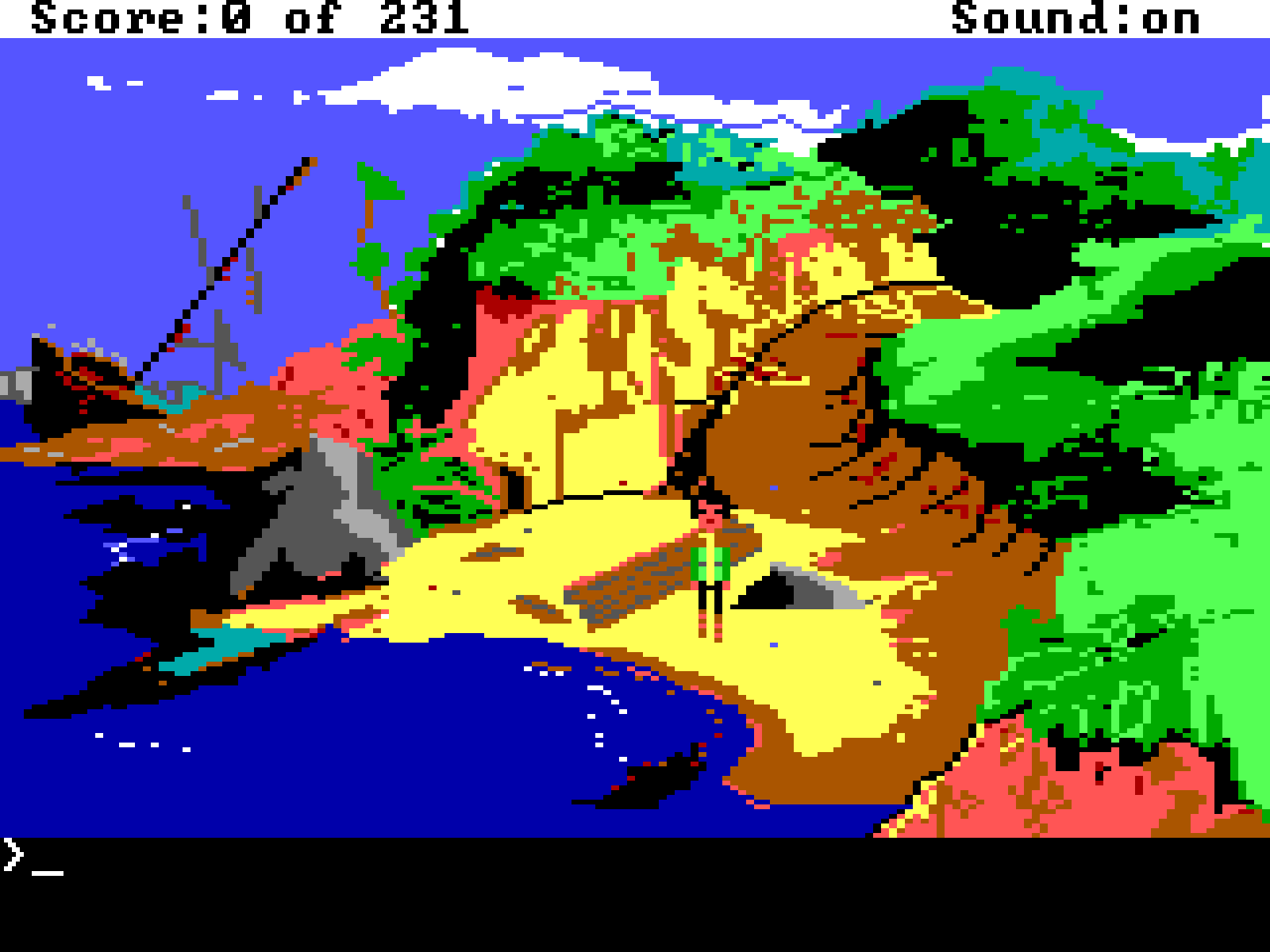
That text box fundamentally alters your interaction with the environment. In the original VGA release, searching an area meant sweeping your mouse cursor over every corner until the icon changed state. Here, you have to observe the low-resolution visual cues and figure out what phrasing the parser expects. Typing direct actions forces you to think about the physical details of Alexander's surroundings rather than clicking systematically through inventory items on every hot spot.
This conversion gives fans an expanded set of possibilities compared to rigid icon menus. Writing out specific interactions opens up alternative text responses and subtle sub-actions that were completely flattened when Sierra abandoned parser interfaces. The trade-off is the return of classic parser friction: guessing which precise verb the game wants when you already know what Alexander needs to accomplish.
King's Quest VI AGI Demake turns classic puzzles into a parser test
Rescuing Princess Cassima from Vizier Abdul Alhazred was originally an exercise in rich 256-color VGA animation and digitized voice acting. In this DOS release, everything relies on pared-down, scaled-back puzzles that fit the memory constraints of an engine designed in the mid-1980s. You navigate the island paths, talk to locals, and store items in an inventory menu that feels directly lifted from the original King's Quest: Quest for the Crown.
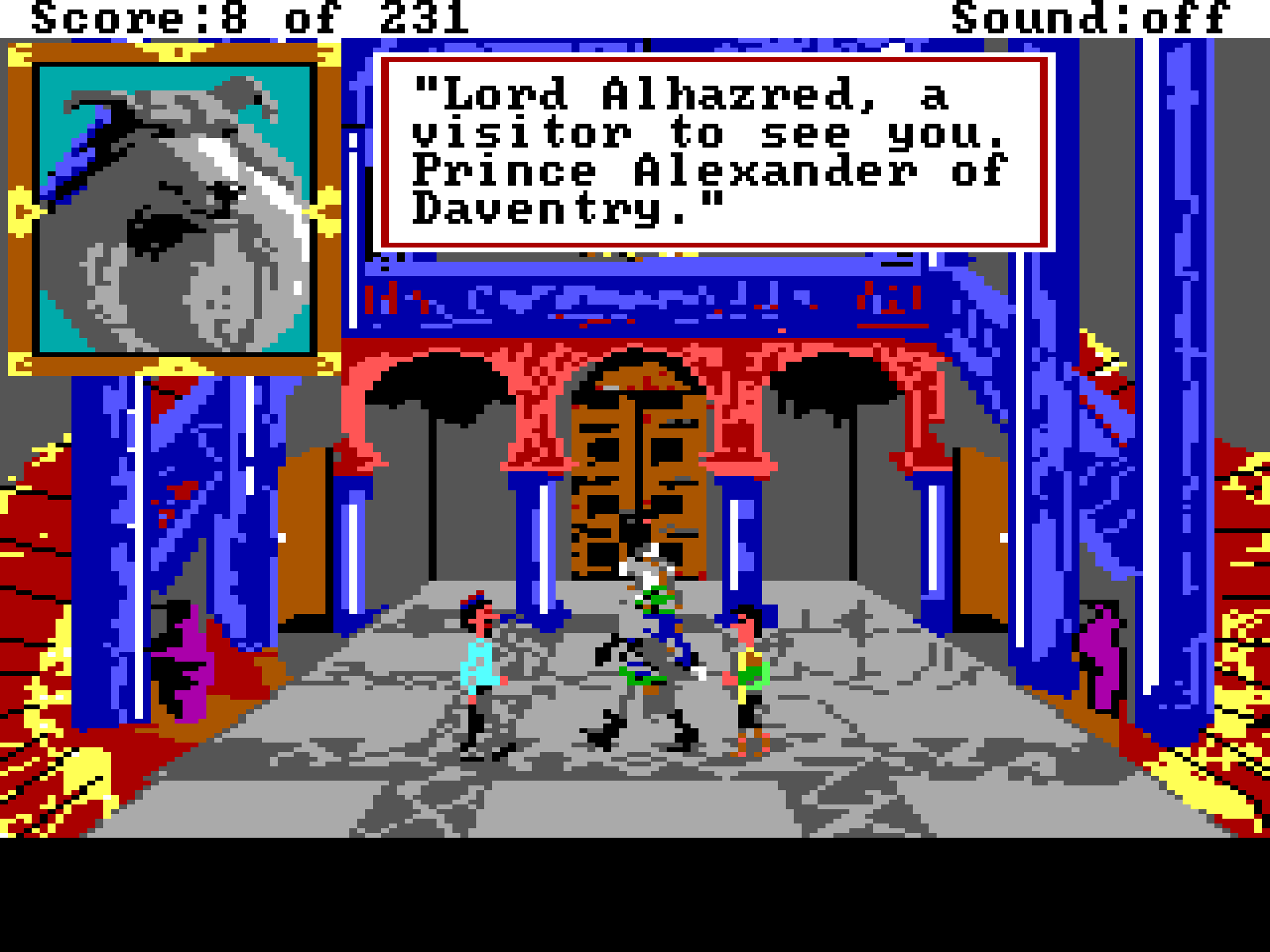
Puzzles that relied on high-resolution graphic details now ask you to rely on sharp deduction and text examination. Where the 1992 release allowed you to rely on visual clarity to spot important objects lying on the ground, the 16-color display requires liberal use of "look" commands to confirm what those blocky pixels actually represent. The sequence logic stays faithful to the original narrative, but the execution feels like an alternate timeline where Sierra never developed the SCI engine.
The game supports both standard 16-color EGA displays and Hercules monochrome graphics modes, giving it the exact visual target of a mid-1980s IBM PC. Because the scope of the original King's Quest VI was so massive, fitting that structure into AGI required creative downsizing. The result is easily one of the largest and most technically dense AGI projects ever assembled, pushing file size limits far beyond what early Sierra programmers ever attempted on 360K floppy disks.
Eighteen years of AGI tools and EGA extraction
Developing a full-length demake inside an engine abandoned decades ago is a massive undertaking. Kouri spent eighteen years, from 2006 to 2024, building and refining this fan recreation. The production involved extracting and downsampling art assets from original Sierra releases, editing game logic inside WinAGI GDS, and compiling the final package through AGI Studio. Sound tracks were built using specialized music utilities like MF2ROL and ROL2SND to fit the limitations of three-voice PC audio chips and sound cards of that era.
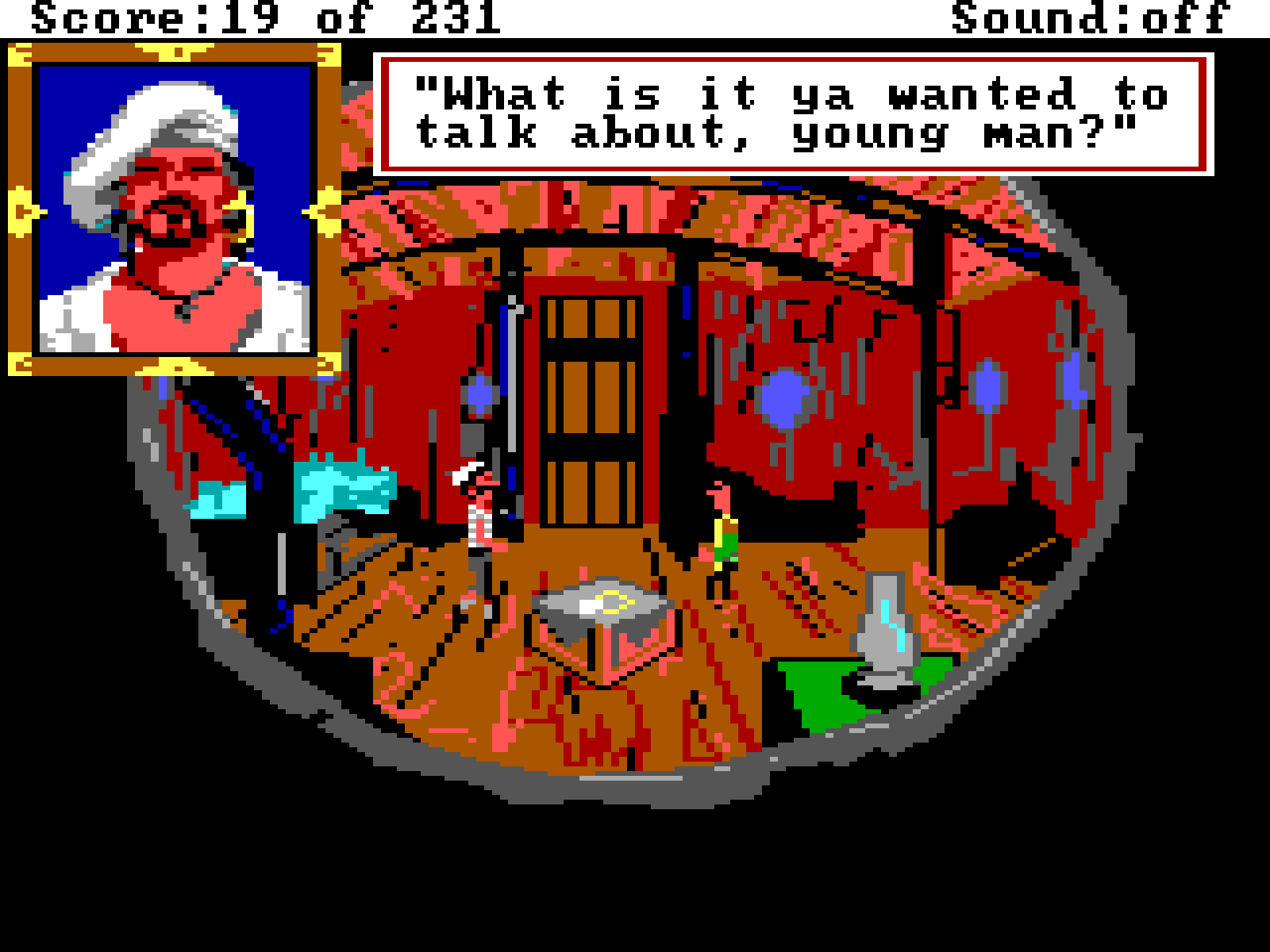
That dedication pays off in how cohesive the environment feels. Rather than looking like a modern engine mimicking old visuals, it runs as a native 2024 release compiled directly for MS-DOS. An Atari ST port constructed by Marko at Atarimania later adapted these PC files using the AGI Quest I ST launcher, though players on that platform quickly discovered a strange quirk: touching the mouse breaks the text parser during play, forcing pure keyboard input.
The technical achievement is obvious to anyone who knows how restrictive the AGI engine can be with screen memory and pathfinding logic. Getting multi-screen island chains, branching dialogue, and inventory puzzles to exist together without crashing the interpreter is a feat that commercial developers in 1987 would have considered impossible.
What holds this demake back and where to play King's Quest VI AGI Demake online
The rough edges of King's Quest VI AGI Demake come direct from the era it imitates. Parsing errors can be frustrating when you know the solution to a puzzle but cannot find the exact verb-noun combination the script requires. The simplified 16-color art also makes a few inventory items hard to identify visually without typing "look ground" or inspecting every room systematically. If you lack patience for early text adventures, the constant trial-and-error typing will test your resolve.
For anyone who grew up on early Sierra software or loves fan-made engine feats, this project bridges two distinct eras of Sierra design. It takes a 1992 point-and-click game and filters it directly through the screen limits and mechanical quirks of 1986 hardware.
You can play King's Quest VI AGI Demake free in your browser right now, with nothing to install and no complex DOS setups to navigate. If you want to experience how Prince Alexander's quest feels when driven entirely by typing commands, launch the game above, keep your fingers on the keyboard, and remember to save early and often before entering unfamiliar screens.
Players' controls
Touch and gamepad controls
The on-screen keyboard and gamepad mapping the browser player uses on a phone, a tablet or a controller, as opposed to the real keys above. $PRO members make their own in the player and share them here; anyone can pick one to play with.
Make your own touch controlsPRO
- 1Open the editorSign in below, then pick what to make. The game starts with the editor open over it.
- 2Place your keysAdd keys and drag them where your thumbs rest, or map a controller's buttons. Test plays the game with them; Save keeps them, and you play with them from then on.
- 3Share themShare them right after saving in the game, or name and share them here. Players vote, and the best become this game's controls for everyone.
Go PROSee how it worksSign in+20 XP for sharing · +50 XP if yours become the game's own
- The game's own controlsNone yet: played with a real keyboard only.In use
5 screenshots
From the archive
No gameplay video yet
No gameplay video for King's Quest VI AGI Demake yet. Sign in to add one.
No reviews yet
Tell the community what you think of King's Quest VI AGI Demake. Reviews are public and tied to your username.
No archived manuals for King's Quest VI AGI Demake yet
No manuals archived for this title yet. Sign in to upload the first scan.
Cheat codes, console commands and memory pokes for King's Quest VI AGI Demake — each one verified and attributed.
Sign in to submitNo cheats yet for this title
Know a working cheat, poke or trainer? Add it with the button above. Moderators check every entry before it goes live.
No archived soundtrack for King's Quest VI AGI Demake yet
No soundtrack archived for this title yet. Sign in to upload the first rip.
No save states for King's Quest VI AGI Demake yet
No save states for this title yet. Sign in to share one.
Discussions
Sign in to post- Threads0
- Total posts0
- Online now6
Community · King's Quest VI AGI Demake
Who's contributing, and what's new
- Reviews0
- Threads0
- Uploadsapproved0
- Contributors0
Recent activity
Nothing here yet
Reviews, discussion threads and approved uploads appear here as members add them.