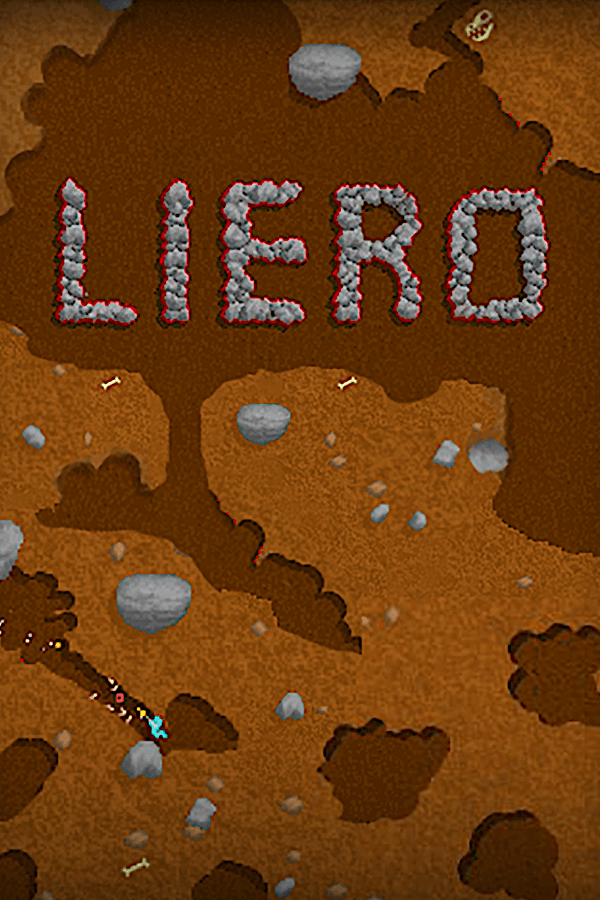

In Liero, two earthworms fire bazookas and swing across fully destructible dirt on a single keyboard while pixelated blood covers the terrain.
Most players who knew Team17's Worms were used to waiting patiently while an opponent lined up an artillery shot. Programmer Joosa Riekkinen stripped that waiting away entirely when he released his hit action game in 1998.
By taking the real-time tunnel digging of the Finnish game MoleZ and combining it with free-aiming weaponry, the game turns every match into a non-stop deathmatch. Two worms spawn in an underground cavern made of soft mud and solid rock. Equipped with a ninja rope grappling hook and five selected weapons, players duel in real time until one reaches the frag target.
You dig through dirt simply by walking into it or by carving paths with heavy explosives. Because terrain stays destroyed, maps constantly reshape during combat. Cluster bomb fragments tear out new caverns, while stray shotgun blasts dig foot-holds into sheer cliff faces.
Before a round starts, each player picks five weapons from an arsenal of forty choices. That initial selection dictates how you navigate and survive the underground arena.
The weapon selection ranges from basic handguns and shotguns to heavy artillery like the Chiquita Bomb, which splits into explosive sub-munitions on impact. Guns have infinite ammunition reserves, but clip sizes force mandatory reload delays after sustained fire.
Heavy weapons trigger longer reload times, leaving your worm completely defenseless while waiting for the timer to reset. Stepping over weapon crates scattered around the dirt immediately replaces whatever gun you currently hold, which can rescue a empty loadout or accidentally swap out a prized rocket launcher mid-fight.
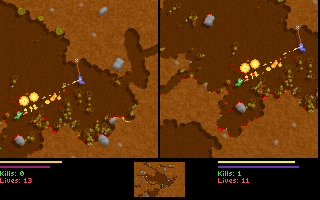
Head-to-head multiplayer on a single shared keyboard is where matches deliver the most fun, but physical hardware limits often got in the way. Sharing one PC keyboard meant two players frequently hit key ghosting limits whenever both tried to jump, aim, and fire their ninja rope simultaneously.
Playing solo against the computer highlights clear technical constraints. The built-in bot was documented by the creator as an AI without true intelligence, and that description holds true during matches.
Computer opponents generally burrow directly toward your position in a straight line, firing non-stop without tactical positioning or rope maneuvering. That makes solo play wear thin quickly, leaving local two-player battles as the primary draw.
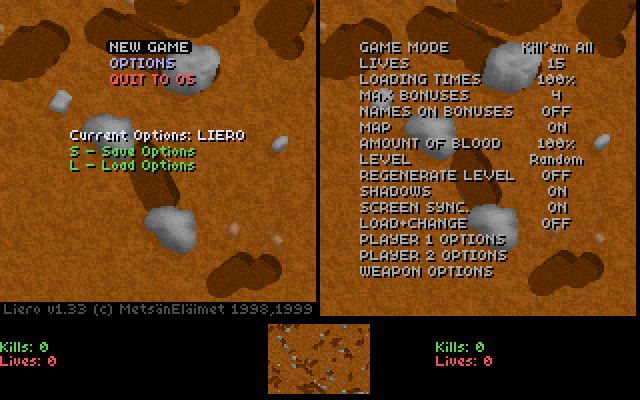
Riekkinen distributed the original Liero MS-DOS game as freeware, requiring a modest 386SX processor and conventional memory with Sound Blaster support. A hard drive crash wiped out the C++ source code, halting official updates after version 1.33 in 2000.
That missing source code prevented official patches, but it motivated players to create custom tools like LieroKit and WormHole. Fans edited weapon stats, wrote sound replacement hacks, and built modern engine clones like OpenLieroX to keep matches active on newer operating systems.
Commercial indie hits like Soldat and Noita explicitly cited this side-scrolling subterranean shooter as a fundamental inspiration for their real-time physics and terrain destruction systems.
The fast movement speed and real-time dirt destruction hold up well today, offering tight matches that reward quick reflexes and smart loadout choices. Single-player battles against the simple AI lack depth, and running original executable files on modern hardware without proper sound switches like /n causes audio crashes, but the core two-player game is still pure entertainment.
You can play Liero free in your browser right now, with nothing to install and no setup needed. Select your loadout of five explosives, master the ninja rope control timing, and dig straight into your opponent before their reload timer runs out.
In Liero, two earthworms fire bazookas and swing across fully destructible dirt on a single keyboard while pixelated blood covers the terrain.
Most players who knew Team17's Worms were used to waiting patiently while an opponent lined up an artillery shot. Programmer Joosa Riekkinen stripped that waiting away entirely when he released his hit action game in 1998.
By taking the real-time tunnel digging of the Finnish game MoleZ and combining it with free-aiming weaponry, the game turns every match into a non-stop deathmatch. Two worms spawn in an underground cavern made of soft mud and solid rock. Equipped with a ninja rope grappling hook and five selected weapons, players duel in real time until one reaches the frag target.
You dig through dirt simply by walking into it or by carving paths with heavy explosives. Because terrain stays destroyed, maps constantly reshape during combat. Cluster bomb fragments tear out new caverns, while stray shotgun blasts dig foot-holds into sheer cliff faces.
Before a round starts, each player picks five weapons from an arsenal of forty choices. That initial selection dictates how you navigate and survive the underground arena.
The weapon selection ranges from basic handguns and shotguns to heavy artillery like the Chiquita Bomb, which splits into explosive sub-munitions on impact. Guns have infinite ammunition reserves, but clip sizes force mandatory reload delays after sustained fire.
Heavy weapons trigger longer reload times, leaving your worm completely defenseless while waiting for the timer to reset. Stepping over weapon crates scattered around the dirt immediately replaces whatever gun you currently hold, which can rescue a empty loadout or accidentally swap out a prized rocket launcher mid-fight.

Head-to-head multiplayer on a single shared keyboard is where matches deliver the most fun, but physical hardware limits often got in the way. Sharing one PC keyboard meant two players frequently hit key ghosting limits whenever both tried to jump, aim, and fire their ninja rope simultaneously.
Playing solo against the computer highlights clear technical constraints. The built-in bot was documented by the creator as an AI without true intelligence, and that description holds true during matches.
Computer opponents generally burrow directly toward your position in a straight line, firing non-stop without tactical positioning or rope maneuvering. That makes solo play wear thin quickly, leaving local two-player battles as the primary draw.

Riekkinen distributed the original Liero MS-DOS game as freeware, requiring a modest 386SX processor and conventional memory with Sound Blaster support. A hard drive crash wiped out the C++ source code, halting official updates after version 1.33 in 2000.
That missing source code prevented official patches, but it motivated players to create custom tools like LieroKit and WormHole. Fans edited weapon stats, wrote sound replacement hacks, and built modern engine clones like OpenLieroX to keep matches active on newer operating systems.
Commercial indie hits like Soldat and Noita explicitly cited this side-scrolling subterranean shooter as a fundamental inspiration for their real-time physics and terrain destruction systems.
The fast movement speed and real-time dirt destruction hold up well today, offering tight matches that reward quick reflexes and smart loadout choices. Single-player battles against the simple AI lack depth, and running original executable files on modern hardware without proper sound switches like /n causes audio crashes, but the core two-player game is still pure entertainment.
You can play Liero free in your browser right now, with nothing to install and no setup needed. Select your loadout of five explosives, master the ninja rope control timing, and dig straight into your opponent before their reload timer runs out.
How Liero is played — the keys the game listens to, grouped by what they do.
Highlighted keys are mapped — hover or tap one to see what it does.
Default key bindings are listed; controls for both players can be fully remapped in the options menu.
The on-screen keyboard and gamepad mapping the browser player uses on a phone, a tablet or a controller, as opposed to the real keys above. $PRO members make their own in the player and share them here; anyone can pick one to play with.
Cheat codes, console commands and memory pokes for Liero — each one verified and attributed.
Sign in to submitaka 虐殺幼蟲
How Liero is played — the keys the game listens to, grouped by what they do.
Highlighted keys are mapped — hover or tap one to see what it does.
Default key bindings are listed; controls for both players can be fully remapped in the options menu.
The on-screen keyboard and gamepad mapping the browser player uses on a phone, a tablet or a controller, as opposed to the real keys above. $PRO members make their own in the player and share them here; anyone can pick one to play with.
Cheat codes, console commands and memory pokes for Liero — each one verified and attributed.
Sign in to submit